As businesses grow, technology becomes increasingly important to productivity, cybersecurity, customer service, and long-term success. Yet many organisations with 10–100 employees reach a point where technology decisions become more complex than simply fixing computers and resetting passwords.
This is where a Strategic vCIO (Virtual Chief Information Officer) can add significant value.
A full-time CIO can cost between £80,000 and £150,000+ per year, making it difficult for many small and mid-sized organisations to justify the investment. A Strategic vCIO provides executive-level technology leadership without the cost of hiring a full-time senior technology executive.
For growing businesses across Scotland, a vCIO helps align technology investments with business objectives, reduce risk, improve cybersecurity, and ensure IT supports growth rather than becoming an obstacle to it.
What Is a Strategic vCIO?
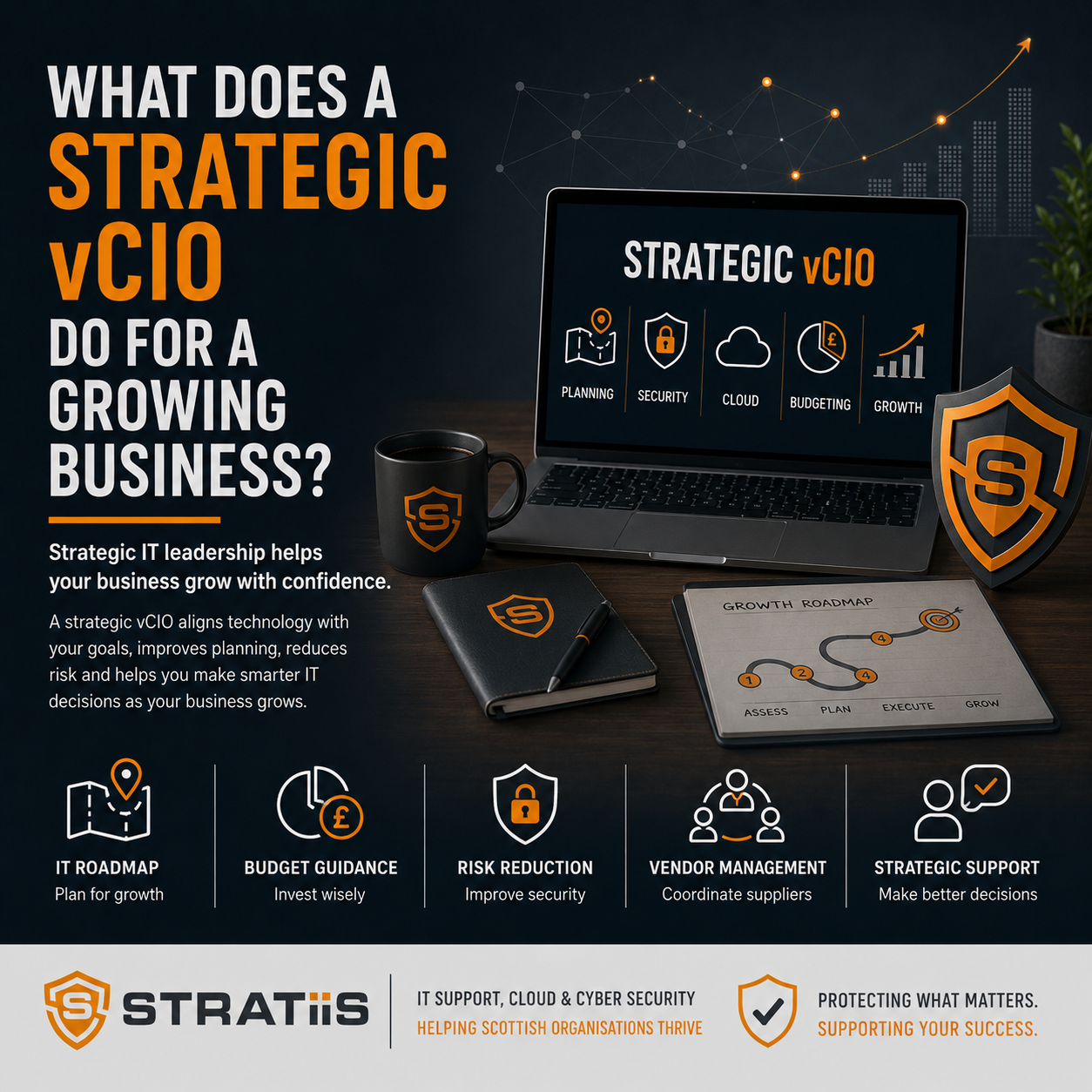
A Strategic vCIO is an outsourced technology advisor who works alongside business leaders to develop and manage the organisation's technology strategy.
Unlike traditional IT support, which focuses on solving technical problems, a vCIO focuses on the bigger picture:
- Technology planning
- Business growth
- Cybersecurity strategy
- IT budgeting
- Risk management
- Digital transformation
- Governance and compliance
Think of a Strategic vCIO as your organisation's technology strategist and trusted advisor.
Their role is to help leadership teams make informed decisions about technology investments and ensure those investments deliver measurable business value.
The Five Core Responsibilities of a Strategic vCIO
- Developing a Technology Roadmap
Many organisations make technology decisions reactively.
Systems are replaced when they fail, software is purchased when someone requests it, and cybersecurity improvements happen only after concerns arise.
A Strategic vCIO takes a proactive approach by creating a technology roadmap.
This roadmap typically includes:
- Business goals
- Technology priorities
- Planned upgrades
- Infrastructure improvements
- Cybersecurity initiatives
- Budget forecasts
A well-developed roadmap provides clarity and helps businesses avoid costly surprises.
- Managing IT Budgets and Technology Investments
Technology spending can quickly become unpredictable without proper planning.
A Strategic vCIO helps organisations:
- Forecast future technology costs
- Plan hardware replacement cycles
- Optimise software licensing
- Reduce unnecessary spending
- Prioritise investments
For example, many businesses overspend on Microsoft licensing or delay equipment replacements until failures occur.
A Strategic vCIO helps ensure investments are made at the right time and for the right reasons.
- Strengthening Cybersecurity
Cybersecurity is now a board-level concern.
Growing businesses face increasing risks from:
- Phishing attacks
- Ransomware
- Data breaches
- Business email compromise
- Supply chain attacks
A Strategic vCIO helps organisations build a structured cybersecurity programme.
This often includes:
- Cyber risk assessments
- Security improvement plans
- Cyber Essentials preparation
- Security awareness training
- Incident response planning
- Business continuity planning
The goal is not simply compliance but reducing risk and improving resilience.
- Optimising Microsoft 365 and Cloud Services
Many organisations invest heavily in Microsoft 365 but only use a fraction of its capabilities.
A Strategic vCIO helps maximise return on investment by reviewing:
- Microsoft licensing
- Security settings
- Teams adoption
- SharePoint strategy
- Data management
- AI readiness
- Cloud optimisation
This ensures technology investments deliver practical business benefits.
- Supporting Leadership and Governance
Technology decisions affect every area of an organisation.
A Strategic vCIO provides leadership teams with:
- Quarterly business reviews
- Technology reports
- Risk assessments
- Strategic recommendations
- Governance support
- Compliance guidance
This enables better decision-making and ensures technology remains aligned with organisational goals.
When Does a Business Need a Strategic vCIO?
Not every organisation requires a Strategic vCIO immediately.
However, several common signs indicate the need for more structured technology leadership.
Sign 1: Technology Spending Feels Reactive
If technology decisions are made only when problems occur, a strategic approach may be needed.
Sign 2: Cybersecurity Concerns Are Growing
As organisations become more dependent on technology, cyber risks increase.
A vCIO helps develop a proactive security strategy.
Sign 3: Business Growth Is Creating New Challenges
New employees, additional locations, acquisitions, or service expansion often create technology complexity.
Sign 4: Leadership Lacks Visibility Into IT
Many business leaders know technology is important but struggle to assess risks, priorities, and opportunities.
Sign 5: There Is No Formal Technology Roadmap
Without a roadmap, organisations often overspend, underinvest, or delay important improvements.
Full-Time CIO vs Strategic vCIO
For many organisations with 10–100 employees, hiring a full-time CIO is neither practical nor necessary.
| Area | Full-Time CIO | Strategic vCIO |
| Annual Cost | £80,000–£150,000+ | Fraction of the cost |
| Strategic Planning | Yes | Yes |
| IT Budgeting | Yes | Yes |
| Cybersecurity Oversight | Yes | Yes |
| Technology Roadmaps | Yes | Yes |
| Board Reporting | Yes | Yes |
| Recruitment Required | Yes | No |
| Suitable for 10–100 Employees | Often Excessive | Ideal |
A Strategic vCIO delivers executive-level expertise while remaining cost-effective for small and medium-sized organisations.
What Results Should You Expect From a Strategic vCIO?
Every organisation is different, but common outcomes include:
Improved Budget Predictability
Planned investments replace reactive spending.
Reduced Technology Risk
Structured cybersecurity programmes help reduce vulnerabilities.
Better Business Alignment
Technology decisions support organisational objectives.
Increased Productivity
Employees benefit from more reliable systems and improved processes.
Greater Leadership Confidence
Decision-makers gain access to clear recommendations and actionable insights.
The most successful organisations view technology as a strategic asset rather than a cost centre.
Real Example: A Growing Manufacturing Business
Imagine a manufacturing company with 60 employees operating across multiple sites.
Challenges
- Ageing infrastructure
- Rising cybersecurity concerns
- Inconsistent technology planning
- Unpredictable IT spending
Strategic vCIO Solution
The organisation receives:
- Quarterly strategic reviews
- A three-year technology roadmap
- Cybersecurity improvement planning
- Microsoft 365 optimisation
- Budget forecasting
Potential Outcomes
- Improved technology planning
- Reduced operational risk
- Better budget control
- Enhanced cybersecurity posture
- Increased productivity
While every organisation's circumstances differ, these are typical benefits of adopting a strategic approach to technology management.
How to Choose the Right Strategic vCIO Partner
Not all IT providers deliver genuine strategic guidance.
When evaluating a potential partner, ask:
Do They Understand Business Objectives?
Technology recommendations should support organisational goals rather than focus solely on technical issues.
Do They Have Strong Cybersecurity Expertise?
Cybersecurity should be embedded within every technology strategy.
Do They Provide Regular Strategic Reviews?
A vCIO relationship should be ongoing, not a one-time consultation.
Do They Understand Microsoft 365 and Modern Cloud Platforms?
Most organisations rely heavily on Microsoft technologies.
Do They Have Experience in Your Sector?
Industry knowledge often improves the quality of recommendations and planning.
Why Businesses Across Scotland Choose Stratiis for Strategic IT Leadership
At Stratiis, we help organisations across Glasgow, Edinburgh, Lanarkshire, Ayrshire, Lothian, Dumfries & Galloway, and Perthshire make better technology decisions.
Our Strategic vCIO services combine:
- Technology roadmaps
- Cybersecurity planning
- IT budgeting
- Microsoft 365 expertise
- Risk management
- Business continuity planning
- Executive reporting
- Long-term technology strategy
We work with charities, nonprofits, accountants, engineering firms, manufacturers, housing associations, law firms, construction companies, and quarry operators to ensure technology supports growth, resilience, and operational success.
Is a Strategic vCIO Worth It?
For many organisations with 10–100 employees, the answer is yes.
A Strategic vCIO provides access to executive-level technology leadership without the significant cost of hiring a full-time CIO.
The value isn't measured by the number of technical problems solved.
It's measured by:
- Better business decisions
- Stronger cybersecurity
- More predictable budgets
- Reduced risk
- Improved productivity
- Clear technology direction
As organisations grow, technology becomes increasingly important to achieving business objectives. A Strategic vCIO helps ensure that technology remains an enabler of growth rather than a source of complexity and risk.