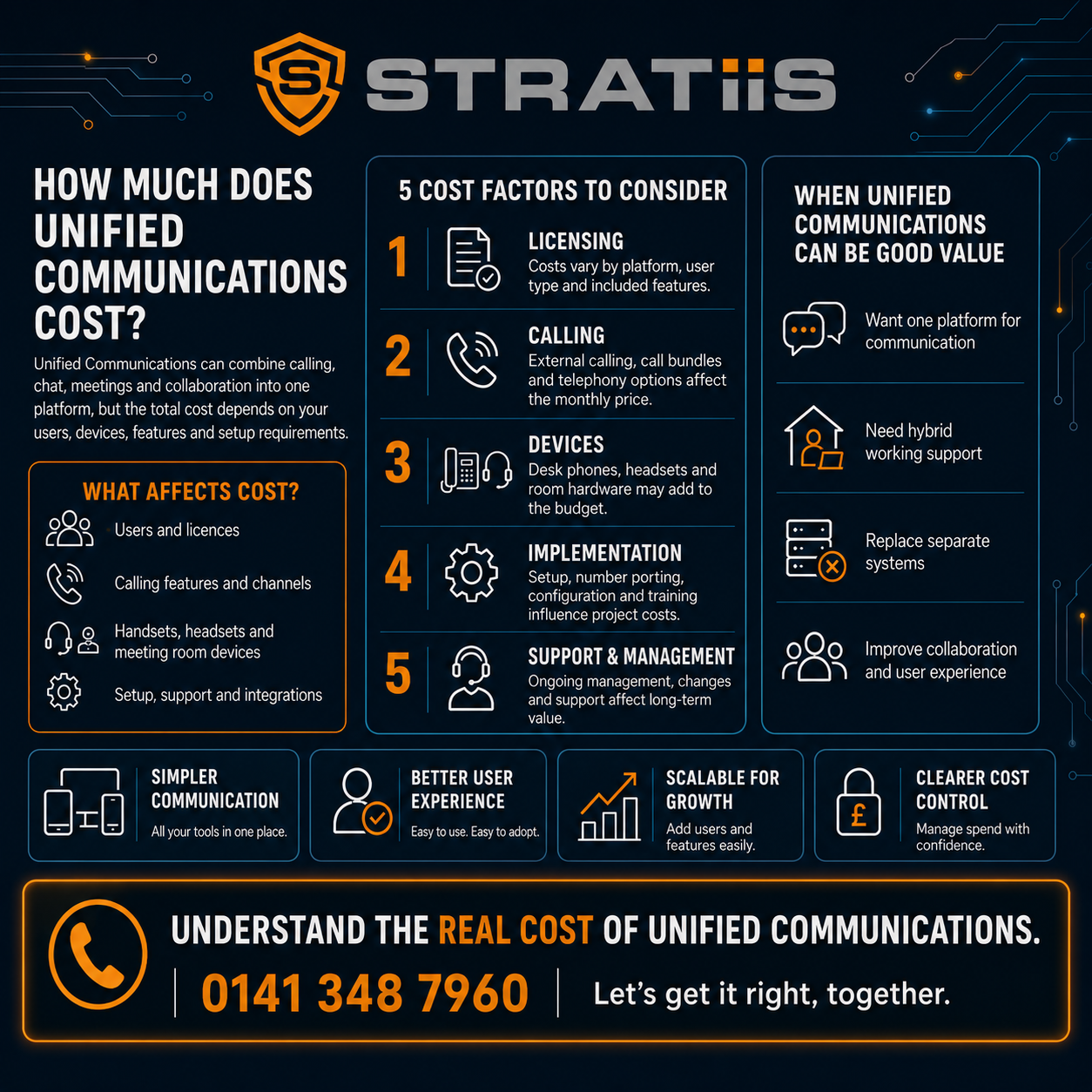
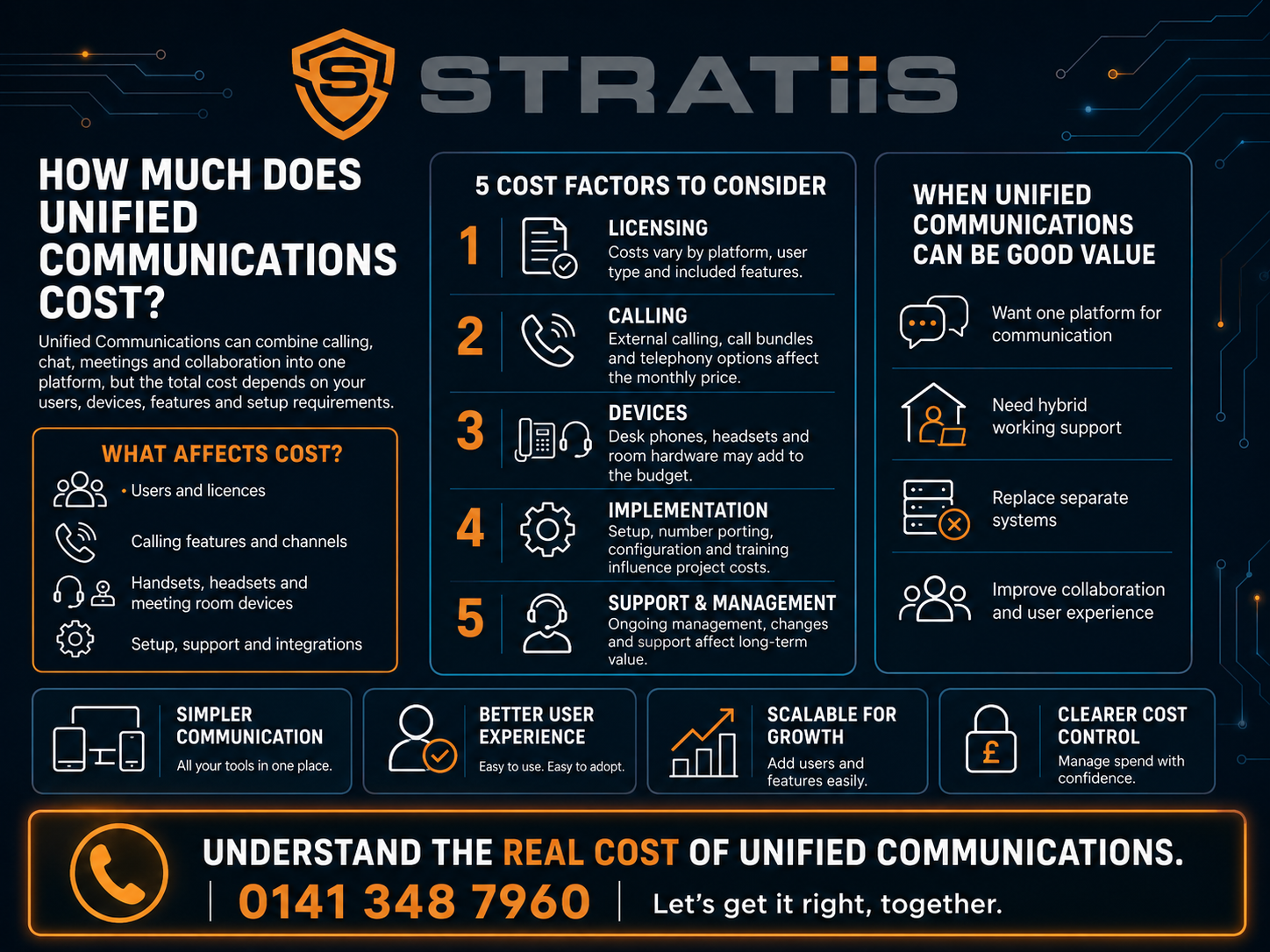
Unified Communications pricing depends on more than a user licence. A complete budget may include cloud calling, collaboration, telephone connectivity, calls, numbers, call routing, hardware, meeting rooms, recording, integrations, training, internet resilience and ongoing support.
The short answer
For early UK budgeting, a straightforward Unified Communications service may cost about £15–£45 per user per month excluding VAT. Basic users may sit around £15–£25, standard business users around £25–£35, and advanced or contact-centre users from £35 to £100 or more. Add one-off setup, number porting, hardware, meeting rooms, connectivity and training. Compare the first-year and three-year total, not the headline licence price.
In this guide
Indicative UK costs
Basic, standard and advanced users
Microsoft Teams Phone costs
Calling and connectivity options
Setup and migration costs
Phones, headsets and rooms
Recording and integrations
Internet and resilience
Budgets for 10, 50 and 100 users
What increases or reduces cost
How to compare quotations
Is Unified Communications worth it?
Frequently asked questions
THE COMPLETE SERVICE
What Does Unified Communications Include?
Unified Communications brings voice, video, messaging and collaboration into a connected platform or user experience. The precise service varies, so two products with the same label may include very different capabilities.
VOICE
Business calling
Telephone numbers, incoming and outgoing calls, voicemail, transfers, auto-attendants and call queues.
MEET
Video and meetings
Online meetings, room systems, screen sharing and collaboration with employees and external guests.
CHAT
Messaging and presence
Instant messaging, availability, mobile and desktop applications and team communication.
SERVE
Customer communications
Advanced routing, contact-centre features, recording, analytics and multiple customer channels.
CONNECT
Integration
Connections with CRM, helpdesk, workflow, identity and business applications.
SUPPORT
Management and support
User changes, call-flow updates, carrier escalation, reporting, security and adoption assistance.
Explore the broader service through Unified Communications.
EARLY BUDGETING
What Are Typical Unified Communications Costs in the UK?
The following ranges are indicative, exclude VAT and support early planning. Actual prices depend on the platform, provider, contract, licence mix, calls, hardware and service level.
| Cost area | Indicative range | What changes the price |
|---|---|---|
| Basic user | £15–£25 per user per month | External calling, number, allowance, support and included collaboration. |
| Standard business user | £25–£35 per user per month | Calling allowance, queues, reporting, support and platform licensing. |
| Advanced or contact-centre user | £35–£100+ per user per month | Routing, supervision, recording, analytics, channels and integrations. |
| Business headset | £30–£250 | Audio quality, wireless use, noise control, battery and warranty. |
| IP desk phone | £90–£300 | Platform certification, screen, keys, connectivity and accessibility. |
| Reception or specialist phone | £200–£500+ | Expansion modules, line handling and specialist requirements. |
| Small meeting room | £1,500–£5,000 | Display, camera, audio, controller, mounting and installation. |
| Medium meeting room | £5,000–£15,000 | Room size, audio coverage, displays, control and cabling. |
| Boardroom or training room | £15,000–£50,000+ | Multiple displays, specialist audio, integration and building work. |
| Setup and configuration | £500–£10,000+ | User count, sites, call flows, numbers, devices, integrations and migration. |
MATCH FEATURES TO ROLES
How Do Basic, Standard and Advanced User Costs Differ?
£15–£25
Basic user
May include a business number, simple external calling, voicemail, mobile and desktop apps, messaging, presence and meetings. Suitable for occasional callers and straightforward routing.
£25–£35
Standard business user
May add call allowances, forwarding, groups, auto-attendant access, reporting and provider support for employees who communicate regularly.
£35–£100+
Advanced or contact-centre user
May include skills routing, supervisor tools, recording, quality management, analytics, workforce features and customer channels.
A mixed licence design usually gives better value than assigning the same advanced package to every employee. Reception, supervisors, agents, light users, common areas and meeting rooms often need different capabilities.
MICROSOFT VOICE
What Makes Up the Cost of Microsoft Teams Phone?
A Teams Phone licence provides cloud phone-system capability, but it may not provide every component required for external calls. The full budget can contain several layers.
A qualifying Microsoft 365 or Teams subscription may be required.
The phone-system licence enables calling features inside Teams.
Calling Plans, Operator Connect or Direct Routing connect Teams to external numbers.
Telephone numbers, allowances, usage, international and premium calls may be separate.
Configuration, number porting, monitoring, support and changes vary by proposal.
Hardware, recording, contact centre, integrations and resilience add further cost.
Microsoft and carrier prices can change, so request a dated breakdown of each licensing and connectivity layer. See Microsoft Teams Phone for the service approach.
EXTERNAL CALLING
How Do Calling Plans, Operator Connect and Direct Routing Affect Cost?
| Option | How it works | Typical cost components |
|---|---|---|
| Microsoft Calling Plans | Microsoft supplies numbers and public telephone calling. | Teams Phone, Calling Plan, usage beyond allowances, special numbers and qualifying Teams licensing. |
| Operator Connect | An approved telecoms operator connects telephone services directly into Teams. | Teams Phone, operator service, numbers, call allowance, support and additional services. |
| Direct Routing | A communications provider connects Teams through a Session Border Controller. | Teams Phone, provider voice service, SBC, SIP connectivity, calls, support and configuration. |
| Independent UC platform | The provider supplies its own combined voice, video and messaging platform. | User licence, numbers, calling, features, support, devices and integrations. |
There is no universally cheapest route. The right choice depends on call patterns, numbers, sites, existing contracts, integration, resilience and the support model.
USAGE CHARGES
Are Call Charges Included?
Some services include UK landline and mobile allowances. Others use pay-as-you-go rates, shared bundles or per-user packages. The monthly licence can look inexpensive when important usage charges are excluded.
Confirm what is included
Ask about inbound calls, UK landlines, UK mobiles, diverted calls, fair-use limits and shared or individual allowances.
Confirm what is extra
Check international, premium, toll-free and out-of-bundle rates, rounding rules and any minimum charges.
Use recent bills and call records to compare pricing models against real usage rather than a generic allowance.
ONE-OFF PROJECT COST
What Does Unified Communications Setup Include?
Setup may cost a few hundred pounds for a simple ten-user service or tens of thousands for a complex, multi-site organisation. The effort reflects discovery and migration work rather than licences alone.
DISCOVER
Requirements and audit
Users, roles, numbers, call flows, locations, licences, contracts, devices, network and customer-service needs.
DESIGN
Configuration
Number plan, auto-attendants, queues, voicemail, permissions, policies, applications and integrations.
MOVE
Migration and porting
Number transfer, user setup, device deployment, continuity, testing and rollback planning.
ADOPT
Training and launch
Administrators, reception, agents and general users need role-specific guidance and launch support.
PROVE
Testing
Inbound, outbound, emergency, queue, voicemail, recording, device and failover scenarios are verified.
MANAGE
Project coordination
Providers, contracts, port dates, dependencies, communication and post-launch issues are controlled.
USER AND ROOM HARDWARE
How Much Should You Budget for Phones, Headsets and Meeting Rooms?
| Equipment | Indicative budget | Design consideration |
|---|---|---|
| Basic wired headset | £30–£80 | Suitable for occasional calling where mobility and advanced noise control are unnecessary. |
| Professional headset | £80–£250 | Audio quality, wireless range, battery, hearing protection and replaceable parts matter for frequent callers. |
| Standard desk phone | £90–£300 | Choose supported models with the required keys, connectivity, power and accessibility. |
| Reception or specialist phone | £200–£500+ | High call volume, expansion modules and shared line visibility increase cost. |
| Small meeting room | £1,500–£5,000 | Camera framing, microphone pickup, display and simple room control. |
| Medium or large room | £5,000–£50,000+ | Multiple displays, room acoustics, coverage, cabling, control, installation and building work. |
Not every employee needs a desk phone. Computer and mobile apps with suitable headsets can reduce hardware cost, while reception, shared spaces, warehouses and accessibility needs may justify dedicated devices. See Video Conferencing for meeting-room planning.
OPTIONAL CAPABILITIES
How Do Recording, Contact Centre and Integrations Affect Price?
RECORD
Call recording
Basic recording may add about £5–£30 or more per recorded user each month. Retention, encryption, transcription, analytics and compliance increase cost.
SERVE
Contact-centre capability
Routing, supervisors, quality management, workforce tools and multiple channels cost more than ordinary business calling.
LINK
Integrations
Standard CRM or helpdesk connections may be included; custom workflows and APIs can require development and ongoing licensing.
Record only users with a clear business, legal or compliance need and define access, retention and administration. Explore Call Recording, Analytics and Compliance and Contact Centre Solutions.
FOUNDATION AND RESILIENCE
Will Internet and Network Changes Add to the Cost?
Voice and video depend on connection quality, local networks and power. A fast download headline does not guarantee reliable calls when packet loss, delay, jitter, upload capacity, Wi-Fi or firewall performance are weak.
Business broadband or a leased line must provide suitable performance and service assurance.
Managed 4G, 5G or a second fixed service can maintain priority communications during an outage.
Equipment must handle traffic, security, quality controls and automatic failover.
Capacity, power delivery, segmentation and physical connectivity affect desk phones and room systems.
Coverage, capacity and roaming matter for mobile calling and meeting experiences.
UPS coverage may be required for network, voice and failover equipment.
Complete a readiness assessment before migration. Relevant services include Business Connectivity, Internet Failover and Managed Wi-Fi.
ONGOING SERVICE
What Should Ongoing Support Cover?
Support may be built into each user price or charged separately. A lower licence can create more internal work if configuration and supplier management are excluded.
Day-to-day administration
New starters, leavers, licences, numbers, voicemail, applications, devices and user questions.
Service management
Call flows, carrier escalation, incidents, monitoring, reporting, recording, security and platform changes.
Confirm support hours, response targets, remote and on-site scope, out-of-hours options, hardware replacement and whether Microsoft and carrier escalation are included.
ILLUSTRATIVE PROJECTS
What Could Unified Communications Cost for 10, 50 or 100 Users?
These examples exclude VAT and support early budgeting. A discovery process is required because user types, hardware, recording, meeting rooms, connectivity and support vary.
| Organisation | Indicative recurring cost | Illustrative one-off cost | First-year view |
|---|---|---|---|
| 10 users | £200–£350 per month | £500–£1,500 headsets plus £500–£2,000 setup | Approximately £3,400–£7,700, excluding internet changes. |
| 50 users | £1,250–£2,250 per month | £5,000–£15,000 hardware plus £3,000–£10,000 setup | Approximately £23,000–£52,000, excluding major room and connectivity work. |
| 100 users | £2,500–£5,000+ per month | £10,000–£40,000 hardware; £7,500–£30,000 setup; rooms from £5,000–£50,000+ | Depends heavily on sites, contact centre, recording, rooms, integration and resilience. |
CONTROL THE BUDGET
What Makes Unified Communications More Expensive or More Affordable?
Costs usually rise with
More users and sites, advanced roles, international calling, desk phones, recording, contact-centre functions, professional meeting rooms, integrations, complex porting, stronger resilience and extended support.
Costs may fall when you
Reuse suitable equipment, mix licence types, remove overlapping platforms, use apps and headsets, simplify call routing, record only necessary users, phase optional work and match call plans to usage.
Existing Microsoft licences may cover part of the requirement, but verify entitlements and renewal terms. Savings only materialise when old contracts and duplicate services are actually removed.
COMPARE LIKE WITH LIKE
How Should You Compare Unified Communications Quotations?
Give each provider the same agreed requirements and ask for a transparent cost model. One quote may look cheaper because it covers only the platform licence while another includes the complete operating service.
| Comparison area | What the quotation should show | Why it matters |
|---|---|---|
| User design | Counts and prices for each user, shared phone, room, agent and supervisor type. | Prevents expensive features being assigned to everyone. |
| Recurring service | Licences, numbers, calls, support, recording, connectivity and optional services. | Reveals the real monthly operating cost. |
| One-off project | Discovery, setup, porting, migration, hardware, installation, training and testing. | Shows what is required to reach a working service. |
| Assumptions and exclusions | Existing licences, reusable hardware, call volumes, network readiness and client tasks. | Makes gaps and commercial risk visible. |
| Contract | Term, renewal, annual increases, licence reduction, support scope and exit arrangements. | Explains how cost can change over time. |
| Total cost | Monthly, one-off, first-year and three-year totals excluding and including optional work. | Provides a fair basis for comparison. |
THE BUSINESS CASE
Is Unified Communications Worth the Cost?
It can offer strong value when it solves defined communication problems and replaces overlapping services. The business case is weaker when the organisation buys features without changing how people work.
SIMPLIFY
Consolidate tools
Replace disconnected telephone, video, messaging and conferencing services where this genuinely reduces complexity.
WORK
Support hybrid teams
Give employees a consistent business identity and communication experience across locations and devices.
SERVE
Improve call handling
Route customers to the right team, reduce missed calls and provide better visibility of demand.
GROW
Scale and change
Add users, sites, numbers and call flows without relying on a traditional on-site telephone system.
CONTINUE
Improve resilience
Use mobile and desktop applications, call rerouting and appropriate connectivity failover.
MANAGE
Simplify support
Clarify ownership across platform, voice, connectivity, hardware and user assistance.
Define which costs will disappear, which remain, which working practices improve and how success will be measured. A simple Hosted Voice service may be better value where collaboration and advanced functions are unnecessary.
FREQUENTLY ASKED QUESTIONS
Questions About Unified Communications Pricing
Is £15–£45 per user the complete price?
It is an early budgeting range. Confirm whether calling, numbers, support, Microsoft licensing, setup, hardware, recording and connectivity are included.
Does every employee need the same licence?
No. Most organisations can mix basic, standard, advanced, contact-centre, reception, shared and room licences around real roles.
Are desk phones required?
No. Many employees can use desktop and mobile applications with a suitable headset. Dedicated phones remain useful for reception, shared areas and some operational roles.
Is number porting normally included?
Sometimes. Confirm the fee, number audit, ownership requirements, rejected-port handling, continuity plan and responsibilities before migration.
Will our internet need upgrading?
Possibly. A readiness assessment should examine packet loss, delay, jitter, upload, Wi-Fi, firewall capacity, failover and power protection.
What is the fairest way to compare providers?
Ask each provider to price the same users and requirements, then compare recurring, one-off, first-year and three-year totals with assumptions and exclusions.
Need a Clear Unified Communications Budget?
Stratiis can review your current telephone system, Microsoft licensing, call patterns, contracts, connectivity and employee requirements, then provide a costed recommendation.