Cybersecurity Services for Scottish Businesses and Organisations
Protect Your People, Data and Reputation from Cyber Threats
Cybersecurity is no longer just an IT concern.
It is a business risk, a financial risk and a reputational risk.
Scottish organisations rely on technology to communicate with customers, deliver essential services, process payments, manage employees and store sensitive information. When those systems are compromised, the impact can reach far beyond an inconvenient IT problem.
A cyberattack can lead to:
- Business disruption
- Lost productivity
- Stolen data
- Fraudulent payments
- Regulatory investigations
- Damaged customer confidence
- Lost contracts
- Unexpected recovery costs
At Stratiis, we help businesses and organisations across Scotland reduce these risks with practical, managed cybersecurity services.
We combine technology, monitoring, employee awareness and strategic guidance to create layers of protection around your organisation.
Concerned about your current cybersecurity?
What Is Business Cybersecurity?
Business cybersecurity is the combination of technology, processes and human behaviour used to protect your organisation from cyber threats.
It covers much more than antivirus software.
Effective cybersecurity should protect:
- Computers and laptops
- Servers
- Microsoft 365
- Email accounts
- Mobile devices
- Cloud applications
- Business data
- User identities
- Internet connections
- Backups
- Remote workers
- Third-party access
It should also help your organisation detect suspicious activity, respond to incidents and recover when something goes wrong.
Cybersecurity cannot remove every possible risk. However, the right controls can make your organisation much harder to attack and significantly reduce the potential impact of an incident.
Why Are Scottish Organisations Being Targeted?
Many organisations assume cybercriminals only target large companies.
That is not how most cybercrime works.
Attackers frequently use automated tools to search the internet for organisations with weak passwords, missing security updates, exposed services or poorly protected email accounts.
They do not always choose their victims by size.
They look for an opportunity.
Small and medium-sized organisations can be attractive targets because they often hold valuable information but may not have an internal cybersecurity team.
Charities, professional firms, housing associations and other organisations may also hold sensitive information about customers, tenants, employees, donors or service users.
Cybercriminals may attempt to exploit this through:
- Phishing emails
- Stolen passwords
- Business email compromise
- Ransomware
- Malicious attachments
- Fake Microsoft 365 login pages
- Unpatched software
- Insecure remote access
- Payment redirection fraud
- Supplier account compromise
- Lost or stolen devices
The question is no longer whether cybersecurity applies to your organisation.
The question is whether your current protection is strong enough.
Common Signs Your Cybersecurity Needs Attention
You do not need to wait for a cyberattack before reviewing your security.
Warning signs can include:
- Employees sharing passwords
- Accounts without Multi-Factor Authentication
- Old or unsupported computers
- Security updates being installed inconsistently
- No central control over laptops and mobile devices
- Staff using personal devices for business information
- Limited visibility of cloud applications
- Backups that are not regularly tested
- Former employees retaining access
- Users having unnecessary administrator permissions
- No employee cybersecurity training
- No documented incident response plan
- Cyber insurance questions that are difficult to answer
- Uncertainty about Cyber Essentials requirements
Individually, these issues may appear manageable.
Together, they can leave gaps that an attacker can exploit.
Our Cybersecurity Services
Stratiis provides managed cybersecurity services designed to protect the technology your organisation depends upon.
Rather than relying on one security product, we build multiple layers of protection around your users, devices, systems and data.
Cybersecurity Risk Assessments
A cybersecurity risk assessment helps you understand where your organisation is currently exposed.
We review the security controls around your:
- Microsoft 365 environment
- User accounts
- Computers and mobile devices
- Networks and internet connections
- Email systems
- Backups
- Remote access
- Business applications
- Security policies
- Employee practices
We then explain the findings in clear business language.
You receive practical recommendations based on risk, urgency and budget, not a list of technical problems without context.
Multi-Factor Authentication
Passwords alone are no longer enough to protect important business accounts.
Multi-Factor Authentication, commonly called MFA, requires the user to provide an additional form of verification when signing in.
This can help stop an attacker from accessing an account even when the password has been stolen.
We help organisations introduce and manage MFA across services such as:
- Microsoft 365
- Cloud applications
- Remote access systems
- Administrator accounts
- Business-critical applications
MFA should be applied carefully and consistently. Protecting some users while leaving other accounts exposed can create an avoidable weakness.
Endpoint Detection and Response
Every laptop, desktop and server represents a possible route into your organisation.
Traditional antivirus software may not provide enough visibility or protection against modern threats.
Endpoint Detection and Response, or EDR, continuously monitors devices for suspicious activity. It can identify behaviour that may indicate malware, ransomware, account misuse or an attempted intrusion.
A managed endpoint security service can include:
- Continuous device monitoring
- Threat detection
- Malicious file blocking
- Suspicious behaviour analysis
- Device isolation
- Security alerts
- Investigation and response
- Central reporting
This provides stronger protection than relying on employees to recognise every threat themselves.
Microsoft 365 Security
Microsoft 365 is central to the daily work of many organisations.
It may contain your email, files, conversations, customer information and business records. This makes it a valuable target for cybercriminals.
Simply using Microsoft 365 does not mean every security feature is automatically configured correctly.
Stratiis can help strengthen your Microsoft 365 environment through:
- Multi-Factor Authentication
- Conditional Access
- Microsoft Defender
- Secure administrator accounts
- Email threat protection
- Device compliance policies
- Intune device management
- External sharing controls
- User access reviews
- Security monitoring
- Data protection policies
- Microsoft Secure Score reviews
Our goal is to balance security with usability.
Your employees should be able to work productively without leaving your information unnecessarily exposed.
Email Security and Phishing Protection
Email remains one of the most common routes used to target organisations.
A convincing phishing email may appear to come from:
- A senior manager
- A colleague
- A customer
- A supplier
- Microsoft
- A bank
- A delivery company
- A trusted professional adviser
The message may ask the recipient to open a document, reset a password, approve a payment or sign in to a fake website.
We use layered email security controls to help identify and block:
- Phishing attempts
- Malicious attachments
- Dangerous links
- Spoofed domains
- Impersonation attacks
- Spam
- Malware
- Suspicious forwarding rules
Technology can reduce the number of threats reaching your employees, but it should be supported by practical security awareness training.
Security Awareness Training
Your employees do not need to become cybersecurity experts.
They do need to understand how to recognise risk and what to do when something feels wrong.
Effective cybersecurity awareness training should help employees understand:
- How phishing attacks work
- How to inspect unexpected emails
- Why password reuse is dangerous
- How to report suspicious activity
- How payment fraud occurs
- Why MFA requests should not be approved automatically
- How to handle business information securely
- What to do after making a mistake
The purpose is not to blame or frighten employees.
It is to build a security-conscious culture where people feel confident reporting potential incidents quickly.
Vulnerability and Security Update Management
Cybercriminals frequently exploit known weaknesses in software.
Manufacturers release security updates to correct these vulnerabilities, but the update only protects your organisation once it has been installed.
We help manage security updates across supported computers, servers and applications.
This includes:
- Monitoring update status
- Identifying missing updates
- Prioritising serious vulnerabilities
- Managing restart requirements
- Reporting on compliance
- Identifying unsupported software
- Planning the replacement of ageing systems
Security update management is also one of the central requirements of Cyber Essentials.
Managed Firewall and Network Security
Your network connects employees, devices, systems and cloud services.
A properly managed firewall helps control the traffic entering and leaving that network.
Stratiis can help with:
- Business-grade firewall management
- Secure network configuration
- Remote access protection
- Virtual Private Networks
- Guest Wi-Fi separation
- Web filtering
- DNS filtering
- Network monitoring
- Firmware updates
- Security rule reviews
Firewall security should not be treated as a one-time installation.
Rules, software and access requirements should be reviewed as your organisation changes.
Identity and Access Management
Many cyber incidents begin with a compromised user account.
Strong identity and access management helps ensure that the right people can access the right information at the right time.
It also helps prevent unnecessary or outdated access from remaining in place.
Our approach can include:
- Secure user onboarding
- Employee leaver processes
- Multi-Factor Authentication
- Administrator account separation
- User access reviews
- Password policies
- Conditional Access
- Least-privilege access
- Shared account reduction
- Dormant account removal
When an employee changes role or leaves the organisation, their access should be updated immediately.
Mobile Device Security
Employees increasingly access business data through smartphones and tablets.
These devices can contain email, Microsoft Teams messages, customer details, documents and authentication applications.
Stratiis can help protect business mobiles through:
- Microsoft Intune
- Mobile Device Management
- Device encryption
- Screen-lock policies
- Application controls
- Remote device removal
- Data separation
- Compliance policies
- Lost-device procedures
- Secure employee offboarding
This gives the organisation greater control over its information without preventing employees from working flexibly.
Backup and Ransomware Recovery
Cybersecurity is not only about preventing attacks.
Your organisation must also be prepared to recover.
Backups provide an important layer of protection against ransomware, accidental deletion, system failure and other forms of data loss.
However, having a backup does not automatically mean your organisation can recover successfully.
A reliable backup strategy should consider:
- What information is protected
- How frequently it is backed up
- Where backups are stored
- Who can access or delete them
- How long data is retained
- Whether Microsoft 365 is covered
- How quickly systems can be restored
- Whether recovery is regularly tested
Stratiis provides managed backup and disaster recovery services designed to support business continuity as well as data protection.
Cybersecurity Monitoring and Response
Cyber threats do not operate only during normal office hours.
Security monitoring helps identify suspicious behaviour before it develops into a larger incident.
Depending on your organisation's needs, monitoring may cover:
- Computers and servers
- Microsoft 365
- User identities
- Security alerts
- Email threats
- Endpoint activity
- Network events
- Backup failures
- Vulnerabilities
When a credible threat is identified, rapid investigation matters.
The faster suspicious activity is contained, the greater the chance of limiting disruption and data loss.
Cyber Essentials and Cyber Essentials Plus
Cyber Essentials is a UK Government-backed certification scheme designed to help organisations protect themselves against common cyber threats.
It covers five main areas:
- Firewalls
- Secure configuration
- Security update management
- User access control
- Malware protection
Cyber Essentials uses an independently assessed self-assessment process.
Cyber Essentials Plus covers the same technical controls but adds hands-on testing by an authorised assessor.
Certification may help your organisation:
- Improve its basic security controls
- Demonstrate good cyber hygiene
- Meet customer or supplier requirements
- Support tender applications
- Reassure trustees and board members
- Prepare for cyber insurance discussions
- Identify gaps in its IT environment
Stratiis can help you understand the requirements, define the scope, address technical gaps and prepare for assessment.
Cybersecurity for Different Scottish Sectors
Every organisation requires strong cybersecurity, but the risks and priorities can vary between sectors.
Cybersecurity for Charities and Nonprofits
Charities and nonprofit organisations may hold information about donors, volunteers, employees, beneficiaries and service users.
They may also face:
- Limited internal IT resources
- Tight budgets
- Trustee governance requirements
- Hybrid working
- Shared devices
- Temporary or volunteer accounts
- Increased sensitivity around reputational damage
We help charities introduce proportionate security controls that protect their mission without creating unnecessary complexity.
Cybersecurity for Housing Associations
Housing associations hold substantial amounts of tenant, employee, financial and property information.
A serious cyber incident could affect frontline services as well as internal operations.
Cybersecurity planning for housing associations should consider:
- Tenant confidentiality
- Housing management systems
- Remote and mobile working
- Microsoft 365
- Third-party suppliers
- Business continuity
- Board-level risk reporting
- Employee awareness
- Incident response
We help housing associations improve resilience, reduce risk and develop practical cybersecurity roadmaps.
Cybersecurity for Accountancy Firms
Accountancy practices process highly sensitive financial, payroll, tax and identity information.
Attackers may target firms to steal data, redirect payments or compromise client communications.
Important controls can include:
- Secure Microsoft 365 configuration
- MFA
- Email security
- Managed endpoints
- User access controls
- Secure file sharing
- Backup and recovery
- Employee training
- Cyber Essentials preparation
We help accountancy firms protect client information while maintaining the productivity required during busy periods.
Cybersecurity for Law Firms
Law firms depend on confidentiality and client trust.
Their systems may contain legal documents, financial information, property transactions, identity documents and commercially sensitive communications.
A cybersecurity strategy for a law firm should address:
- Email account compromise
- Payment redirection fraud
- Secure remote working
- Document protection
- Access permissions
- Data recovery
- Mobile device security
- Employee awareness
- Supplier risk
We help legal practices reduce risk without disrupting the way solicitors and support teams work.
Cybersecurity for Engineering Companies
Engineering companies often hold valuable intellectual property, project files, drawings, customer information and commercially sensitive designs.
They may also work across offices, sites and customer locations.
Cybersecurity planning should therefore cover:
- Remote access
- High-performance workstations
- CAD and BIM environments
- Mobile devices
- Microsoft 365
- Project collaboration
- Backup and recovery
- Customer security requirements
- Supplier access
We help engineering firms build secure, reliable technology environments that support project delivery.
Cybersecurity for Renewable Energy Companies
Renewable energy businesses may operate across multiple sites and depend on cloud systems, mobile teams, external partners and specialist platforms.
Cybersecurity should be included in wider operational resilience planning.
We help renewable energy organisations strengthen:
- User identity security
- Remote access
- Device protection
- Microsoft 365
- Supplier access
- Data backup
- Security awareness
- Incident preparation
- Strategic IT governance
Cybersecurity for Quarry Operators
Quarry businesses increasingly rely on connected technology for production, logistics, finance, communications and regulatory reporting.
A cyber incident can disrupt more than office administration. It may affect operational planning, deliveries and customer service.
We help quarry operators protect:
- Office and site-based users
- Remote connections
- Business systems
- Mobile devices
- Microsoft 365
- Financial processes
- Data backups
- Multi-site networks
What Does a Strong Cybersecurity Strategy Include?
A strong cybersecurity strategy should be based on risk rather than isolated product purchases.
It should bring together six key areas.
1. Understand the Risk
You need visibility of your users, devices, applications, information and vulnerabilities.
Without this, it is difficult to know which risks require attention first.
2. Protect Your Organisation
Introduce appropriate technical controls such as MFA, endpoint protection, email security, secure configuration and managed updates.
3. Train Your People
Help employees recognise suspicious activity and report it quickly.
4. Detect Threats
Monitor systems for signs of compromise, unusual behaviour and security failures.
5. Respond to Incidents
Agree who will make decisions, who will investigate and how the organisation will communicate during an incident.
6. Recover Operations
Maintain tested backups and a practical business continuity plan.
Cybersecurity is strongest when these areas work together.
What Is a Cybersecurity-First Managed IT Service?
Cybersecurity should not be treated as an optional addition to IT support.
Everyday IT decisions affect your organisation's security.
Creating a user account, configuring a laptop, approving remote access or installing an application can introduce risk when it is not handled correctly.
A cybersecurity-first managed IT provider should build security into:
- New employee onboarding
- Employee offboarding
- Device configuration
- Microsoft 365 administration
- Technical support
- Software updates
- Backup management
- Account permissions
- Remote working
- Technology projects
- Strategic planning
At Stratiis, managed IT support and cybersecurity work together.
This helps reduce gaps between the people who support your technology and the people responsible for protecting it.
How Much Do Managed Cybersecurity Services Cost?
The cost of cybersecurity depends on:
- The number of employees
- The number and type of devices
- The complexity of the IT environment
- Microsoft licensing
- Existing security tools
- The sensitivity of the information held
- Compliance requirements
- The level of monitoring required
- The number of locations
- The organisation's current security position
A small organisation with a straightforward Microsoft 365 environment will have different requirements from a multi-site organisation with servers, specialist applications and an internal IT team.
We begin by understanding the risk and existing environment.
We can then recommend the controls that are most relevant rather than selling unnecessary technology.
Can Stratiis Work with an Internal IT Team?
Yes.
Some organisations need Stratiis to manage their entire IT environment.
Others already employ an IT manager or technical team but require additional cybersecurity expertise, monitoring or capacity.
Our co-managed services can support an internal team with:
- Endpoint security
- Security monitoring
- Microsoft 365 security
- Vulnerability management
- Cyber Essentials preparation
- Backup oversight
- Strategic cybersecurity reviews
- Escalation support
- Security projects
- Additional technical expertise
The responsibilities can be clearly divided so your internal team retains control while gaining access to additional resources.
What Should You Look for in a Cybersecurity Provider?
Choosing a cybersecurity partner requires more than comparing a list of software products.
Ask potential providers:
- Will you assess our current risks before recommending services?
- How will you monitor our environment?
- Who responds when a threat is identified?
- How do you secure Microsoft 365?
- How do you manage employee onboarding and offboarding?
- Will you help us prepare for Cyber Essentials?
- How are backups protected and tested?
- Can you support our internal IT team?
- How will security performance be reported?
- Will you help us build a longer-term cybersecurity roadmap?
- Can you explain risk to our directors or trustees?
- What happens if we experience a cyber incident?
A good provider should be able to explain cybersecurity clearly.
You should understand what is being protected, why each control is needed and what will happen when a threat is detected.
Why Choose Stratiis?
Stratiis has supported businesses and organisations with their technology since 2002.
We combine managed IT services, Microsoft cloud expertise, cybersecurity, backup and strategic guidance through one technology partnership.
Our approach is built around four priorities.
Practical Protection
We focus on controls that reduce meaningful business risks.
Clear Communication
We explain cybersecurity in straightforward language rather than hiding behind technical terminology.
Proactive Management
We look for vulnerabilities, failures and warning signs before they develop into major problems.
Long-Term Improvement
Cybersecurity is not a one-time project.
We help organisations continually review, strengthen and adapt their protection as technology and threats change.
Stratiis supports organisations across Scotland, including businesses and teams in Glasgow, Edinburgh, Lanarkshire, Ayrshire, the Lothians, Dumfries and Galloway, Perthshire and beyond.
Our Cybersecurity Process
1
Step 1: Assess
We review your current technology, security controls, risks and business requirements.
2
Step 2: Prioritise
We explain which issues should be addressed first and why.
3
Step 3: Protect
We implement the agreed cybersecurity controls around your users, devices, systems and data.
4
Step 4: Monitor
We monitor the environment for threats, vulnerabilities and security failures.
5
Step 5: Improve
We review performance and help your organisation plan its next security improvements.
This creates a practical route from uncertainty to a more secure and resilient organisation.
Frequently Asked Questions
Does a small business really need cybersecurity?
Yes. Small organisations use the same email platforms, cloud applications and online banking services as larger companies. They can also be targeted through automated attacks, phishing and stolen passwords.
Your controls should be proportionate to your risks, but cybersecurity is relevant to organisations of every size.
Is antivirus enough to protect a business?
No single security product can protect an organisation from every threat.
Antivirus or endpoint protection should be supported by controls such as MFA, secure configuration, security updates, email filtering, employee awareness, backups and monitoring.
What is the most important cybersecurity control?
There is no single control that eliminates cyber risk.
However, MFA, supported and updated software, secure device configuration, endpoint protection, reliable backups and employee awareness provide a strong starting point.
Do we need Multi-Factor Authentication on every account?
MFA should be enabled wherever the service supports it, particularly for email, Microsoft 365, remote access, financial systems, administrator accounts and other business-critical applications.
Can Microsoft 365 be made more secure?
Yes. Microsoft 365 includes many security capabilities, but the appropriate settings and licences must be selected and configured.
A review may cover MFA, Conditional Access, Defender, administrator roles, external sharing, email protection, device management and data security.
What is the difference between cybersecurity and cyber resilience?
Cybersecurity focuses primarily on preventing, detecting and responding to threats.
Cyber resilience also considers how the organisation will continue operating and recover when an incident occurs.
Both are important.
What is Cyber Essentials?
Cyber Essentials is a UK Government-backed certification scheme covering five fundamental security controls.
It helps organisations protect themselves against common attacks and demonstrate that appropriate baseline measures are in place.
Do Scottish charities need Cyber Essentials?
Cyber Essentials is not automatically mandatory for every charity.
However, it may be requested by funders, customers, insurers, partners or public-sector procurement teams. It can also provide trustees with a recognised framework for reviewing basic cybersecurity controls.
How often should we review our cybersecurity?
Cybersecurity should be monitored continuously and formally reviewed at least annually.
A further review may be needed after significant changes such as an office move, acquisition, Microsoft 365 migration, security incident, major recruitment programme or introduction of a new business system.
What should we do if we suspect a cyber incident?
Contact your IT or cybersecurity provider immediately.
Do not wait for further evidence if an employee believes an account or device may have been compromised. Fast reporting can make it easier to contain the incident.
Avoid deleting evidence or attempting unplanned changes unless instructed by the person managing the response.
Can Stratiis take over from our current cybersecurity provider?
Yes.
We begin by reviewing your existing environment, licences, services, documentation and security controls. We then create a structured transition plan designed to minimise disruption.
Take the Next Step Towards Stronger Cybersecurity
You do not need to understand every cyber threat or purchase every security product.
You need a clear view of your risks, appropriate protection and a trusted team that knows what to do when something goes wrong.
Stratiis can help you:
- Understand your current cybersecurity position
- Identify important security gaps
- Protect Microsoft 365
- Secure computers and mobile devices
- Reduce phishing and email risk
- Improve employee awareness
- Prepare for Cyber Essentials
- Protect and test backups
- Develop a cybersecurity roadmap
- Respond to suspicious activity
Speak to Stratiis about protecting your organisation.
Related Articles
What Are the Most Common Cybersecurity Mistakes Made by Scottish SMEs?
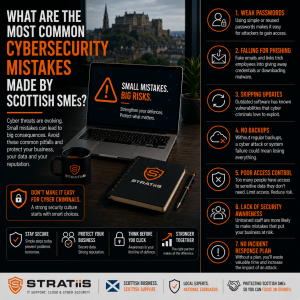
Cybersecurity is no longer just a concern for large corporations. Today, small and medium-sized businesses across Scotland are regularly targeted by cybercriminals looking to exploit weaknesses in technology, processes, and human behaviour. Whether you're a …
Read MoreWhat Cybersecurity Protections Does a 50-Person Business Actually Need?
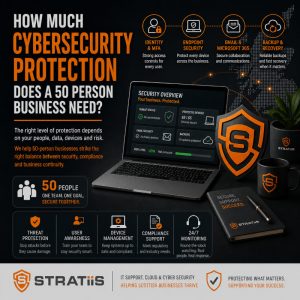
Cybersecurity can feel overwhelming for growing businesses. Every week there seems to be a new threat, a new security product, or a new compliance requirement. Business owners are often left asking: "What cybersecurity protections do …
Read MoreYour CRM Provider Has Suffered a Security Incident: What Should You Do Next?
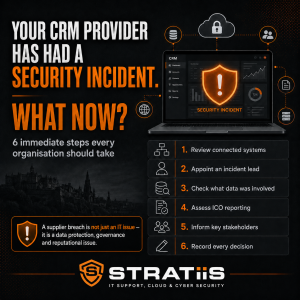
A message arrives from your CRM provider informing you that it has experienced a security incident. It may explain that unauthorised access took place, that customer data could have been involved and that an …
Read MoreHow Can Manufacturing Companies Reduce Ransomware Risk Without Increasing IT Spend?
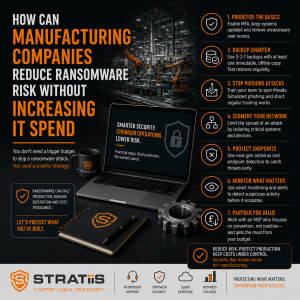
Ransomware remains one of the biggest cybersecurity threats facing manufacturing companies today. From production downtime and lost revenue to damaged customer relationships and supply chain disruption, the impact of a ransomware attack can be …
Read More