Ransomware remains one of the biggest cybersecurity threats facing manufacturing companies today.
From production downtime and lost revenue to damaged customer relationships and supply chain disruption, the impact of a ransomware attack can be significant. Yet many manufacturing businesses face a difficult challenge:
How do you improve cybersecurity without increasing IT spend?
The good news is that reducing ransomware risk does not always require expensive new technology investments.
In fact, many successful ransomware attacks occur because organisations fail to fully utilise security features they already own or because basic cybersecurity controls are not consistently applied.
For most manufacturing companies with 10–100 employees, meaningful risk reduction can often be achieved through better processes, stronger security practices, and more effective use of existing tools.
In this guide, we'll explore practical ways manufacturing businesses can strengthen cybersecurity without significantly increasing costs.
Why Manufacturing Companies Are Frequently Targeted
Manufacturing organisations have become attractive targets for cybercriminals because they rely heavily on technology to maintain operations.
A successful attack can affect:
- Production systems
- Inventory management
- Supply chain operations
- Customer deliveries
- Financial systems
- Business continuity
Unlike some industries, manufacturing companies often face immediate operational disruption when systems become unavailable.
This creates pressure to restore operations quickly, making ransomware attacks particularly damaging.
The Real Problem: Most Businesses Already Own Security Tools They Don't Fully Use
One of the most common findings during cybersecurity reviews is that businesses already possess security capabilities that have not been fully implemented.
Examples include:
- Multi-Factor Authentication not enabled
- Microsoft 365 security features unused
- Device management not configured
- Security alerts ignored
- Backup testing never performed
Before investing in additional solutions, organisations should maximise the value of their existing investments.
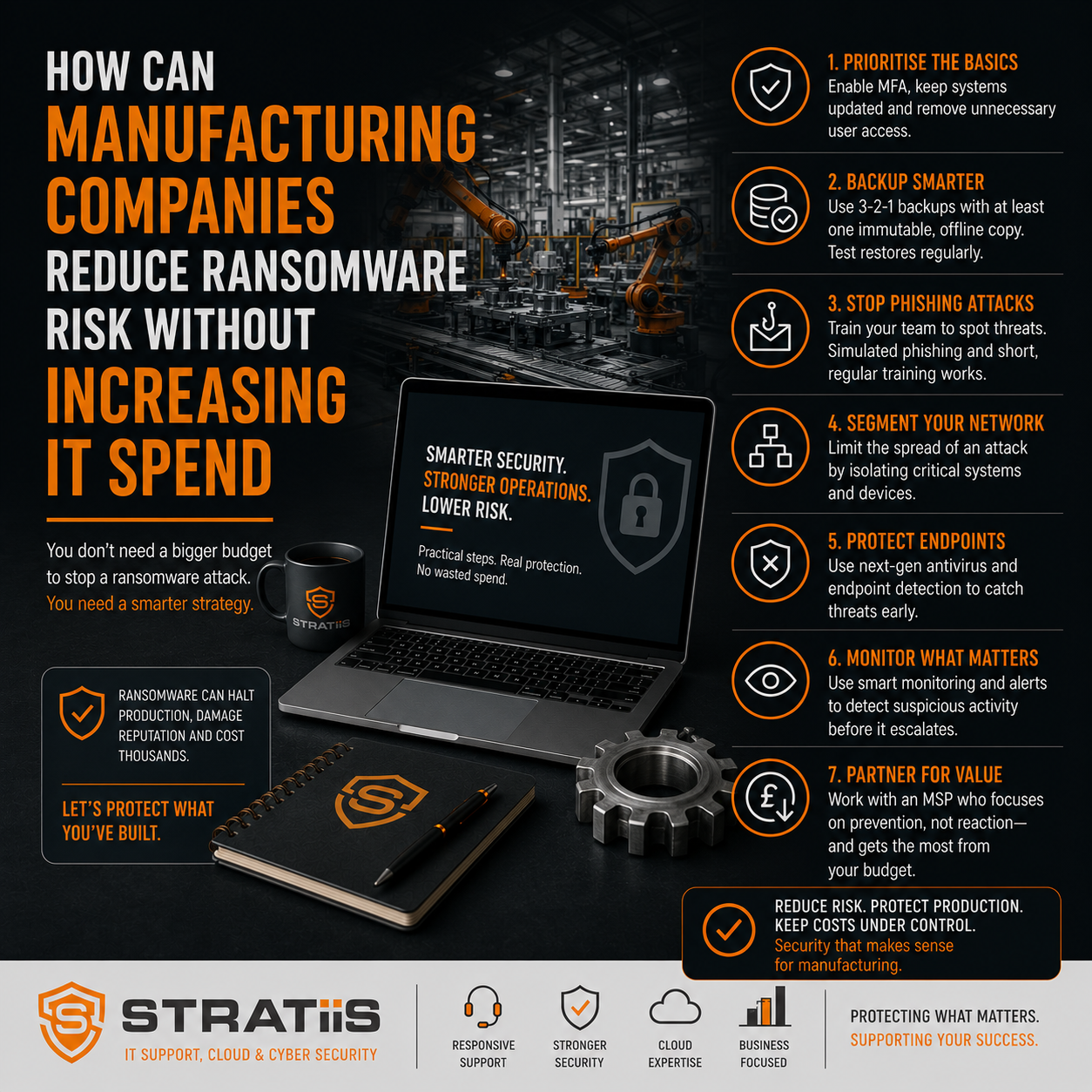
The 7 Most Cost-Effective Ways to Reduce Ransomware Risk
1. Enable Multi-Factor Authentication Everywhere
Multi-Factor Authentication (MFA) remains one of the most effective security controls available.
Yet many organisations still fail to deploy it consistently.
MFA should be enabled for:
- Microsoft 365
- Email accounts
- Remote access
- Business applications
- Administrative accounts
The cost is often minimal because many businesses already have access to MFA through their existing Microsoft licences.
Why It Matters
Stolen passwords remain one of the most common causes of successful ransomware attacks.
MFA dramatically reduces this risk.
2. Improve Security Awareness Training
Cybercriminals frequently target employees rather than technology.
Many ransomware attacks begin with:
- Phishing emails
- Fake invoices
- Malicious links
- Social engineering
Regular security awareness training helps employees identify threats before they become incidents.
Low-Cost Improvements
- Quarterly awareness sessions
- Simulated phishing exercises
- Security reminders
- Incident reporting guidance
Training is often one of the highest-return cybersecurity investments available.
3. Strengthen Patch Management
Many ransomware attacks exploit vulnerabilities that already have available security updates.
Unfortunately, patching is often inconsistent.
Manufacturing businesses should ensure:
- Operating systems are updated
- Applications are updated
- Firmware is updated
- Security patches are prioritised
Most organisations already possess the tools needed to improve patch management.
The challenge is often process rather than budget.
4. Review Administrative Privileges
Many users have more system access than they actually require.
Excessive privileges increase risk because ransomware can spread more easily once a compromised account gains access.
Best practice includes:
- Limiting administrator accounts
- Reviewing permissions regularly
- Removing unnecessary access
- Applying least-privilege principles
This often requires little or no additional spending.
5. Test Your Backups Regularly
Backups are one of the most important defences against ransomware.
However, many organisations assume backups are working without testing them.
Questions every manufacturing business should ask:
- Can we recover critical systems?
- How long would recovery take?
- Have we tested restoration recently?
- Are backups protected from ransomware?
A backup that cannot be restored provides limited value during an incident.
6. Use Microsoft 365 Security Features More Effectively
Many manufacturing companies already subscribe to Microsoft 365 Business Premium.
This licence includes powerful security capabilities such as:
- Multi-Factor Authentication
- Conditional Access
- Microsoft Defender for Business
- Device management
- Security policies
Yet many organisations only use Microsoft 365 for email and productivity.
Improving configuration often provides significant security benefits without increasing licence costs.
7. Achieve Cyber Essentials Certification
Cyber Essentials provides a practical cybersecurity framework that helps organisations address the most common attack methods.
The framework focuses on:
- Firewalls
- Secure configuration
- User access control
- Malware protection
- Security updates
Many of the controls required for certification involve improving existing processes rather than purchasing additional technology.
Cyber Essentials often delivers substantial risk reduction for a relatively modest investment.
What Does Good Ransomware Protection Look Like?
A manufacturing company with strong ransomware protection typically has:
Identity Protection
✓ Multi-Factor Authentication
✓ Strong password policies
✓ Restricted administrator access
Device Security
✓ Managed devices
✓ Endpoint protection
✓ Security updates
✓ Device encryption
Data Protection
✓ Tested backups
✓ Recovery procedures
✓ Access controls
User Security
✓ Security awareness training
✓ Phishing education
✓ Incident reporting processes
Governance
✓ Cyber Essentials readiness
✓ Risk reviews
✓ Incident response plans
The objective is creating multiple layers of protection rather than relying on a single solution.
Common Mistakes Manufacturing Companies Make
Mistake 1: Assuming Antivirus Is Enough
Modern ransomware attacks frequently bypass traditional antivirus solutions.
Mistake 2: Ignoring User Training
Human error remains one of the biggest cybersecurity risks.
Mistake 3: Not Testing Backups
Many organisations discover backup problems during a crisis.
Mistake 4: Delaying Security Updates
Known vulnerabilities remain a common attack vector.
Mistake 5: Treating Cybersecurity as an IT Issue
Cybersecurity should be considered a business risk and operational resilience issue.
How Stratiis Helped A Manufacturing Business with 60 Employees
Their Challenges
- Growing cybersecurity concerns
- Ageing devices
- Limited IT budget
- Increased ransomware awareness
The Improvements Stratiis Implemented
Rather than purchasing multiple new security products, the business focused on:
- MFA deployment
- Microsoft 365 security optimisation
- Patch management improvements
- Backup testing
- Security awareness training
- Cyber Essentials preparation
Their Outcome
The benefits included:
- Reduced ransomware risk
- Improved security posture
- Greater operational resilience
- Better visibility into vulnerabilities
- Increased confidence from customers and suppliers
- Cyber Essentials Plus Certification – achieved in 8 weeks
The organisation improved security significantly without a major increase in IT spending.
A Practical Ransomware Reduction Framework
If your manufacturing business has 10–100 employees, focus on these priorities:
Priority 1
Enable MFA across all critical systems.
Priority 2
Improve backup testing and recovery readiness.
Priority 3
Strengthen patch management.
Priority 4
Implement security awareness training.
Priority 5
Prepare for Cyber Essentials certification.
These five steps often deliver greater risk reduction than purchasing additional security tools.
Why Manufacturing Companies Across Scotland Choose Stratiis
At Stratiis, we help manufacturers throughout Glasgow, Edinburgh, Lanarkshire, Ayrshire, Lothian, Dumfries & Galloway, and Perthshire improve cybersecurity without unnecessary complexity or expense.
Our cybersecurity-first approach includes:
- Managed IT support
- Microsoft security optimisation
- Cyber Essentials guidance
- Security awareness training
- Device management
- Backup and disaster recovery
- Strategic vCIO services
We help manufacturing businesses reduce risk, strengthen resilience, and make better technology decisions.
Final Thoughts
Reducing ransomware risk does not always require larger IT budgets.
For most manufacturing companies, the biggest opportunities lie in improving the effectiveness of existing security controls.
By focusing on Multi-Factor Authentication, user awareness, patch management, backup testing, Microsoft 365 security, and Cyber Essentials, organisations can significantly strengthen their cybersecurity posture without substantial additional investment.
The goal is not to eliminate every risk.
The goal is to make your business a far more difficult target than organisations that fail to implement the basics.
In cybersecurity, consistency often delivers greater value than complexity.
Related Articles
What Does a Strategic vCIO Do for a Growing Business and Is It Worth It?
How Much Should Managed IT Support Cost for a 10-100 Employee Business in Scotland?
How Much Cybersecurity Protection Does a 50-Person Business Actually Need?
What Cyber Essentials Requirements Apply to Scottish SMEs and Charities in 2026?
Microsoft 365 Business Premium vs E5: Which Is Best for Scottish Businesses?