Digital transformation can sound like something designed for banks, global manufacturers or companies with huge IT budgets. For most small and medium-sized businesses, it is much more practical: using the right technology, systems and working practices to remove everyday frustrations and help the business operate more securely and efficiently.
The short answer
What is digital transformation for an SME?
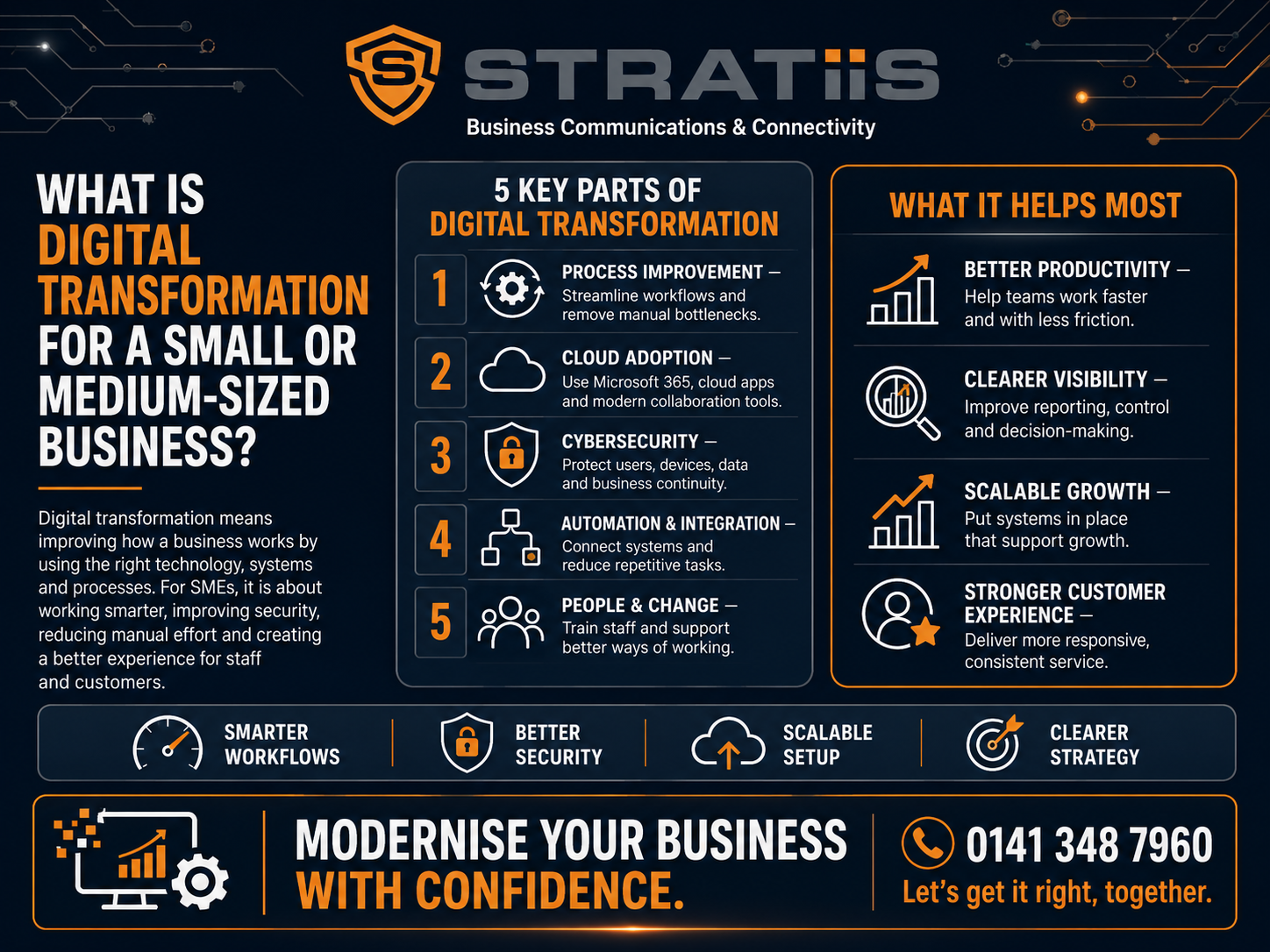
Digital transformation is the process of improving how an organisation works by changing its technology, processes and working practices. It should begin with a business problem—not with a product—and create a measurable improvement such as less manual work, stronger security, faster reporting or better service.
What does digital transformation actually mean?
Digital transformation is not simply buying new software. A business can spend thousands of pounds on a platform and still rely on duplicate spreadsheets, email chains and unofficial workarounds because the system does not fit the way people work.
Real transformation happens when technology supports a better process. Consider holiday requests handled through email: an employee contacts a manager, the approval is forwarded to administration, somebody checks an allowance in a spreadsheet and the dates are confirmed manually. An online form and automated workflow could route the request, update one central record and notify everyone involved. The technology enables the change; the transformation is the removal of unnecessary manual work.
Is digital transformation the same as moving to the cloud?
| Cloud migration | Digital transformation |
|---|---|
| Moves data, applications or infrastructure from local systems into cloud services. | Improves the process, experience or business outcome that the technology supports. |
| Example: moving files from an office server into SharePoint. | Example: redesigning how teams organise, share, approve and retain those documents. |
The cloud can be an important part of a transformation programme, but moving a workload does not automatically improve the way the business works.
How can you tell when change is needed?
Not every SME needs a large transformation programme. Most organisations, however, have systems or processes that have grown slowly and could now be improved.
Examples of digital transformation for small businesses
SharePoint and document management
Replace disorganised shared drives with structured libraries, version control, search, permissions, secure sharing and approval workflows.
Better use of Microsoft 365
Use Teams, OneDrive, SharePoint, Intune, Forms, Lists and Power Automate where they solve a defined operational problem.
Process automation
Reduce repetitive administration across approvals, onboarding, leavers, equipment requests, enquiries and recurring reports.
Hybrid working
Create a consistent and secure experience for communication, applications, files, devices and phone services wherever staff work.
Infrastructure modernisation
Replace ageing servers or adopt an appropriate cloud, local or hybrid design based on the workload—not on a blanket rule.
Cybersecurity improvement
Build in MFA, device management, email and endpoint security, cloud backup, access controls, awareness and incident planning.
What business problems can transformation solve?
| Business problem | Potential improvement | Useful measure |
|---|---|---|
| Lost time and repeated work | Workflow redesign and automation | Administration hours saved |
| Poor communication | Shared workspaces for conversations, documents and tasks | Fewer delays and duplicate requests |
| Inconsistent processes | Standardised digital workflows and ownership | Fewer errors and exceptions |
| Limited management visibility | Centralised information and automated reporting | Faster, more reliable reports |
| Difficulty scaling | Systems that support more users without matching growth in administration | Cost or admin time per employee |
| Customer service delays | Connected information and clearer request tracking | Response and resolution time |
How much does digital transformation cost and how long does it take?
The cost depends on the problem, number of users, data, systems, locations and security requirements. A focused improvement using tools already included in Microsoft 365 may cost relatively little. A programme involving new platforms, migration, hardware, integration, training and multiple sites can require a significant investment.
Typical cost components
- Discovery, planning and project management
- Licences, cloud services and hardware
- Configuration, integration and data migration
- Cybersecurity controls, testing and training
- Ongoing support and improvement
Typical timescale factors
- Number of people, systems and suppliers
- Volume and quality of existing data
- Internal decisions and employee availability
- Testing, security and training requirements
- Dependencies between projects
A small, focused project may take several weeks. A wider programme may take months or be delivered over several years. For many SMEs, the sensible approach is a roadmap with improvements delivered in manageable phases.
Where should a business start?
Find the friction
Ask where people lose time, duplicate information or depend on unreliable systems.
Understand risk
Review ageing technology, cyber exposure, dependencies and operational impact.
Choose value
Rank opportunities by risk, urgency, cost, impact and expected benefit.
Change in phases
Test, communicate and introduce manageable improvements with clear ownership.
Check outcomes
Compare results with the original business problem and continue improving.
The best starting point is a review of how the organisation currently works—not a product demonstration. Useful questions include: which tasks frustrate employees, which processes depend on one person, what creates delays for customers, where information is duplicated, and which risks or business goals are being limited by technology?
Why do digital transformation projects fail?
Unclear objectives
The organisation has not defined the business improvement it expects.
Limited employee involvement
The people who understand the daily process are not asked for their input.
Weak ownership
No one has authority to make decisions, coordinate suppliers or resolve issues.
Inadequate planning
Dependencies, data problems and security requirements appear too late.
Too much change at once
People become overwhelmed and return to familiar, unofficial processes.
No measurement
The installation is treated as success even when the expected benefit is missing.
Employee involvement and role-based training are essential. Staff often know where information gets lost and which workarounds exist. Training should show how the new process supports the person’s actual job, with follow-up help after launch—not just a generic software demonstration.
How should cybersecurity be included?
Security should be designed into every stage. A project may change where data is stored, who can access it, how devices connect and which suppliers are involved. Review identities, administrator access, MFA, device security, data permissions, external sharing, backup, recovery, logging, monitoring and employee awareness before the new process goes live.
Building these controls into the design is normally easier and less expensive than adding them afterwards.
How do you measure success?
Measure the result against the original business problem. Useful indicators can include time saved, fewer manual errors, faster onboarding, improved customer response, reduced downtime, faster reporting, stronger security controls, greater adoption of approved systems and improved employee satisfaction. A project is not successful simply because the system launched on time; it should produce a useful improvement.
Do SMEs need a digital transformation strategy?
A strategy is useful, but it does not need to be a long or complicated document. A practical technology roadmap can identify current systems, business risks, ageing technology, security weaknesses, process problems, priorities, estimated costs, dependencies and realistic timescales. This helps management plan investment and avoid reactive spending.
How can Stratiis help?
Business-led planning
Stratiis helps small and medium-sized organisations across Scotland identify the real requirement, map processes, review technology and security, compare options and create a practical roadmap.
Coordinated delivery
Projects can include Microsoft 365 and SharePoint, cloud migration, server replacement, automation, cybersecurity, backup and recovery, connectivity, communications, project management, user adoption and training.
We begin by understanding what the organisation is trying to achieve, then design and deliver a solution that supports the business rather than simply adding more technology.
Frequently asked questions
What is digital transformation in simple terms?
It means using technology to improve how a business works—for example through better systems, automated processes, stronger security or improved employee and customer experiences.
Is digital transformation only for large organisations?
No. SMEs can often achieve significant benefits by improving a small number of important processes.
Does digital transformation always involve replacing systems?
No. Better configuration, integration or use of existing technology may produce the required outcome.
Is Microsoft 365 a digital transformation platform?
Microsoft 365 can support transformation through Teams, SharePoint, OneDrive, Intune, Forms and Power Automate, provided the tools are aligned with clear processes and outcomes.
What is the first step?
Identify a real business problem or opportunity and understand what needs to improve before selecting technology.
Can digital transformation improve cybersecurity?
Yes. A well-designed project can strengthen identity, device security, access controls, backup, monitoring and employee awareness.
Can Stratiis create a technology roadmap?
Yes. Stratiis can assess current systems, risks and priorities, then recommend a practical sequence of technology projects.
Modernise your business with confidence
Are ageing systems, manual processes or disconnected technology making the organisation harder to manage? Stratiis can help you identify practical opportunities and build a realistic technology roadmap.
Discuss your next project