
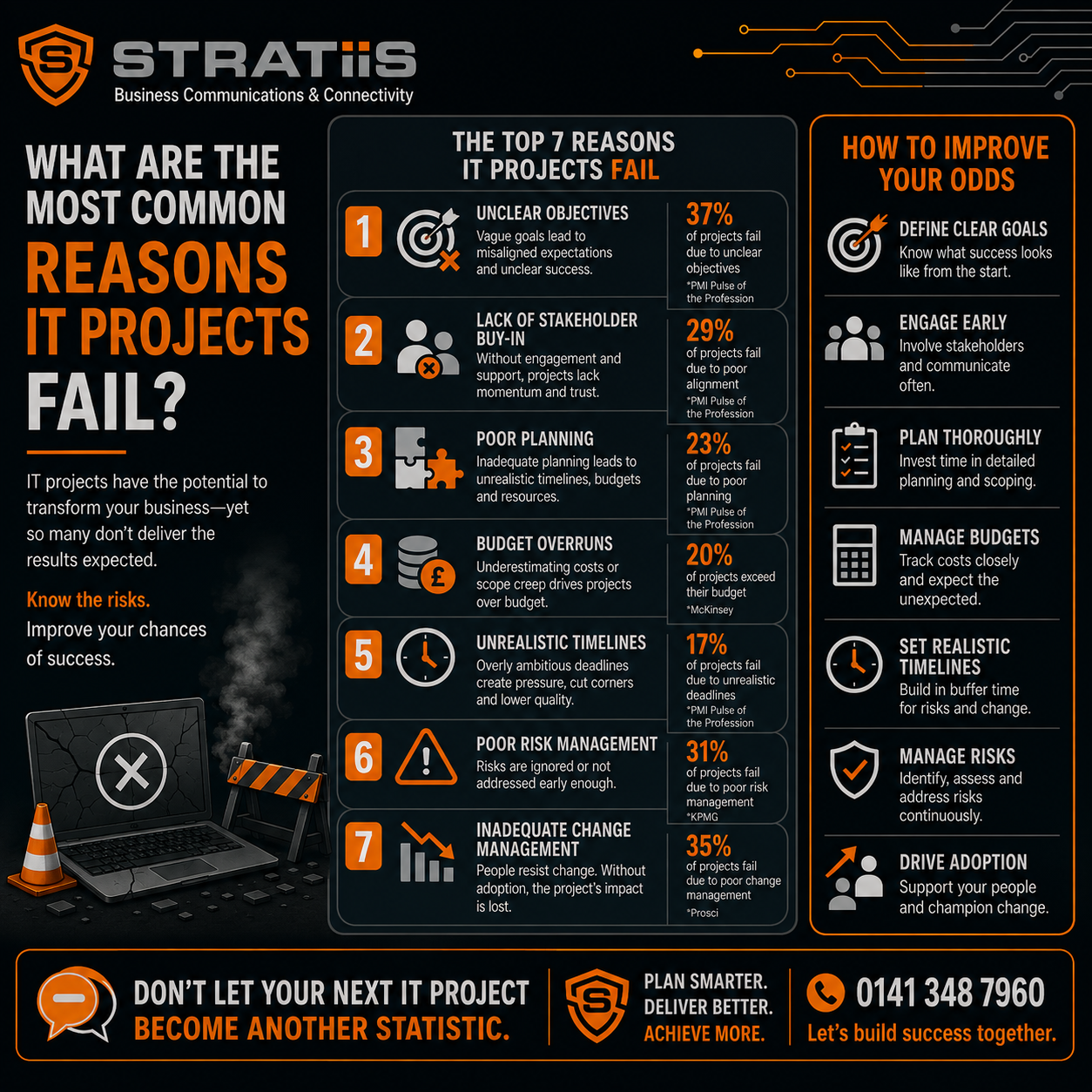
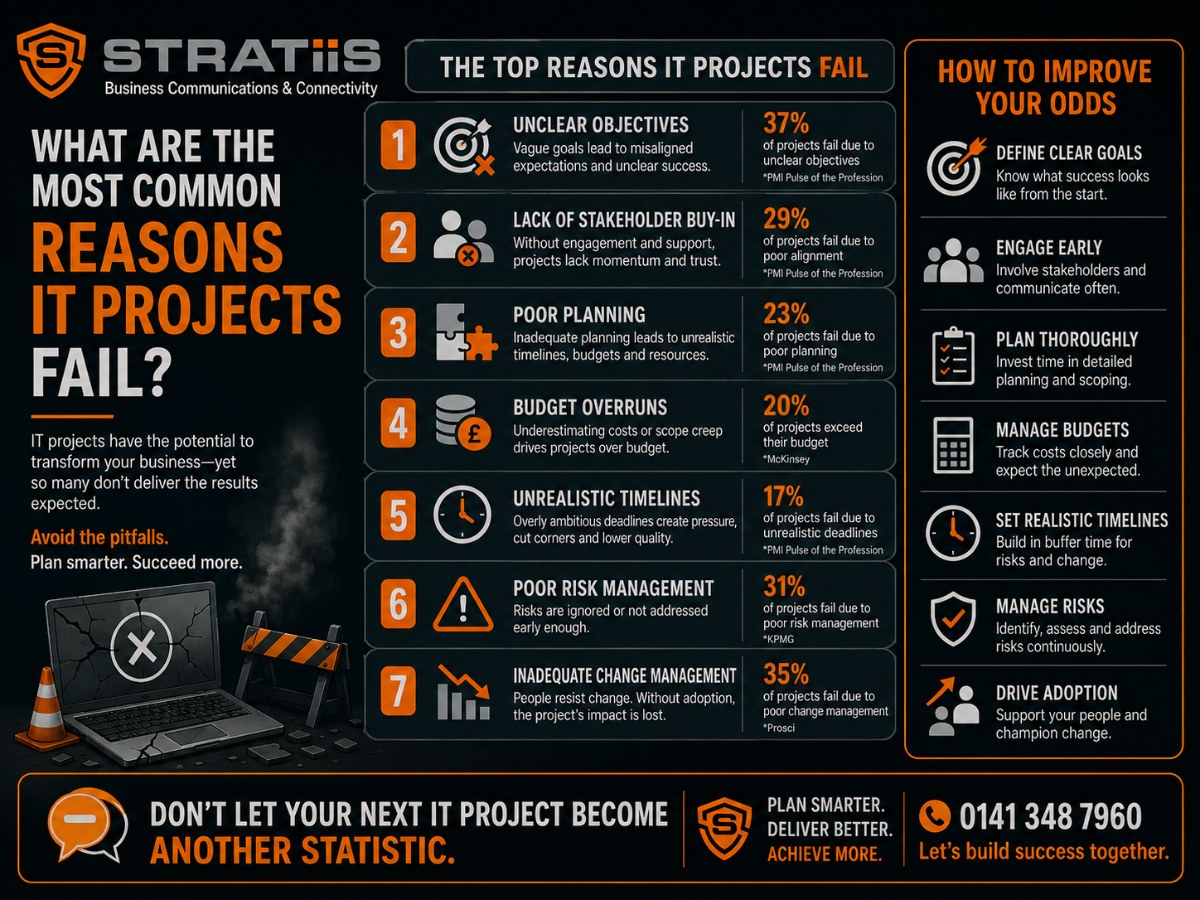
IT projects usually fail because the business problem, scope, ownership and change process were not controlled closely enough. The technology can work exactly as designed while the project still runs late, exceeds its budget or fails to improve how the organisation operates.
Why do IT projects fail?
The most common causes are unclear objectives, weak sponsorship, incomplete requirements, uncontrolled scope, unrealistic budgets or deadlines, poor supplier coordination, underestimated data, inadequate testing and low user adoption. Successful projects define the business outcome first, assign clear ownership and manage delivery, security and change from discovery through post-launch support.
In this guide
DEFINE SUCCESS PROPERLY
What Does It Mean When an IT Project Fails?
An IT project does not need to collapse or be abandoned to have failed. It can go live on time and still be unsuccessful if employees reject it, important processes do not work, security weakens or the promised business improvement never appears.
Delivery failure
The project misses deadlines, exceeds the approved budget, delivers only part of the scope or creates excessive disruption.
Outcome failure
The system launches, but people continue using old tools, service does not improve and the organisation cannot demonstrate value.
Success should therefore combine delivery measures with business outcomes. A document system is successful when authorised users can find, manage and protect information more effectively, not simply when the software has been installed.
CAUSES 1–4: THE FOUNDATION
Projects Fail When the Problem, Scope and Requirements Are Unclear
Many troubled projects begin with a product decision rather than a clearly stated business problem. “We need SharePoint” or “we need AI” describes a possible solution. It does not explain which process is failing, who is affected or how improvement will be measured.
The business problem is unclear
Without a defined problem, teams cannot judge whether the proposed technology is appropriate. Record the current difficulty, its impact, the people affected and the result the organisation needs.
The scope is vague
Management may expect migration, training, devices, integrations and post-launch support while the supplier has priced only configuration. Define deliverables, exclusions, responsibilities and acceptance criteria in writing.
Requirements are incomplete
High-level wishes leave gaps that different people fill with different assumptions. Use interviews, workshops, process mapping, data assessment and representative users to describe real tasks and exceptions.
The programme is too ambitious
Changing identity, devices, files, telephony, security, reporting and processes in one launch creates too many dependencies. Phased delivery lets the organisation test, learn and control risk.
A Technology Roadmap can place related projects in a sensible order, while IT Project Management provides the controls needed to define and protect the scope.
CAUSES 5–8: PEOPLE AND OWNERSHIP
Projects Struggle Without Active Ownership and User Involvement
Technology changes how people work. A technically sound design can still fail when decisions stall, departments disagree or users discover too late that the new process does not reflect reality.
No one owns the outcome
A senior sponsor must support the business case, approve major decisions, remove internal blockers and resolve competing priorities. The sponsor can delegate tasks but must remain visibly involved.
Employees are not involved
Front-line users often know the exceptions, workarounds, hidden data and customer effects that managers overlook. Include representative users in discovery, design, testing and review.
Communication is poor
Silence creates uncertainty and resistance. Explain what is changing, why it matters, when it will happen, how roles are affected and where people can get help.
The organisation is not ready
A project is at risk when managers cannot agree, departments will not standardise, decisions take too long or employees have no time to contribute. A smaller pilot may be the right first step.
Change readiness should be assessed before a major commitment. Confirm that the sponsor is active, managers support the outcome, key users are available and the organisation is willing to retire outdated processes.
CAUSES 9–12: DELIVERY CONTROL
Weak Planning Turns Manageable Problems Into Project Failure
The budget is unrealistic
The software price is only one component. Discovery, project management, hardware, migration, integration, security, testing, training, internal time, dual running and ongoing support may all be required.
The deadline is unrealistic
Rushed dates reduce discovery, testing, documentation and training. Build the plan around decisions, procurement, supplier lead times, data preparation and contingency.
Project management is weak
A practical structure needs named owners, milestones, risks, decisions, changes, budget tracking, testing and escalation. The amount of documentation should match the complexity and risk.
Suppliers are not coordinated
Each supplier may complete its task correctly while the complete service still fails. Record dependencies, delivery dates, contacts and escalation routes, with one party coordinating the whole technical plan.
| Control | Question leaders should ask | Evidence to expect |
|---|---|---|
| Scope | What is included, excluded and assumed? | Agreed scope, responsibilities and acceptance criteria. |
| Governance | Who decides, approves and escalates? | Sponsor, project manager, decision log and escalation route. |
| Risk | What could disrupt cost, service or security? | Owned risk register with actions and review dates. |
| Change | How will new requirements be controlled? | Impact assessment and approval before work begins. |
| Readiness | What must be true before launch? | Testing, training, support and rollback criteria. |
Stratiis supports discovery, planning and delivery through Projects and Digital Transformation and IT Project Management.
CAUSES 13–15: TECHNICAL READINESS
Data, Cybersecurity and Testing Cannot Be Left Until the End
Existing data is underestimated
Duplicates, old records, missing fields, unsupported formats, unclear ownership and incorrect permissions can delay migration. Decide what moves, what is deleted, who owns it and how accuracy will be approved.
Cybersecurity is considered too late
Identity, administrator access, MFA, devices, sharing, encryption, backup, monitoring and supplier access belong in the design. Retrofitting them after launch costs more and may force redesign.
Testing is inadequate
Testing must cover data, permissions, integrations, performance, backup, recovery and real business tasks. Representative users should confirm the solution supports the work they actually perform.
Relevant services include Cybersecurity, Infrastructure Upgrades and New System Deployments.
CAUSES 16–20: ADOPTION AND VALUE
Going Live Is the Beginning of Adoption, Not the End of the Project
Training is an afterthought
Generic demonstrations rarely prepare people for their roles. Training should use real tasks, arrive close to launch and be reinforced with short guides and follow-up sessions.
Old systems remain available
Indefinite dual running spreads information across two environments and undermines adoption. Set dates for read-only access, final retention, withdrawal and contract cancellation.
Post-launch support is missing
Early issues with permissions, devices, data and unusual scenarios can quickly damage confidence. Plan extra support, issue reviews, supplier escalation and follow-up training until the service is stable.
Success is not measured
Agree measures before delivery, such as time saved, fewer errors, reduced downtime, faster approvals, stronger security and use of approved systems. Compare the position before and after launch.
Lessons are not captured
A short post-project review should record what worked, what changed, which outcomes were achieved and what the organisation will do differently next time.
Users and Adoption and Support and Change help turn a technical launch into a sustainable operational change.
ACT BEFORE THE PROJECT SLIPS FURTHER
What Are the Early Warning Signs That an IT Project Is Failing?
One warning sign does not prove failure. Several appearing together should trigger a formal review.
Important questions remain open and suppliers wait for direction.
New requirements appear without cost or schedule approval.
Risks and actions are discussed but assigned to no one.
Employees know little about the project and testing excludes real roles.
Dependencies and responsibilities are interpreted differently.
Cleansing, permissions and migration effort were not assessed early.
The launch date stays fixed while readiness work is removed.
No practical plan exists for adoption or early-life support.
Forecasts change but management cannot see the drivers.
The team can explain the technology but not the business outcome.
PAUSE, ASSESS AND RESET
Can a Failing IT Project Be Recovered?
Yes. Recovery normally starts by pausing long enough to establish the facts. Continuing the same approach can consume more budget while reducing the options available.
Return to the outcome
Confirm the original business problem and decide whether it still justifies the project.
Assess the current position
Review completed work, budget, risks, dependencies, decisions and contractual commitments.
Reduce uncertainty
Clarify ownership, narrow the first phase and agree the minimum safe and useful result.
Rebuild the plan
Set realistic milestones for data, security, testing, communication, training and support.
Make a clear decision
Continue, re-scope, replace a supplier or stop work that no longer supports the outcome.
Stopping part of a project can be the responsible decision when the original assumptions no longer hold. The aim is to protect the organisation and recover useful value, not simply to preserve the original plan.
BEFORE DELIVERY BEGINS
IT Project Success Checklist
The business need and measures of success are agreed.
Deliverables, responsibilities and assumptions are documented.
An active owner can approve and remove blockers.
Real processes, exceptions and representative roles are covered.
Quality, ownership, migration and dependencies are understood.
One-off, recurring, internal and contingency costs are visible.
Access, devices, backup, monitoring and response are designed in.
Scenarios, owners, defects and launch criteria are written down.
People know why the change matters and how to work differently.
Early-life support and the old-system exit plan have dates and owners.
Baseline and post-launch results will be compared.
Lessons and remaining actions will be captured after delivery.
FREQUENTLY ASKED QUESTIONS
Questions About IT Project Failure
Is technology usually the main cause of failure?
Not usually. Governance, decisions, data, communication and adoption often create more risk than the technology itself.
Who should own an IT project?
A senior sponsor should own the business outcome. A project manager coordinates delivery, while the sponsor approves major decisions and removes blockers.
Why do migrations take longer than expected?
Existing data often contains duplicates, errors, outdated information, unclear ownership and permissions that must be resolved before a safe move.
Can an unrealistic deadline cause failure?
Yes. It can lead to rushed requirements, reduced testing, poor training and greater disruption during launch.
Should cybersecurity be included from the start?
Yes. Identity, access, data protection, backup, devices and monitoring should shape the design and acceptance criteria.
Why do employees resist new systems?
Resistance often reflects unclear reasons, missing involvement, unsuitable processes or inadequate training and support.
Should old systems be removed?
Normally, yes. A controlled transition may require short dual running, but indefinite access creates duplication, confusion and security risk.
How do you measure success?
Measure the result against agreed outcomes such as time saved, fewer errors, better service, stronger security, lower downtime and user adoption.
Planning or Recovering an IT Project?
Stratiis can help define the outcome, assess risks, coordinate suppliers and create a practical delivery plan for organisations across Scotland.