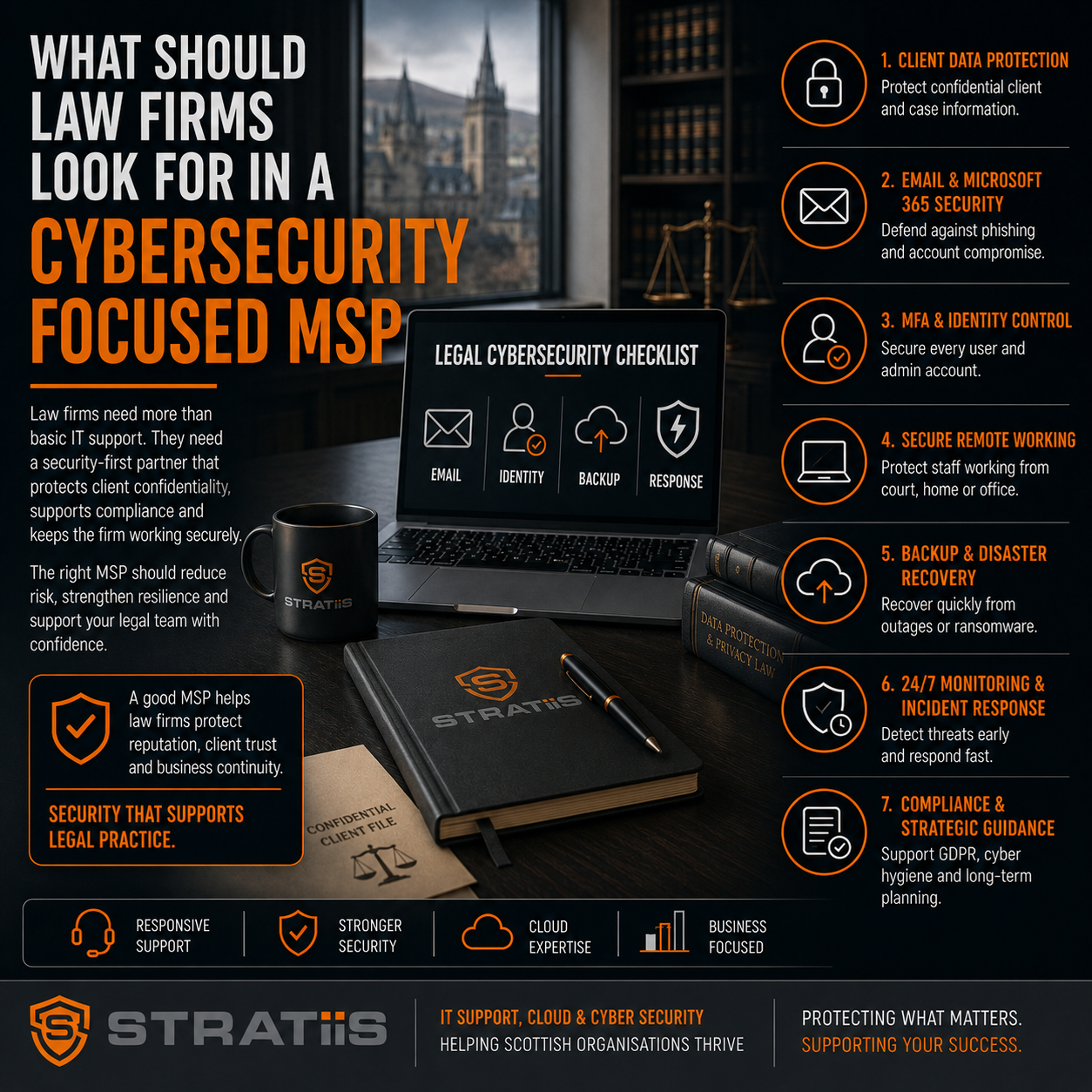
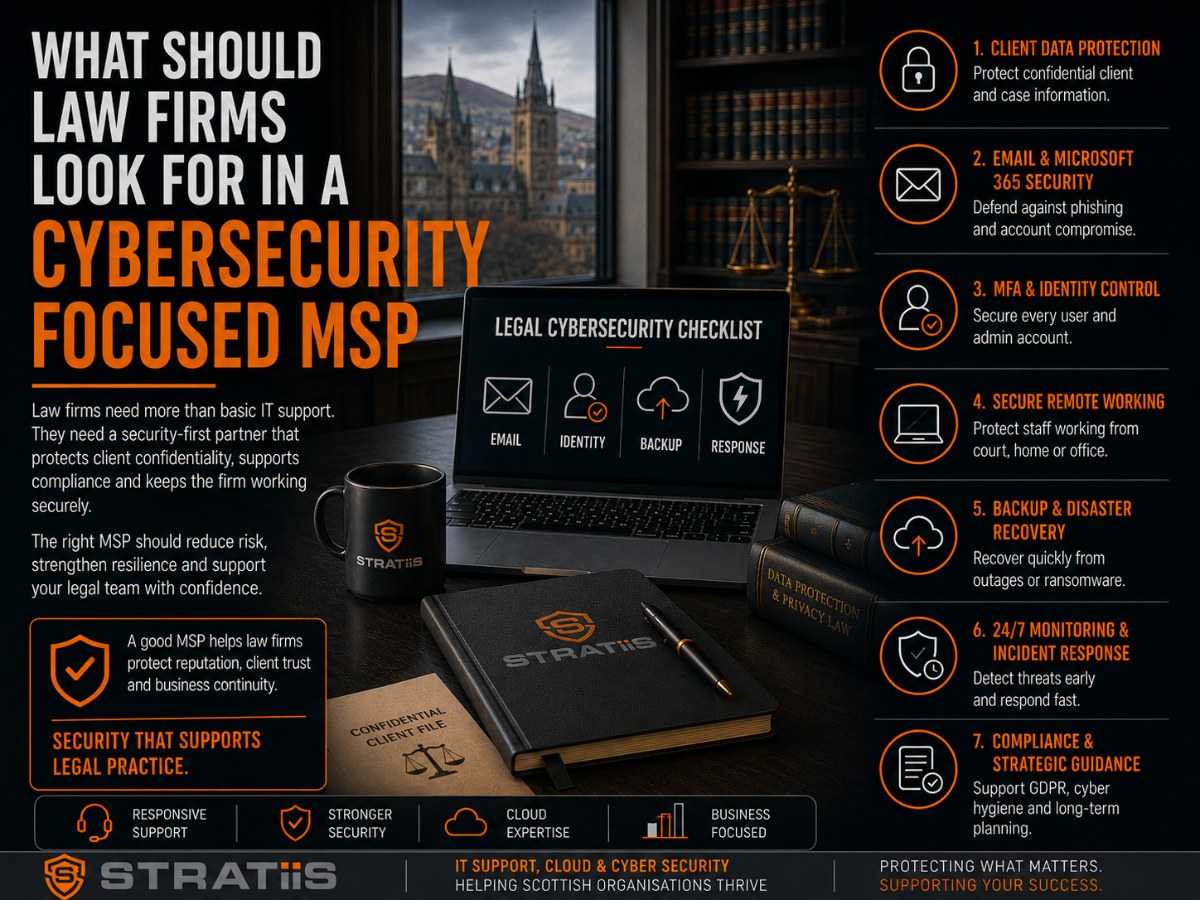
For law firms, cybersecurity is not simply an IT concern.
It is a client trust issue, a compliance issue, a business continuity issue, and ultimately a reputation issue.
Law firms hold highly sensitive information including:
- Client records
- Financial information
- Commercial contracts
- Litigation documents
- Intellectual property
- Employment records
- Merger and acquisition data
A single cybersecurity incident can result in financial loss, operational disruption, regulatory scrutiny, and significant reputational damage.
This is why many legal practices are moving away from traditional IT support providers and looking for cybersecurity-focused Managed Service Providers (MSPs).
But what exactly should a law firm look for when selecting an MSP?
In this guide, we'll explain the key capabilities legal practices should prioritise and the questions every law firm should ask before choosing an IT partner.
Why Law Firms Are a Prime Target for Cybercriminals
Cybercriminals are attracted to law firms because they often hold highly valuable and confidential information.
Examples include:
- Corporate transactions
- Property transactions
- Client financial information
- Litigation strategies
- Personal data
- Commercial agreements
In many cases, attackers view law firms as a gateway to larger organisations and high-value clients.
Common threats include:
- Ransomware attacks
- Business email compromise
- Phishing attacks
- Data theft
- Account compromise
- Supply chain attacks
As a result, cybersecurity should be considered a core requirement when evaluating IT providers.
The 7 Qualities Every Cybersecurity-Focused MSP Should Have
1. Cybersecurity Must Be Built Into Every Service
Many MSPs offer cybersecurity as an optional add-on.
For law firms, that approach creates unnecessary risk.
Security should be embedded into:
- Device management
- Email systems
- User access controls
- Microsoft 365 environments
- Backup solutions
- Remote working platforms
Ask potential providers:
"Is cybersecurity included by default or sold separately?"
The answer will tell you a great deal about their approach.
2. Strong Microsoft 365 Security Expertise
Most law firms rely heavily on Microsoft 365.
However, many practices only use a fraction of the available security capabilities.
A cybersecurity-focused MSP should understand:
- Multi-Factor Authentication (MFA)
- Conditional Access
- Microsoft Defender
- Microsoft Intune
- Data Loss Prevention (DLP)
- Secure document sharing
- Microsoft Purview capabilities
Microsoft 365 security configuration is often one of the most effective ways to reduce cyber risk.
3. Experience Supporting Legal Practices
Law firms operate differently from many other organisations.
A provider should understand:
- Confidentiality requirements
- Client expectations
- Compliance obligations
- Time-sensitive workflows
- Document management systems
- Legal software platforms
An MSP that understands legal operations can often provide better recommendations and support.
Questions to Ask
- How many law firms do you support?
- What legal software platforms are you familiar with?
- How do you approach confidentiality and data protection?
Industry knowledge matters.
4. Cyber Essentials and Compliance Expertise
Many legal practices are strengthening cybersecurity governance and compliance.
A suitable MSP should be able to support:
- Cyber Essentials
- Cyber Essentials Plus
- Data protection requirements
- Information governance
- Risk management programmes
Even where certification is not mandatory, recognised cybersecurity frameworks provide valuable assurance.
What Good Looks Like
A provider should help you:
- Assess security gaps
- Prioritise improvements
- Implement controls
- Maintain compliance readiness
5. Advanced Backup and Disaster Recovery Planning
Backups are critical for every organisation.
For law firms, they are essential.
Ask potential providers:
- How often are backups tested?
- How quickly could systems be restored?
- Are backups protected against ransomware?
- What happens during a major outage?
A provider should have clear and documented answers.
Key Capabilities
✓ Automated backups
✓ Recovery testing
✓ Business continuity planning
✓ Disaster recovery procedures
6. Security Awareness Training for Staff
Technology alone cannot prevent every cyber incident.
Employees remain one of the most important security controls.
A cybersecurity-focused MSP should provide:
- Security awareness training
- Phishing simulations
- Cybersecurity guidance
- User education
Legal professionals are frequently targeted because of the information they handle.
Ongoing awareness training helps reduce this risk.
7. Strategic Cybersecurity Guidance
The best MSPs do more than solve technical issues.
They help law firms plan for the future.
This often includes:
- Cybersecurity roadmaps
- Risk assessments
- Technology planning
- Budget forecasting
- Compliance reviews
This is where Strategic vCIO services become particularly valuable.
Questions to Ask
- Will we receive regular security reviews?
- Do you provide cybersecurity reporting?
- How do you help firms plan future improvements?
Technology should support business objectives, not simply maintain existing systems.
What Security Controls Should Every Law Firm Have?
Regardless of size, most legal practices should have:
Identity Protection
✓ Multi-Factor Authentication
✓ Strong password policies
✓ Role-based access controls
Device Security
✓ Managed devices
✓ Endpoint protection
✓ Encryption
✓ Security updates
Email Security
✓ Anti-phishing protection
✓ Link protection
✓ Threat detection
Data Protection
✓ Secure document sharing
✓ Backup systems
✓ Access controls
Governance
✓ Incident response plans
✓ Cyber Essentials readiness
✓ Risk reviews
These controls form the foundation of a strong cybersecurity programme.
Common Mistakes Law Firms Make When Choosing an MSP
Choosing Based on Price Alone
The cheapest provider rarely delivers the strongest security outcomes.
Focusing Only on Helpdesk Support
Technical support is important, but cybersecurity expertise is equally critical.
Ignoring Strategic Planning
A reactive approach often increases long-term risk.
Assuming Compliance Equals Security
Compliance frameworks help, but they do not replace good cybersecurity practices.
Not Reviewing Security Reporting
Leadership teams need visibility into risk and improvement activities.
A Growing Scottish Law Firm
Their Challenges
- Increasing cybersecurity concerns
- Growing Microsoft 365 usage
- Remote and hybrid working
- Client expectations around data protection
Cybersecurity Improvements Made
The firm implemented:
- Multi-Factor Authentication
- Datto EDR and SOC Solution
- Device management
- Backup testing
- Security awareness training
- Cyber Essentials preparation
Their Outcomes
Benefits included:
- Reduced cyber risk
- Improved client confidence
- Better security visibility
- Enhanced business continuity
- Stronger governance
The focus was not simply technology.
It was reducing business risk.
Questions Every Law Firm Should Ask a Prospective MSP
Before making a decision, ask:
Security
How do you protect our data?
Compliance
How do you help firms maintain compliance readiness?
Recovery
How quickly can systems be restored following an incident?
Strategy
Do you provide cybersecurity roadmaps and planning?
Industry Experience
What experience do you have supporting legal practices?
The quality of these answers often reveals the maturity of the provider.
Law Firm Cybersecurity Checklist
A cybersecurity-focused MSP should not only protect your systems but also help you understand where your firm may still be exposed. Use this quick self-assessment to review your current position:
- Is multi-factor authentication enabled for all users?
MFA should protect email accounts, Microsoft 365, remote access, case management systems and other sensitive applications. - Are your backups tested regularly?
Having backups is not enough. Your provider should regularly test that files, systems and Microsoft 365 data can be restored successfully. - Do you receive regular cybersecurity reporting?
Your MSP should provide clear reports covering security alerts, patching, vulnerabilities, backup status, user risks and recommended actions. - Has your firm completed a cybersecurity risk assessment within the last 12 months?
A regular risk assessment can identify weaknesses across your technology, people, processes, suppliers and regulatory responsibilities. - Do you have a documented incident response plan?
Your team should know exactly what to do if the firm experiences a cyberattack, data breach, ransomware incident or loss of access to critical systems.
If you answered no or not sure to any of these questions, your law firm may have cybersecurity gaps that need to be addressed.
Stratiis helps law firms assess their current cybersecurity position, identify areas of risk and put practical protections in place. Get in touch with Stratiis to arrange a conversation about your firm’s cybersecurity and IT support requirements.
Why Law Firms Across Scotland Choose Stratiis
At Stratiis, we help legal practices throughout Glasgow, Edinburgh, Lanarkshire, Ayrshire, Lothian, Dumfries & Galloway, and Perthshire strengthen cybersecurity while improving productivity and resilience.
Our cybersecurity-first approach includes:
- Managed IT support
- Microsoft 365 security expertise
- Cyber Essentials readiness
- Device management
- Backup and disaster recovery
- Security awareness training
- Strategic vCIO services
- Technology roadmaps
We help law firms protect client information, reduce cyber risk, and make informed technology decisions.
Final Thoughts
Law firms face unique cybersecurity challenges.
The right MSP should provide far more than helpdesk support.
They should act as a strategic cybersecurity partner that helps your practice:
- Protect client information
- Reduce cyber risk
- Strengthen compliance readiness
- Improve business continuity
- Plan for the future
When evaluating providers, focus on cybersecurity expertise, Microsoft knowledge, legal-sector experience, strategic guidance, and proven processes.
The best MSPs do not simply respond to problems.
They help prevent them.
Related Articles
How Much Cybersecurity Protection Does a 50-Person Business Actually Need?
What Cyber Essentials Requirements Apply to Scottish SMEs and Charities in 2026?
What Does a Strategic vCIO Do for a Growing Business and Is It Worth It?
Microsoft 365 Business Premium vs E5: Which Is Best for Scottish Businesses?