Cybersecurity can be confusing for growing businesses.
One IT provider recommends advanced security tools. Another talks about Cyber Essentials. A software vendor suggests additional security licences. Meanwhile, business owners are left wondering:
"How much cybersecurity protection do we actually need?"
For most businesses with around 50 employees, the answer is not "everything available."
However, it is also far more than basic antivirus software.
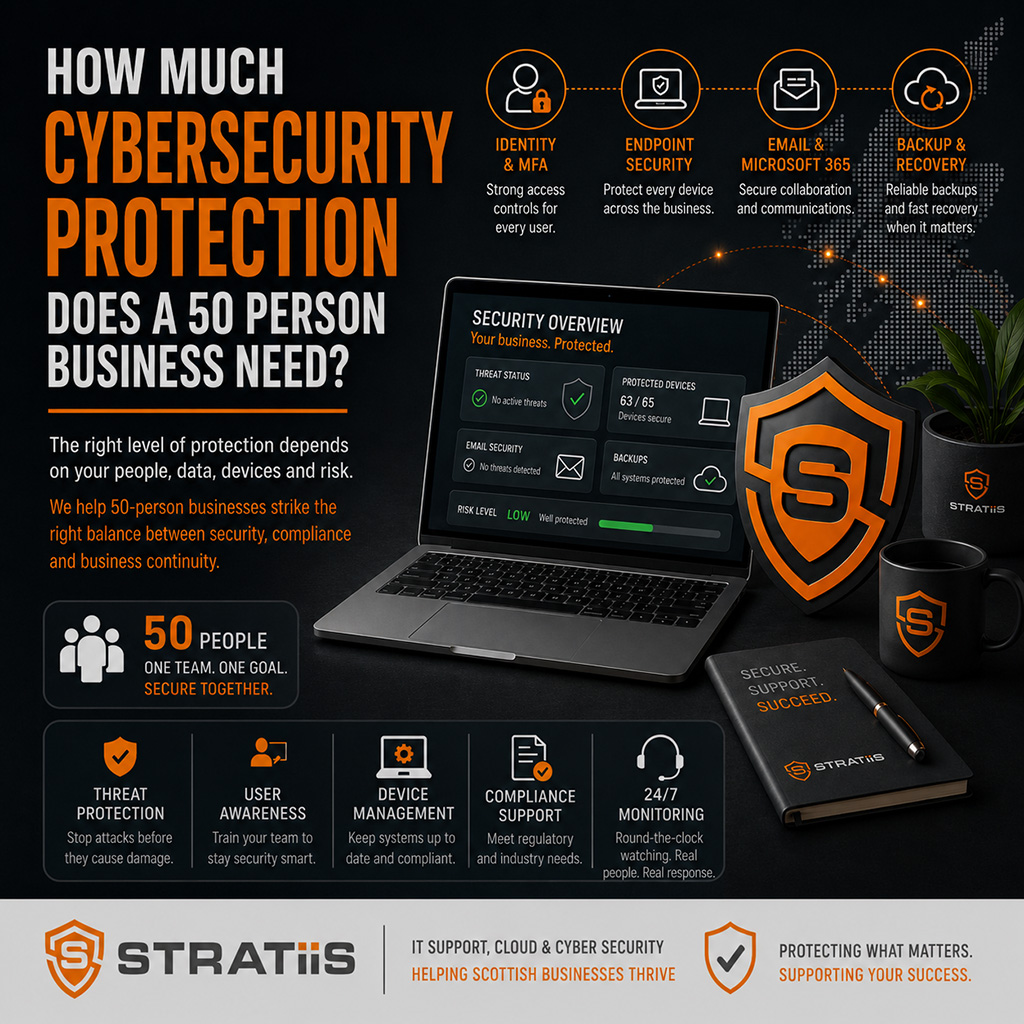
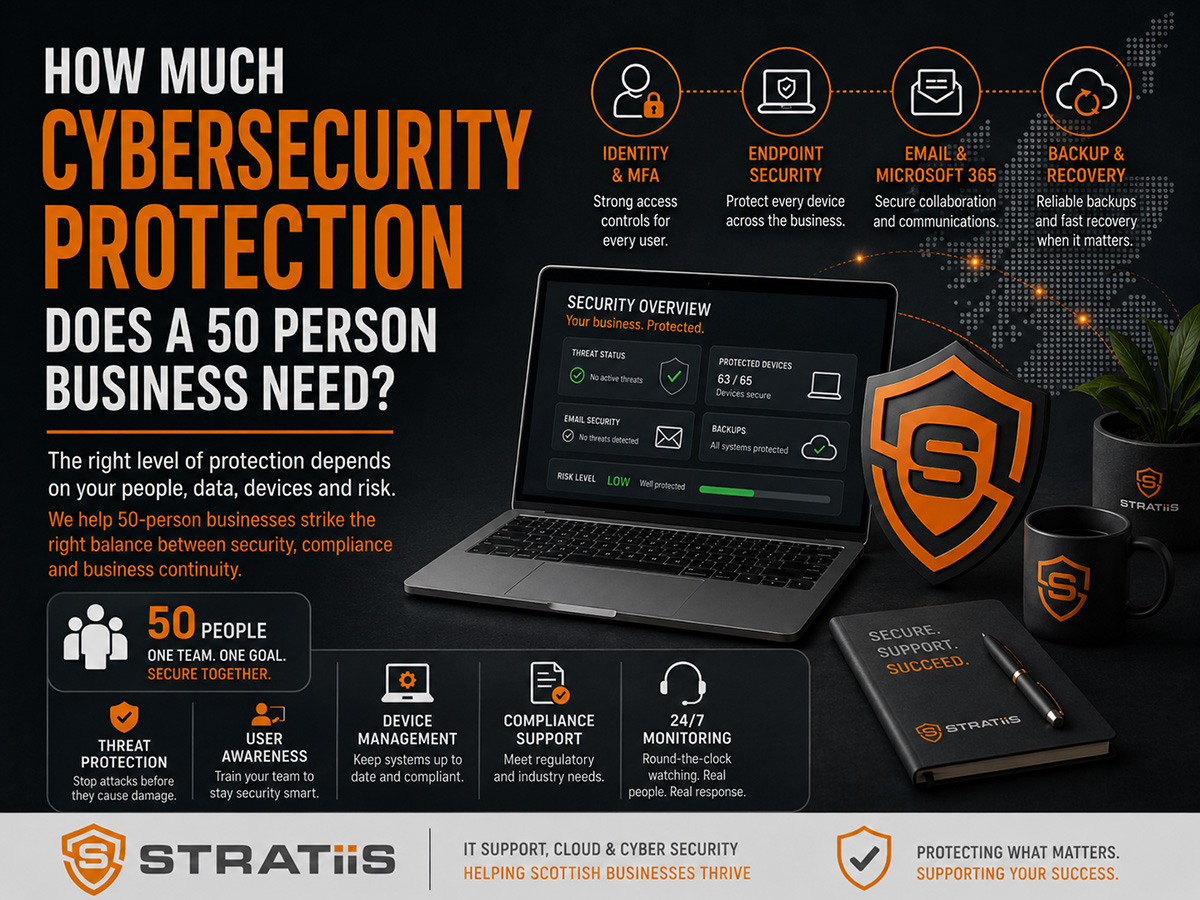
A typical 50-person business should expect to invest in a layered cybersecurity strategy that includes:
- Multi-Factor Authentication (MFA)
- Endpoint protection
- Email security
- Security monitoring
- Backup and disaster recovery
- User awareness training
- Device management
- Cyber Essentials controls
The exact level of protection depends on the industry, regulatory requirements, risk profile, and sensitivity of the data being handled.
This guide explains what cybersecurity a 50-person business actually needs and how to avoid both under-investing and overspending.
Why 50-Person Businesses Are Frequently Targeted
Many business owners assume cybercriminals only target large enterprises.
The reality is very different.
Organisations with 50 employees often present an attractive target because:
- They hold valuable business data
- They rely heavily on technology
- They may have limited internal IT resources
- Security controls are often inconsistent
- Cybersecurity expertise may be limited
Common targets include:
- Charities
- Accountancy firms
- Law firms
- Manufacturers
- Engineering companies
- Construction businesses
- Housing associations
Cybercriminals often view mid-sized organisations as easier targets than large enterprises.
The 7 Essential Layers of Cybersecurity
Rather than relying on a single solution, modern cybersecurity should be built in layers.
Think of cybersecurity like protecting a building.
You don't rely solely on a lock.
You use:
- Doors
- Alarms
- CCTV
- Access controls
- Security procedures
The same principle applies to technology.
Layer 1: Multi-Factor Authentication (MFA)
If your organisation only implements one cybersecurity improvement this year, make it MFA.
MFA requires users to provide an additional verification factor beyond a password.
Examples include:
- Authentication apps
- Security tokens
- Biometric verification
MFA significantly reduces the risk of account compromise.
Every Microsoft 365 account should have MFA enabled.
Layer 2: Endpoint Protection
Traditional antivirus software is no longer sufficient on its own.
Modern endpoint protection helps identify:
- Malware
- Ransomware
- Suspicious activity
- Zero-day threats
Businesses should deploy advanced endpoint protection across:
- Laptops
- Desktop computers
- Servers
- Mobile devices
Layer 3: Email Security
Email remains the most common attack vector.
Threats include:
- Phishing emails
- Business email compromise
- Malicious attachments
- Credential theft
Modern email security should include:
- Spam filtering
- Threat detection
- Link protection
- Attachment scanning
Layer 4: Device Management
Businesses often underestimate the importance of device management.
Every business-owned device should be:
- Monitored
- Updated
- Secured
- Managed remotely
Solutions such as Microsoft Intune help organisations maintain consistent security standards.
Layer 5: Backup and Disaster Recovery
Cybersecurity is not just about prevention.
It is also about recovery.
Businesses should maintain:
- Automated backups
- Cloud backups
- Recovery testing
- Business continuity plans
A backup that has never been tested should not be considered a backup.
Layer 6: Security Awareness Training
Employees remain one of the most important security controls.
Cybercriminals frequently target people rather than technology.
Training should cover:
- Phishing awareness
- Password security
- Social engineering
- Data protection
- Safe remote working
Regular awareness training reduces human risk.
Layer 7: Ongoing Monitoring and Response
Cybersecurity is not a one-time project.
Threats evolve constantly.
Businesses should have:
- Security monitoring
- Alert management
- Vulnerability assessments
- Incident response procedures
This ensures threats can be identified and addressed quickly.
What Does Good Cybersecurity Look Like for a 50-Person Business?
A well-protected organisation should typically have:
Identity Security
✓ Multi-Factor Authentication
✓ Strong password policies
✓ Conditional access controls
Device Security
✓ Managed devices
✓ Endpoint protection
✓ Security updates
✓ Encryption
Data Security
✓ Microsoft 365 protection
✓ Backup systems
✓ Data access controls
User Security
✓ Security awareness training
✓ Phishing simulations
✓ Acceptable use policies
Governance
✓ Cyber Essentials readiness
✓ Incident response plans
✓ Business continuity plans
✓ Risk reviews
This creates a practical and achievable security baseline.
How Cyber Essentials Fits Into the Picture
Cyber Essentials provides an excellent starting point for most organisations.
The framework focuses on:
- Firewalls
- Secure configuration
- User access control
- Malware protection
- Security update management
For many businesses with 50 employees, Cyber Essentials represents the minimum cybersecurity standard that should be achieved.
Many organisations then build additional controls on top of this foundation.
Common Cybersecurity Mistakes Made by Growing Businesses
Mistake 1: Relying on Antivirus Alone
Modern threats require multiple layers of protection.
Mistake 2: Ignoring User Training
Technology cannot prevent every human error.
Mistake 3: Weak Password Policies
Password-only security is no longer sufficient.
Mistake 4: Failing to Test Backups
Recovery capability is just as important as prevention.
Mistake 5: Treating Cybersecurity as an IT Issue
Cybersecurity should be viewed as a business risk, not simply a technical problem.
How Much Should a 50-Person Business Budget for Cybersecurity?
There is no universal figure because requirements vary significantly.
However, most organisations should expect cybersecurity investment to cover:
- Security licensing
- Device protection
- Monitoring
- Backup solutions
- User training
- Compliance requirements
- Strategic security planning
Businesses that view cybersecurity as a business continuity investment rather than an IT expense are generally better positioned to manage risk.
The cost of preventative security is often significantly lower than the cost of recovering from a cyber incident.
Here’s how Stratiis Helped A 50-Person Manufacturing Business
Challenges
- Multiple locations
- Increasing ransomware concerns
- Ageing devices
- Inconsistent security controls
Security Improvements
The organisation implemented:
- Multi-Factor Authentication
- Datto EDR and RocketCyber managed SOC
- Device management
- Backup improvements
- Security awareness training
- Cyber Essentials Plus certification
Outcomes
Benefits included:
- Reduced cyber risk
- Improved compliance posture
- Greater visibility of security issues
- Faster recovery capabilities
- Increased confidence from customers and partners
The most successful organisations focus on risk reduction rather than chasing every available security tool.
Why Businesses Across Scotland Choose Stratiis for Cybersecurity
At Stratiis, we help organisations across Glasgow, Edinburgh, Lanarkshire, Ayrshire, Lothian, Dumfries & Galloway, and Perthshire develop practical cybersecurity strategies.
Our cybersecurity-first approach combines:
- Managed IT support
- Microsoft security expertise
- Cyber Essentials guidance
- Endpoint protection
- Device management
- Backup and disaster recovery
- Security awareness training
- Strategic vCIO services
We support charities, nonprofits, law firms, manufacturers, engineering companies, housing associations, construction businesses, and other growing organisations throughout Scotland.
Final Thoughts
A 50-person business does not need enterprise-level cybersecurity spending.
However, it does need more than basic antivirus software.
The right approach is a layered cybersecurity strategy that combines:
- People
- Processes
- Technology
- Governance
For most organisations, this means implementing Multi-Factor Authentication, endpoint protection, device management, backup and recovery, user awareness training, and Cyber Essentials controls.
Cybersecurity is no longer optional.
The question is not whether your organisation will face cyber threats.
The question is whether your organisation is prepared when they arrive.