Cybersecurity is no longer just an IT issue. For Scottish SMEs, charities, housing associations, law firms, engineering companies, and manufacturers, it has become a business-critical requirement.
One of the most widely recognised cybersecurity certifications in the UK is Cyber Essentials. In many sectors, achieving Cyber Essentials is now a requirement for contracts, funding applications, supply chain partnerships, and cyber insurance policies.
For organisations across Scotland, understanding Cyber Essentials requirements is essential to protecting systems, reducing risk, and demonstrating a commitment to cybersecurity.
This guide explains what Cyber Essentials is, what the requirements are in 2026, who should consider certification, and how Scottish organisations can prepare successfully.
What Is Cyber Essentials?
Cyber Essentials is a UK government-backed cybersecurity certification scheme designed to help organisations protect themselves against common cyber threats.
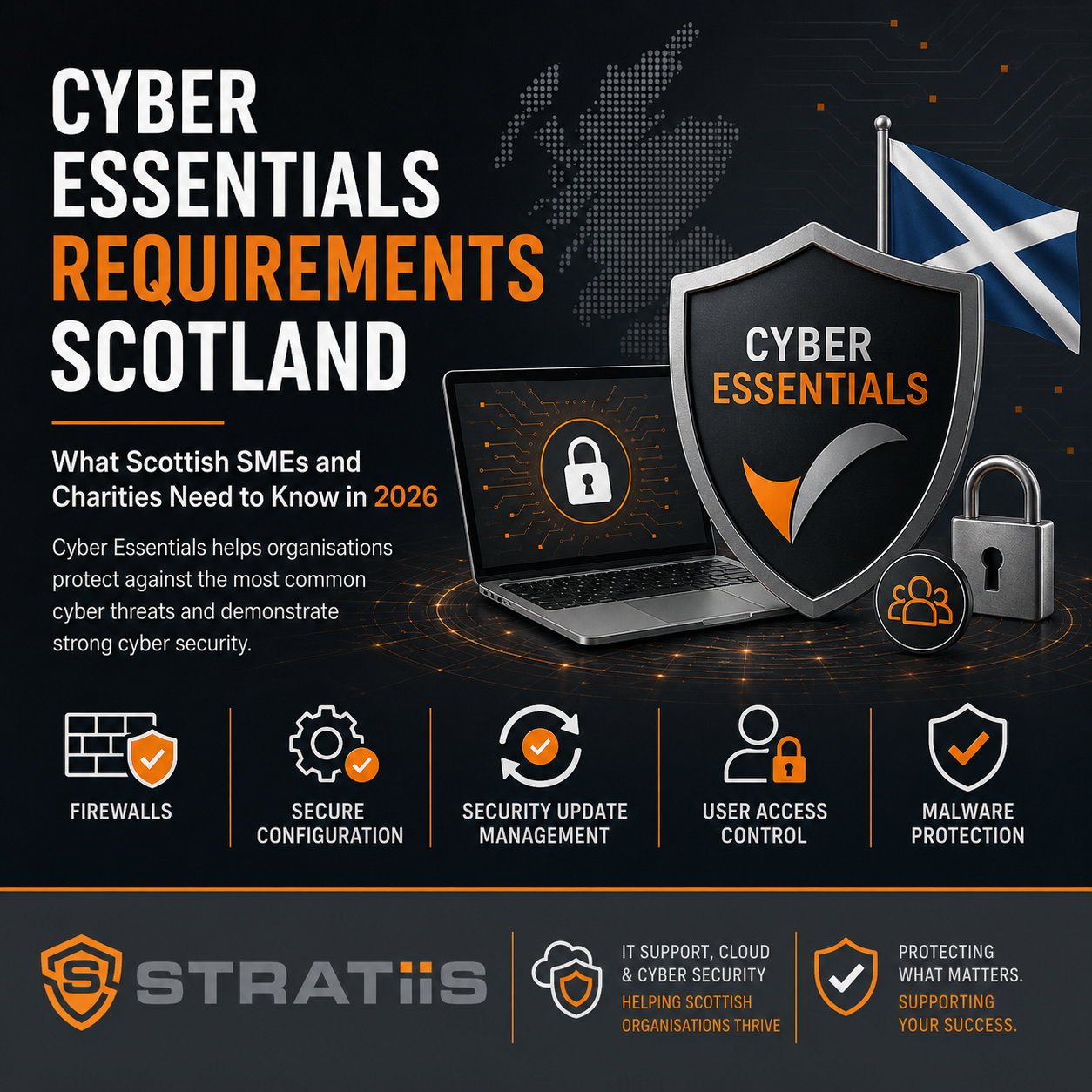
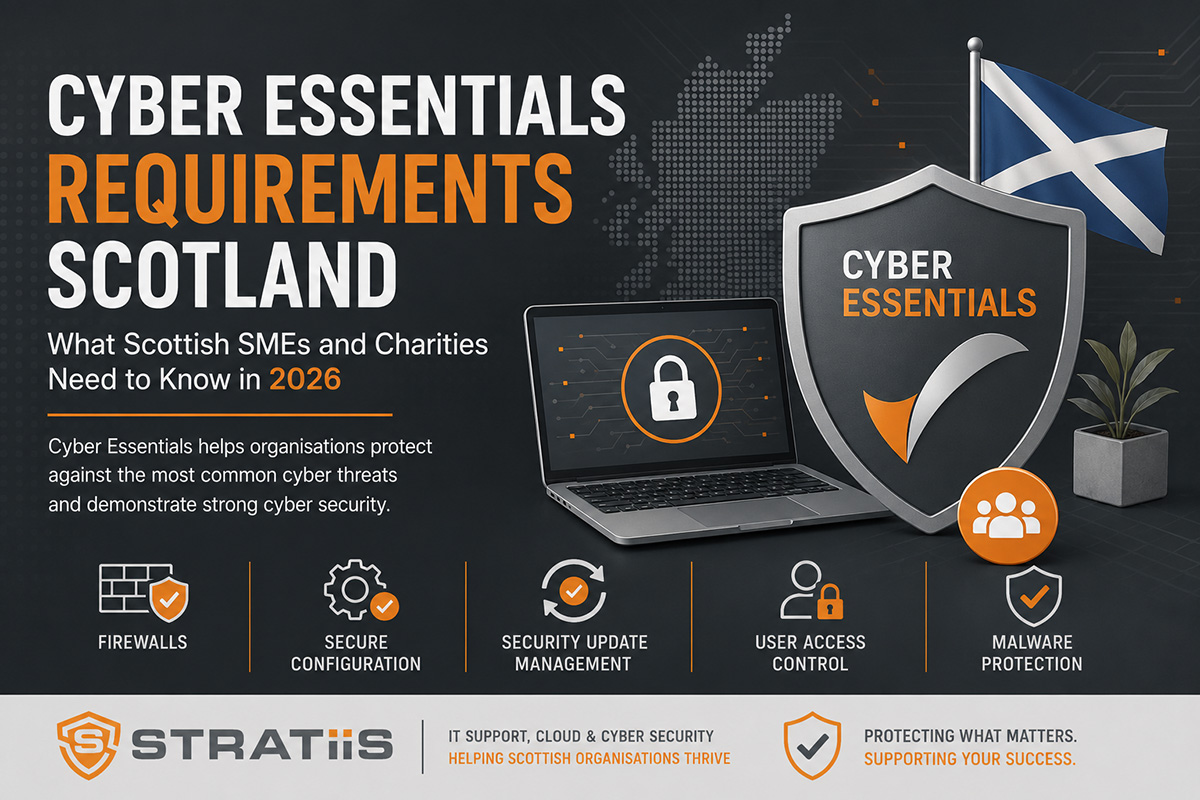
The certification focuses on five key technical controls that help defend against the majority of common cyber attacks.
These controls are designed to reduce the risk of:
- Phishing attacks
- Malware infections
- Ransomware
- Unauthorised access
- Credential theft
For many organisations, Cyber Essentials provides a practical baseline for improving cybersecurity without the complexity of larger compliance frameworks.
Why Is Cyber Essentials Important in 2026?
Cyber threats continue to evolve, but many successful attacks still exploit basic security weaknesses.
Examples include:
- Weak passwords
- Unpatched software
- Misconfigured systems
- Poor access controls
- Inadequate endpoint protection
Cyber Essentials helps organisations address these common vulnerabilities.
In addition, many organisations now require suppliers to hold Cyber Essentials certification before awarding contracts.
Common examples include:
- Public sector organisations
- Local authorities
- Housing associations
- Healthcare providers
- Education organisations
- Government-funded projects
Many charities are also finding that grant providers and trustees increasingly expect stronger cybersecurity governance.
Who Should Consider Cyber Essentials?
Cyber Essentials is particularly valuable for:
Charities and Nonprofits
Organisations handling donor, volunteer, employee, and service-user information.
Small and Medium-Sized Businesses
Businesses seeking a practical cybersecurity framework.
Housing Associations
Organisations managing sensitive tenant information.
Law Firms
Practices handling confidential client and case data.
Engineering and Manufacturing Companies
Businesses protecting intellectual property, designs, and operational systems.
Construction Companies
Organisations working with multiple contractors, suppliers, and remote teams.
In reality, almost any organisation using email, cloud services, or internet-connected devices can benefit from certification.
The Five Cyber Essentials Technical Controls
Cyber Essentials focuses on five core security requirements.
1. Firewalls and Internet Gateways
Organisations must have properly configured firewalls protecting devices and networks.
This includes:
- Business firewalls
- Router security
- Network access controls
- Secure configuration standards
The goal is to prevent unauthorised access from external networks.
2. Secure Configuration
Systems should not be left with default settings.
Examples include:
- Removing unused software
- Disabling unnecessary services
- Changing default passwords
- Applying secure settings
Secure configuration reduces the number of opportunities attackers can exploit.
3. User Access Control
Users should only have access to systems and data required for their role.
Requirements include:
- Individual user accounts
- Strong password policies
- Multi-factor authentication
- Restricted administrator privileges
This limits the impact of compromised accounts.
4. Malware Protection
Organisations must implement effective protection against malicious software.
Examples include:
- Endpoint protection
- Antivirus software
- Threat detection tools
- Security monitoring
Modern solutions often provide real-time protection against ransomware and advanced threats.
5. Security Update Management
Keeping systems updated remains one of the most important cybersecurity controls.
Requirements include:
- Applying security updates promptly
- Updating operating systems
- Updating applications
- Managing firmware updates
Many successful cyber attacks exploit vulnerabilities that already have available patches.
Cyber Essentials vs Cyber Essentials Plus
Many organisations ask whether Cyber Essentials alone is sufficient.
Cyber Essentials
- Self-assessment certification
- Independent review of responses
- Lower cost
- Demonstrates basic cybersecurity controls
Cyber Essentials Plus
- Independent technical verification
- Vulnerability testing
- Device assessments
- Additional assurance
Cyber Essentials Plus provides greater confidence to customers, partners, and stakeholders.
For organisations handling sensitive information, Cyber Essentials Plus is often recommended.
What Has Changed for Cyber Essentials in 2026?
While the core principles remain consistent, organisations should expect increasing focus on:
Multi-Factor Authentication (MFA)
MFA is now considered essential for protecting cloud services and business accounts.
Cloud Security
Organisations must ensure cloud services are configured securely and managed appropriately.
Remote and Hybrid Working
Security controls must apply regardless of where employees work.
Device Management
Businesses need better visibility and control over laptops, mobile devices, and remote endpoints.
Third-Party Risk
Organisations are expected to understand and manage supplier-related security risks.
These areas continue to receive greater scrutiny during certification preparation.
Common Reasons Organisations Fail Cyber Essentials
The most common issues include:
Missing Security Updates
Outdated systems remain one of the leading causes of failure.
Weak Password Policies
Shared accounts and weak credentials create significant risks.
Lack of Multi-Factor Authentication
MFA is increasingly expected across critical systems.
Excessive Administrator Access
Too many users having elevated privileges increases risk.
Poor Asset Visibility
Organisations often struggle to maintain accurate inventories of devices and software.
Fortunately, these issues can usually be addressed before certification.
Cyber Essentials vs Cyber Essentials Plus: What Is the Difference?
Cyber Essentials and Cyber Essentials Plus are based on the same five technical controls. The main difference is how compliance is checked. Cyber Essentials uses an independently reviewed self-assessment, while Cyber Essentials Plus adds a hands-on technical audit to confirm that the controls are working in practice.
| Comparison point | Cyber Essentials | Cyber Essentials Plus |
|---|---|---|
| What it is | The entry-level, government-backed cyber security certification. | The higher-assurance version of Cyber Essentials. |
| Security requirements | Covers the five Cyber Essentials controls: firewalls, secure configuration, security update management, user access control and malware protection. | Covers exactly the same five technical controls. It does not introduce a separate or more advanced set of requirements. |
| Assessment method | Your organisation completes an online self-assessment questionnaire. The answers are signed off by a board member or equivalent and reviewed by an independent assessor. | Your organisation completes the Cyber Essentials assessment and then undergoes an independent technical audit of the systems included within the certification scope. |
| Evidence required | Written information about your devices, users, software, cloud services, security settings and working arrangements. | Technical evidence gathered through vulnerability scans, device sampling and practical testing by an authorised assessor. |
| Technical testing | No hands-on testing of devices or networks is normally carried out. | Includes internal and external testing of networks, computers and other representative devices within scope. |
| Devices checked | You declare the devices and services covered by the assessment. | The assessor selects a representative sample that can include servers, desktop computers, laptops, thin clients, tablets and mobile phones. |
| Internet-facing systems | You confirm that internet-facing services, firewalls and routers are securely configured. | The assessor carries out external vulnerability scans against the organisation's public IP addresses and internet-facing services. |
| Security updates | You confirm that supported software is used and high-risk or critical security updates are installed within the required timescales. | The assessor checks sampled devices for missing security updates and vulnerabilities. Any remediation must apply across the relevant certification scope, not only to the sampled devices. |
| User testing | Your answers describe how user accounts, administrator privileges, authentication and malware protection are controlled. | The audit may include observing users perform everyday tasks to test whether protections prevent malicious files or unsafe activity. |
| Level of assurance | Provides independently verified confirmation that the organisation states it has implemented the required controls. | Provides stronger assurance because an independent assessor has tested whether those controls are operating effectively. |
| Time needed | Usually quicker, although the time required depends on how prepared the organisation is and whether remediation is needed. | Normally takes longer because audit planning, technical testing, evidence collection and possible remediation are required. |
| Cost in 2026 | Fixed assessment pricing ranges from £320 plus VAT for organisations with 0-9 employees to £600 plus VAT for organisations with 250 or more employees. | Individually quoted by a Certification Body. The price depends on the organisation's size, technical complexity, number of locations, devices and certification scope. |
| Certification sequence | Can be achieved as a standalone certification. | Requires Cyber Essentials first. The Plus audit must normally be completed within three months of the corresponding Cyber Essentials certification, although both stages can be arranged together. |
| Certificate validity | Valid for 12 months and must be renewed annually. | Valid for 12 months and must be renewed annually. |
| Best suited to | Scottish SMEs and charities looking to establish a recognised baseline, meet basic supplier requirements or demonstrate sensible cyber security controls. | Organisations handling sensitive information, working with public-sector bodies, bidding for higher-risk contracts or needing stronger independent assurance. |
| Typical procurement use | Frequently requested as a minimum supplier security standard. | More likely to be requested where the customer, funder or contracting authority requires independently tested security controls. |
| Does it guarantee security? | No. Certification reduces exposure to common internet-based attacks but does not prove that an organisation is immune from every cyber threat. | No. The technical audit provides greater confidence, but it is still a baseline certification rather than a guarantee against cyber incidents. |
How Scottish Organisations Can Prepare for Cyber Essentials
The most successful certifications follow a structured approach.
Step 1: Assess Your Current Environment
Review:
- Devices
- Users
- Software
- Cloud services
- Security controls
Step 2: Identify Gaps
Compare your environment against Cyber Essentials requirements.
Step 3: Implement Improvements
Address:
- Security updates
- MFA deployment
- Device security
- Access controls
- Endpoint protection
Step 4: Conduct Internal Reviews
Verify controls are operating as intended.
Step 5: Complete Certification
Submit your application and supporting information.
Stratiis Client Example: A Scottish Charity Preparing for Cyber Essentials
A charity with 35 employees using Microsoft 365 across multiple locations.
Challenges
- Inconsistent password practices
- Limited device management
- Growing cybersecurity concerns
- Trustee expectations around risk management
Solution
The organisation undertook a Cyber Essentials readiness programme covering:
- MFA implementation
- Security policy improvements
- Device management
- User access reviews
- Endpoint protection upgrades
Outcomes
Benefits included:
- Improved cybersecurity posture
- Reduced risk of ransomware
- Greater trustee confidence
- Stronger supplier credibility
- Better preparation for future compliance requirements
From start to finish, certification delivered to the client in 5 weeks.
Why Cyber Essentials Matters Beyond Certification
The goal should not simply be obtaining a certificate.
The real value lies in:
- Reducing cyber risk
- Protecting organisational data
- Supporting business continuity
- Improving stakeholder confidence
- Strengthening operational resilience
Certification demonstrates commitment, but the underlying controls provide the real protection.
Why Scottish Organisations Choose Stratiis for Cyber Essentials Support
At Stratiis, we help organisations across Glasgow, Edinburgh, Lanarkshire, Ayrshire, Lothian, Dumfries & Galloway, and Perthshire improve cybersecurity and prepare for certification.
Our approach combines:
- Cybersecurity-first IT support
- Cyber Essentials readiness assessments
- Microsoft 365 security expertise
- Device management
- Strategic cybersecurity planning
- Ongoing compliance guidance
We work with charities, nonprofits, housing associations, law firms, engineering firms, manufacturers, construction companies, and SMEs throughout Scotland.
Final Thoughts
Cyber Essentials remains one of the most practical and effective cybersecurity frameworks available to Scottish organisations.
For SMEs and charities, it provides a structured approach to improving security, reducing risk, and demonstrating good governance.
Whether certification is required by customers, funding bodies, insurers, or simply as part of good cybersecurity practice, the five Cyber Essentials controls provide a strong foundation for protecting your organisation in 2026 and beyond.
The question is no longer whether organisations should improve cybersecurity.
The question is whether they can afford not to.