
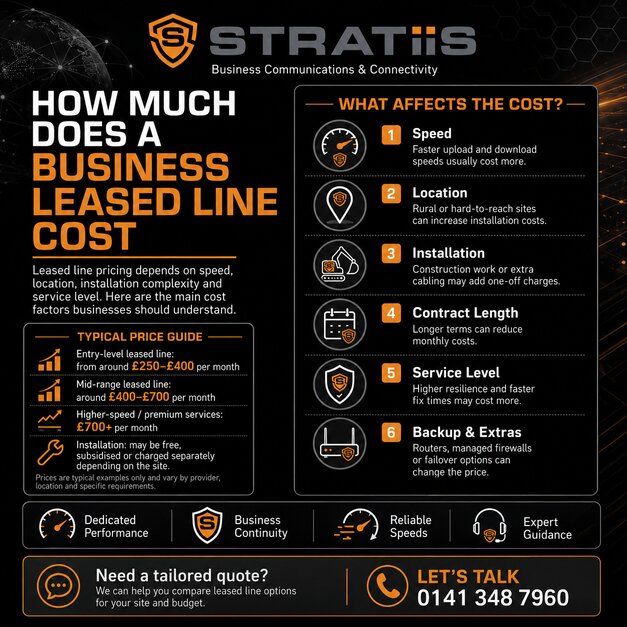
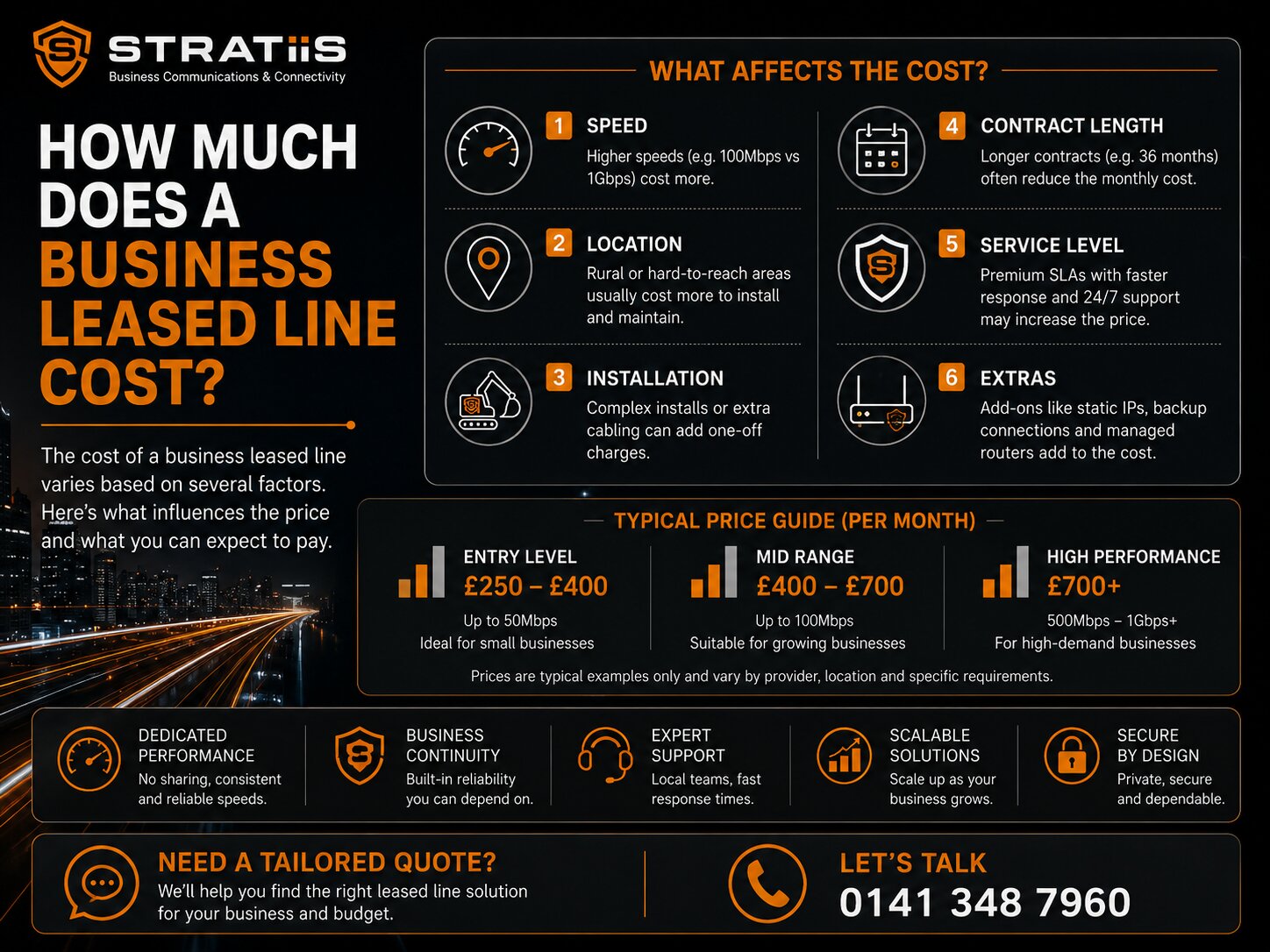
A business leased line in the UK typically costs between £150 and £700 per month, excluding VAT.
For early budgeting, you might expect to pay approximately:
- 100 Mbps: £150 to £300 per month
- 500 Mbps: £250 to £500 per month
- 1 Gbps: £300 to £700 per month
- 10 Gbps: £800 to £2,000 or more per month
These are indicative planning ranges rather than fixed prices.
Some leased lines are available below these figures in well-connected urban areas. Others can cost considerably more when the building is far from existing fibre infrastructure or requires significant construction work.
Current advertised starting prices illustrate the variation. Virgin Media O2 Business advertises Dedicated Internet Access from £185 per month, while BT advertises selected BTnet leased-line services from £245 per month. Both require a location-specific quotation, and the advertised starting price may apply only to particular speeds, contracts and network areas.
The true cost depends on:
- Your postcode
- Which carriers serve the building
- Distance from existing fibre
- Required speed
- Contract length
- Installation work
- Service-level agreement
- Router and firewall requirements
- Backup connectivity
- Construction charges
- Whether the quoted price can rise during the contract
A leased line should therefore never be priced using speed alone.
Two businesses ordering a 1 Gbps service can receive very different quotations because one building already has suitable fibre nearby and the other requires a new physical route.
What is a business leased line?
A leased line is a dedicated internet connection provided for one customer.
It may also be described as:
- Dedicated Internet Access
- DIA
- Ethernet Internet Access
- Fibre Ethernet
- Business Ethernet
- Dedicated fibre
- Internet leased line
Unlike standard broadband, a leased line normally provides:
- Dedicated capacity
- Equal upload and download speeds
- Guaranteed or committed bandwidth
- Business service levels
- Faster fault response
- Static IP addresses
- Network monitoring
- Greater control over resilience
Virgin Media O2 Business describes Dedicated Internet Access and leased lines as the same type of dedicated service, providing a connection that is not shared with other customers.
A 500 Mbps leased line would normally provide up to:
- 500 Mbps download
- 500 Mbps upload
This is different from many broadband services, which may advertise a high download speed but provide much lower upload capacity.
Why does leased-line pricing vary so much?
Leased-line pricing is based partly on the cost of delivering fibre to your exact building.
Providers need to understand:
- Which carrier networks are nearby
- Whether the building is already connected
- How far new fibre must travel
- Whether roads or pavements need to be excavated
- Whether landlord permission is required
- Whether wayleaves are needed
- Which exchange or point of presence will serve the site
- How much bandwidth is required
- What service level is included
This means there is no reliable national price for a specific speed.
A 1 Gbps leased line in a well-connected Glasgow city-centre building may cost less than a 100 Mbps service at a remote industrial site.
How much does a 100 Mbps leased line cost?
A 100 Mbps leased line may cost approximately £150 to £300 per month, excluding VAT.
Some highly competitive or well-connected locations may receive lower quotations.
More difficult sites may exceed £300 per month.
A 100 Mbps service may suit:
- Smaller offices
- Professional-services firms
- Organisations with moderate cloud use
- Businesses using Hosted Voice
- Smaller hybrid-working teams
- Sites without heavy video or data-transfer requirements
Before choosing 100 Mbps, consider whether it provides enough capacity for the full contract period.
A three-year contract may outlast your current bandwidth requirement.
How much does a 500 Mbps leased line cost?
A 500 Mbps leased line may cost approximately £250 to £500 per month, excluding VAT.
This speed may suit organisations using:
- Microsoft 365
- Cloud applications
- Frequent video meetings
- Hosted Voice
- Cloud backups
- Remote desktop
- Large file transfers
- Several office locations
- Cloud-based customer systems
The price difference between 100 Mbps and 500 Mbps may be smaller than expected when both services use the same underlying fibre connection.
Ask the provider to quote several bandwidth options.
Do not assume that moving from 100 Mbps to 500 Mbps will multiply the price by five.
How much does a 1 Gbps leased line cost?
A 1 Gbps leased line may cost approximately £300 to £700 per month, excluding VAT.
Pricing can fall below this range in buildings with strong carrier competition.
It may rise above it in rural, remote or difficult-to-connect locations.
A 1 Gbps service may suit:
- Medium and larger offices
- Cloud-heavy organisations
- Multi-site businesses
- Contact centres
- Design or media companies
- Organisations handling large files
- Businesses with many video meetings
- Companies replacing on-site systems with cloud services
A 1 Gbps service may also provide room for growth during a three- or five-year contract.
However, buying 1 Gbps is unnecessary when the organisation has twenty employees and consistently uses only a small fraction of that capacity.
How much does a 10 Gbps leased line cost?
A 10 Gbps leased line may cost from approximately £800 to £2,000 or more per month, excluding VAT.
The price is particularly dependent on:
- Location
- Carrier network
- Building connectivity
- Equipment
- Required interface
- Contract term
- Resilience
- Data-centre proximity
A 10 Gbps connection may be appropriate for:
- Large enterprises
- Data-intensive organisations
- Universities
- Media-production companies
- Data centres
- Large cloud environments
- Very large offices
- Major public-sector sites
Most small and medium-sized businesses do not need 10 Gbps.
It should be justified by measured use, growth or specific application requirements.
Why are some advertised leased lines much cheaper?
Some providers advertise starting prices considerably below typical market ranges.
These offers may be genuine.
They may apply only when:
- The building is already connected
- A particular carrier serves the postcode
- A long contract is selected
- Installation is simple
- The service uses a specific access network
- The bandwidth is limited
- Support is more basic
- Installation or hardware costs are separate
Current advertised comparisons show just how wide the range can be. Some aggregators advertise entry pricing below £150 per month in well-served postcodes, while broader market guides place typical 100 Mbps services closer to £150–£300 and 1 Gbps services around £300–£800 or more.
The starting price should be treated as an invitation to obtain a quotation, not as the final budget.
Does the monthly price include installation?
Sometimes.
Installation may be:
- Included
- Discounted
- Waived on a longer contract
- Charged separately
- Subject to survey
- Limited to standard construction work
A standard installation charge may range from approximately £500 to £2,000, excluding VAT.
More complicated installations may cost considerably more.
Some providers absorb the standard installation cost when the customer signs a 36- or 60-month agreement.
That does not always cover Excess Construction Charges.
What are Excess Construction Charges?
Excess Construction Charges are additional costs for work beyond the provider’s standard installation allowance.
They may apply when the carrier needs to:
- Dig a new trench
- Cross a road
- Install new ducting
- Clear blocked ducts
- Add poles
- Build a new fibre route
- Enter a difficult site
- Complete specialist civil engineering
- Obtain access to third-party land
These charges may be:
- A few thousand pounds
- Tens of thousands of pounds
- Higher for exceptionally difficult routes
The carrier normally confirms them after completing a site survey or detailed planning work.
The customer may then be able to:
- Accept the charge
- Negotiate a contribution
- Extend the contract
- Choose another carrier
- Change the route
- Choose broadband or wireless connectivity
- Cancel the order, subject to the agreement
Do not assume that an accepted monthly quotation guarantees free installation.
What is a wayleave?
A wayleave is permission allowing a communications provider to install or maintain equipment on property it does not own.
It may be required when:
- The business rents its premises
- Fibre crosses a landlord’s property
- The building has communal areas
- The route crosses neighbouring land
- The carrier needs access to a business park
- The building is managed by a factor
A wayleave may involve:
- Building owner
- Landlord
- Managing agent
- Solicitor
- Carrier
- Customer
The wayleave itself may not add a large provider charge.
It can delay the installation significantly.
Businesses should involve the landlord as early as possible.
Does location affect leased-line cost?
Yes. Location is one of the biggest pricing factors.
A service may cost less when:
- Several carriers already serve the street
- The building has existing fibre
- The site is in a city centre
- A data centre or exchange is nearby
- Another tenant already uses the carrier
- Existing ducts are clear
It may cost more when:
- The site is rural
- Fibre infrastructure is distant
- Only one carrier is available
- Roads must be excavated
- The building is difficult to access
- Ducts are blocked
- Third-party permissions are needed
This is why the provider needs the full installation address before giving a meaningful quote.
Does the floor or unit number matter?
Yes.
The carrier needs the exact location, including:
- Building name
- Street address
- Postcode
- Unit number
- Floor
- Communications room
- Delivery point
A building may already have fibre in the basement while your office is on the tenth floor.
The external connection may be straightforward, but internal cabling and landlord permission may still be required.
A postcode-only quotation can hide important installation work.
Does contract length affect the price?
Yes.
Common leased-line contract terms include:
- 12 months
- 24 months
- 36 months
- 60 months
A longer contract may provide:
- Lower monthly rental
- Reduced installation cost
- Free standard installation
- Better hardware pricing
It also creates a longer commitment.
Before signing a lengthy contract, consider:
- Lease expiry
- Planned office move
- Growth
- Downsizing
- Remote-working policy
- Merger or acquisition
- Ability to upgrade
- Early termination charges
A low monthly price can be poor value when the business may leave the building in eighteen months.
Will the price increase during the contract?
It might.
Some providers offer fixed pricing for the minimum term.
Others include:
- Annual percentage increases
- Inflation-linked increases
- Fixed cash increases
- Price-review clauses
- Increases after an introductory period
The quotation should state:
- Initial monthly price
- When it can increase
- How the increase is calculated
- Whether calls, hardware or support increase too
- Expected three-year total
Do not compare providers using only the first-month rental.
What speed should we buy?
The right speed depends on:
- Number of employees
- Cloud applications
- Video meetings
- Hosted Voice
- File sizes
- Cloud backups
- Remote workers
- CCTV
- Guest Wi-Fi
- Growth plans
- Multi-site traffic
A provider should review actual network usage rather than recommending a speed based only on headcount.
For example, a 100-person call centre may use less bandwidth than a 20-person design studio moving large media files.
How much bandwidth does a 20-person business need?
A 20-person business may work comfortably with:
- 100 Mbps
- 200 Mbps
- 500 Mbps
The answer depends on how employees work.
A professional-services firm using Microsoft 365, Teams and Hosted Voice may not need 1 Gbps.
A design business transferring large files may benefit from it.
The decision should also include growth over the contract term.
How much bandwidth does a 50-person business need?
A 50-person organisation may consider:
- 200 Mbps
- 500 Mbps
- 1 Gbps
Factors include:
- Number of simultaneous video meetings
- Cloud applications
- Upload use
- Backups
- Call-centre activity
- Guest Wi-Fi
- Multi-site connectivity
- Home-working access
The organisation should review peak use rather than average use alone.
A connection may appear lightly used for most of the day but become congested during backups or busy meeting periods.
How much bandwidth does a 100-person business need?
A 100-person office may consider:
- 500 Mbps
- 1 Gbps
- More than 1 Gbps for specialist requirements
The correct speed depends on:
- Application use
- Cloud strategy
- Video
- File transfer
- Contact centre
- Data centre access
- Business continuity
- Expected growth
A 1 Gbps bearer may allow the business to start with less committed bandwidth and increase later.
What is a bearer?
The bearer is the maximum physical capacity of the installed connection.
For example, a provider may install:
- A 1 Gbps bearer with 100 Mbps committed bandwidth
- A 1 Gbps bearer with 500 Mbps committed bandwidth
- A 10 Gbps bearer with 1 Gbps committed bandwidth
This can allow the service to be upgraded without installing a completely new fibre circuit.
Ask the provider:
- What bearer will be installed?
- What speed will be active initially?
- How quickly can it be upgraded?
- What will upgrades cost?
- Will the contract restart after an upgrade?
A higher-capacity bearer can provide flexibility.
It may cost more.
Are upload and download speeds the same?
Usually.
Leased lines are generally symmetrical.
A 500 Mbps service normally provides up to:
- 500 Mbps download
- 500 Mbps upload
This is valuable for businesses using:
- Cloud backups
- Video conferencing
- Hosted Voice
- File sharing
- Cloud servers
- Remote access
- CCTV uploads
- Off-site replication
Standard broadband may provide fast downloads but much slower uploads.
That difference can affect cloud performance.
Is the speed guaranteed?
A leased line normally includes committed bandwidth rather than an “up to” consumer-style speed.
The exact commitment should be confirmed in the contract.
Ask whether the service is:
- Dedicated
- Contended
- Rate limited
- Burstable
- Guaranteed end to end
- Guaranteed only on the access circuit
Also ask how the provider measures and reports performance.
What is contention?
Contention means multiple customers share network capacity.
Standard broadband is normally contended.
A leased line usually provides dedicated access capacity to the customer.
This does not mean every part of the global internet is reserved for your business.
It means the connection into the provider’s network is designed to deliver the contracted bandwidth without being shared in the same way as ordinary broadband.
Does the price include a router?
Sometimes.
The provider may include:
- Managed router
- Basic router
- Router rental
- Monitoring
- Replacement
- Configuration
- Static IP addresses
It may not include:
- Business firewall
- Advanced security
- Wi-Fi
- Network switches
- Internal cabling
- SD-WAN equipment
- Internet failover
Ask whether the router is:
- Provider owned
- Customer owned
- Fully managed
- Monitored
- Replaced after failure
- Capable of the full connection speed
A router designed for 100 Mbps may become a bottleneck on a 1 Gbps service.
Does the price include a firewall?
Usually not unless the quotation specifically says so.
The leased line provides internet connectivity.
A managed firewall may be a separate service.
Firewall costs depend on:
- Number of users
- Required throughput
- Security inspection
- VPN use
- High availability
- Support
- Subscription licences
- Contract length
The firewall must be capable of processing the full leased-line speed with the required security features enabled.
A 1 Gbps internet circuit does not provide 1 Gbps of usable performance when an underpowered firewall can process only 300 Mbps.
Does the price include Wi-Fi?
Usually not.
The leased line brings connectivity to the premises.
Employees still need a local network.
This may include:
- Firewall
- Network switches
- Wi-Fi access points
- Cabling
- Network management
- Guest Wi-Fi
- Security
- Monitoring
Poor office Wi-Fi can make a fast leased line feel slow.
The internet circuit and the internal network should be assessed separately.
[Explore Managed Business Wi-Fi]
Does the price include static IP addresses?
Many leased-line services include one or more static public IP addresses.
Additional addresses may cost extra.
Static IPs may be needed for:
- Firewalls
- VPNs
- Remote access
- Hosted systems
- Email security
- Website services
- Provider allow lists
- Monitoring
The organisation should request only what it needs.
Large public IP ranges may require technical justification.
Does the price include support?
A leased-line price should include some form of carrier support.
The level of service varies.
Ask about:
- Support hours
- Fault-reporting process
- Network monitoring
- Response target
- Repair target
- Escalation
- Service credits
- Engineer attendance
- Router replacement
- Out-of-hours support
A low-cost circuit may provide a weaker service level than a more expensive business-critical service.
What service level should a leased line include?
A leased line normally provides a stronger Service Level Agreement than ordinary business broadband.
The SLA may cover:
- Availability
- Fault response
- Target repair time
- Packet loss
- Latency
- Engineer escalation
- Service credits
Some providers advertise fix targets of several hours.
Read the wording carefully.
There is a difference between:
- Response target
- Update target
- Target repair
- Guaranteed repair
- Service-credit commitment
A financial service credit does not compensate for lost customer service or employee downtime.
Does a leased line guarantee no downtime?
No.
Leased lines can still fail.
Possible causes include:
- Fibre damage
- Roadworks
- Power loss
- Carrier equipment failure
- Router failure
- Firewall failure
- Building damage
- Exchange problem
- Human error
- Widespread provider incident
A leased line may offer stronger performance and faster fault handling.
It is still one connection unless additional resilience is purchased.
Do we need a backup connection?
A backup should be considered when losing the leased line would stop:
- Customer calls
- Cloud applications
- Microsoft Teams
- Hosted Voice
- Payments
- Remote access
- Contact-centre activity
- Business operations
Possible backup options include:
- Business Full Fibre
- Second leased line
- 4G
- 5G
- Fixed wireless
- Satellite
- Another carrier
The right backup depends on:
- Required capacity
- Outage tolerance
- Budget
- Mobile coverage
- Building location
- Critical applications
[Explore Internet Failover]
How much does leased-line backup cost?
Backup connectivity may cost from approximately:
- £20 to £100 per month for basic mobile failover
- £40 to £150 per month for business broadband backup
- £150 to £700 or more per month for a second leased line
Additional costs may include:
- Router
- Firewall configuration
- Mobile data
- External antenna
- Second carrier
- Installation
- Monitoring
- Automatic failover
These are broad planning ranges and exclude VAT.
The backup does not always need to match the full capacity of the primary connection.
It may be configured to support only critical applications.
Is a second leased line fully resilient?
Not automatically.
Two leased lines may still share:
- Fibre route
- Duct
- Exchange
- Carrier
- Building entry point
- Street cabinet
- Power supply
A single road excavation could cut both.
Ask whether the second service provides:
- Different carrier
- Different physical path
- Different building entry
- Different exchange
- Different network core
True route diversity normally costs more and may require specialist surveying.
What is a diverse leased line?
A diverse leased-line design uses physically separate routes to reduce the chance of one incident affecting both connections.
It may include:
- Two carriers
- Two building entry points
- Separate ducts
- Separate exchanges
- Separate network nodes
- Automatic failover
Diversity may be important for:
- Contact centres
- Healthcare
- Financial services
- Critical public services
- High-volume e-commerce
- Cloud-dependent organisations
The provider should document what “diverse” actually means.
Do not rely on the word without route evidence.
How much does a leased line cost over three years?
A £300-per-month service costs:
£300 × 36 months = £10,800, excluding VAT.
That does not include:
- Installation
- Construction charges
- Router upgrades
- Firewall
- Backup
- Annual price increases
- Internal network work
A £500-per-month service costs:
£500 × 36 months = £18,000, excluding VAT.
A proper comparison should show:
- Monthly cost
- Installation cost
- Hardware
- Support
- Price increases
- Backup
- Three-year total
The lowest monthly price may not provide the lowest overall cost.
How To Budget For A 100 Mbps leased-line
A small organisation might receive the following indicative costs:
- 100 Mbps leased line: £220 per month
- Managed router: included
- Standard installation: included
- 4G failover: £40 per month
- Setup: £300
The first-year cost would be approximately:
- Leased line: £2,640
- Failover: £480
- Setup: £300
- Total: £3,420 excluding VAT
This is an illustrative example, not a quotation.
Budgeting For A 500 Mbps leased-line budget
A medium-sized business might budget:
- 500 Mbps leased line: £375 per month
- Managed router: £25 per month
- Business broadband backup: £65 per month
- Installation: £1,000
The first-year cost would be approximately:
- Leased line: £4,500
- Router: £300
- Backup: £780
- Installation: £1,000
- Total: £6,580 excluding VAT
The provider may waive installation on a longer agreement.
Budgeting For A 1 Gbps leased-line budget
A cloud-dependent organisation might budget:
- 1 Gbps leased line: £550 per month
- Managed firewall: £150 per month
- 5G failover: £75 per month
- Installation: £1,500
The first-year cost would be approximately:
- Leased line: £6,600
- Firewall: £1,800
- Failover: £900
- Installation: £1,500
- Total: £10,800 excluding VAT
This example includes security and resilience, not only the circuit.
How long does a leased line take to install?
A straightforward leased line may take approximately 45 to 90 working days.
A complex installation may take longer.
The timeline may be affected by:
- Site survey
- Carrier planning
- Civil engineering
- Blocked ducts
- Road permits
- Wayleaves
- Landlord approval
- Excess Construction Charges
- Building access
- Internal cabling
The provider should avoid promising a fixed launch date before the carrier has completed the necessary planning.
A temporary service may be needed while the leased line is installed.
What temporary connectivity can we use?
Possible temporary options include:
- Business broadband
- Full Fibre
- 4G
- 5G
- Fixed wireless
- Satellite
- Existing connection
The temporary service should be assessed for:
- Capacity
- Upload speed
- Stability
- Hosted Voice
- Video meetings
- Security
- Mobile signal
- Data limits
A temporary connection should not become an unplanned permanent service.
Can we upgrade the speed later?
Usually.
The ease of upgrading depends on:
- Installed bearer
- Carrier
- Contract
- Router
- Firewall
- Port capacity
A service installed on a 1 Gbps bearer may be upgraded from 100 Mbps to 500 Mbps without new fibre construction.
A move beyond the bearer capacity may require:
- New equipment
- New interface
- New circuit
- New contract
- Additional installation
Ask for upgrade prices before signing.
Can we reduce the speed later?
Sometimes, but it may be more difficult than upgrading.
The provider may require:
- Contract change
- New minimum term
- Early termination charge
- Repricing
- Continued payment at the original level
Choose enough capacity for growth, but do not assume it can be reduced freely if employee numbers fall.
Is a leased line cheaper than business broadband?
No. A leased line normally costs more.
Business broadband may cost from tens of pounds per month.
A leased line may cost hundreds.
The extra cost may provide:
- Dedicated capacity
- Symmetrical speed
- Stronger service level
- Faster repair
- Better upload performance
- Greater scalability
- Business monitoring
A modern Full Fibre broadband service may be sufficient for many small businesses.
A leased line should be purchased because the organisation needs its performance, service level or resilience—not because it sounds more professional.
Leased line vs Full Fibre broadband
Full Fibre broadband may suit:
- Smaller offices
- Lower budgets
- Moderate cloud use
- Businesses able to tolerate longer repairs
- Sites with strong local broadband availability
A leased line may suit:
- Cloud-dependent organisations
- Larger offices
- Contact centres
- Heavy upload use
- Critical Hosted Voice
- Businesses needing stronger service levels
- Organisations requiring guaranteed capacity
Full Fibre broadband can now provide very high speeds in some areas.
That does not make it identical to Dedicated Internet Access.
Is a leased line worth it?
It may be worth it when internet failure or poor performance would cost more than the circuit.
Consider the impact of:
- Employees unable to work
- Customers unable to call
- Payments stopping
- Cloud systems unavailable
- Video meetings failing
- Missed sales
- Service-level breaches
- Reputational damage
For example, if fifty employees lose two hours of work during a broadband fault, the business cost may exceed several months of leased-line rental.
A leased line is less likely to provide value when:
- The business has only a few users
- Full Fibre broadband is reliable
- Upload requirements are low
- Downtime has limited impact
- Mobile failover provides enough continuity
What are the disadvantages of a leased line?
Higher monthly cost
It is more expensive than standard broadband.
Long contract
Three- and five-year agreements are common.
Long installation time
Delivery may take several months.
Construction risk
Unexpected charges may appear after survey.
It can still fail
A leased line is not automatic resilience.
Upgrade equipment may be needed
The firewall and network must handle the speed.
Moving office can be expensive
The circuit normally belongs to the installation address.
What happens if we move office?
A leased line usually cannot simply be picked up and moved.
The new location may require:
- New quotation
- New installation
- New construction
- New contract
- Overlapping services
- Early termination of the old circuit
Ask about:
- Office-move policy
- Remaining contract liability
- Ability to novate or transfer
- Temporary connectivity
- Number and IP-address changes
- Installation lead time
Do not sign a long leased-line contract when the building lease may end much sooner.
What happens at the end of the contract?
Possible outcomes include:
- Service continues on rolling terms
- Contract renews automatically
- Price changes
- New term is negotiated
- Equipment must be returned
- Service is cancelled
Review the agreement well before expiry.
The business may be able to:
- Reprice the existing circuit
- Increase bandwidth
- Change provider
- Add resilience
- Replace the service with newer connectivity
Do not assume the provider will automatically offer the best available price.
What hidden costs should we look for?
Potential additional costs include:
- Installation
- Excess Construction Charges
- Wayleave costs
- Router
- Firewall
- Static IP addresses
- Internal cabling
- Wi-Fi
- Backup connectivity
- Mobile data
- Out-of-hours support
- Annual price increases
- Early termination
- Office move
- Upgrade charges
- Professional services
- Monitoring
The quotation should list what is included and excluded.
How should we compare leased-line quotations?
Ask every provider to quote the same requirement.
Compare:
- Active bandwidth
- Bearer capacity
- Monthly rental
- Installation
- Construction allowance
- Contract length
- Price increases
- Router
- Static IPs
- SLA
- Repair target
- Availability target
- Monitoring
- Support hours
- Backup connectivity
- Upgrade cost
- Cancellation terms
- Office-move terms
- Three-year total
A £200 service and a £300 service may not be equivalent.
One may include a managed router, better repair target and standard installation.
The other may include only the carrier circuit.
Questions to ask a leased-line provider
- What speed do you recommend and why?
- What bearer will be installed?
- Is the service symmetrical?
- Is the bandwidth dedicated?
- Which carrier will provide it?
- Is the monthly price fixed?
- Can it increase annually?
- Is installation included?
- What construction allowance is included?
- Could Excess Construction Charges apply?
- Is a wayleave required?
- What router is included?
- Who manages the router?
- How many static IP addresses are included?
- What is the availability commitment?
- What is the repair target?
- Is support available 24 hours a day?
- What service credits apply?
- What backup do you recommend?
- Does the backup use another carrier?
- Is the backup physically diverse?
- How quickly can speed be increased?
- What happens if we move office?
- What is the total three-year cost?
- Who takes responsibility when it fails?
Warning signs to watch for
Be cautious when a provider:
- Gives a final price without checking the address
- Promises installation without discussing surveys
- Says construction charges can never apply
- Does not explain the bearer
- Recommends 1 Gbps without reviewing use
- Calls standard broadband a leased line
- Does not explain the SLA
- Uses “guaranteed” without defining it
- Provides no backup option
- Cannot identify the underlying carrier
- Ignores the firewall and internal network
- Quotes only the first-year monthly price
- Hides annual increases
- Does not discuss the building lease
- Cannot explain the office-move policy
How much should you budget for a business leased line?
For initial planning, a UK organisation might budget:
Smaller site
- 100 Mbps leased line
- Approximately £150 to £300 per month
- Plus router, installation and backup where required
Medium office
- 500 Mbps leased line
- Approximately £250 to £500 per month
- Plus security and resilience
Larger or cloud-dependent office
- 1 Gbps leased line
- Approximately £300 to £700 per month
- Plus managed firewall and backup
Specialist or very large site
- 10 Gbps leased line
- Approximately £800 to £2,000 or more per month
All ranges exclude VAT and are for planning only.
Your actual price can be confirmed only after providers check the exact address and available carrier infrastructure.
The cheapest leased line is not always the lowest-cost connection
A low monthly price is attractive.
It should not be considered in isolation.
The real cost includes:
- Installation
- Construction
- Contract term
- Annual increases
- Support
- Security
- Backup
- Downtime
- Ability to upgrade
- Ability to move
A more expensive leased line may provide better value when it includes:
- Faster repair
- Managed equipment
- Stronger monitoring
- Better resilience
- Clearer support ownership
A cheaper circuit may be the right choice when the services are genuinely equivalent.
The comparison needs to be fair.
Get an address-specific quotation before setting the budget
A realistic leased-line budget cannot be created from speed alone.
The provider needs to understand:
- Exact address
- Building and floor
- Number of employees
- Applications
- Upload use
- Growth
- Business impact of failure
- Required contract term
- Existing connectivity
- Backup requirement
- Building-lease dates
Stratiis can review your existing internet connection, bandwidth use, cloud services, Hosted Voice, firewall, Wi-Fi and business-continuity requirements.
We can then compare available carriers and provide a clear breakdown of:
- Monthly rental
- Installation
- Construction risk
- Hardware
- Service levels
- Backup connectivity
- Contract term
- Three-year cost
[Book a Business Leased Line Cost Review]
Call: 0141 348 7960
Email: sales@stratiis.com
Prices in this article were reviewed on 20 August 2026. All figures are indicative UK planning ranges, exclude VAT and are not quotations. Availability, installation charges and monthly rental depend on the exact site, carrier and contract.