Business broadband and leased lines both connect your organisation to the internet.
The main difference is the level of performance, service and commitment you are buying.
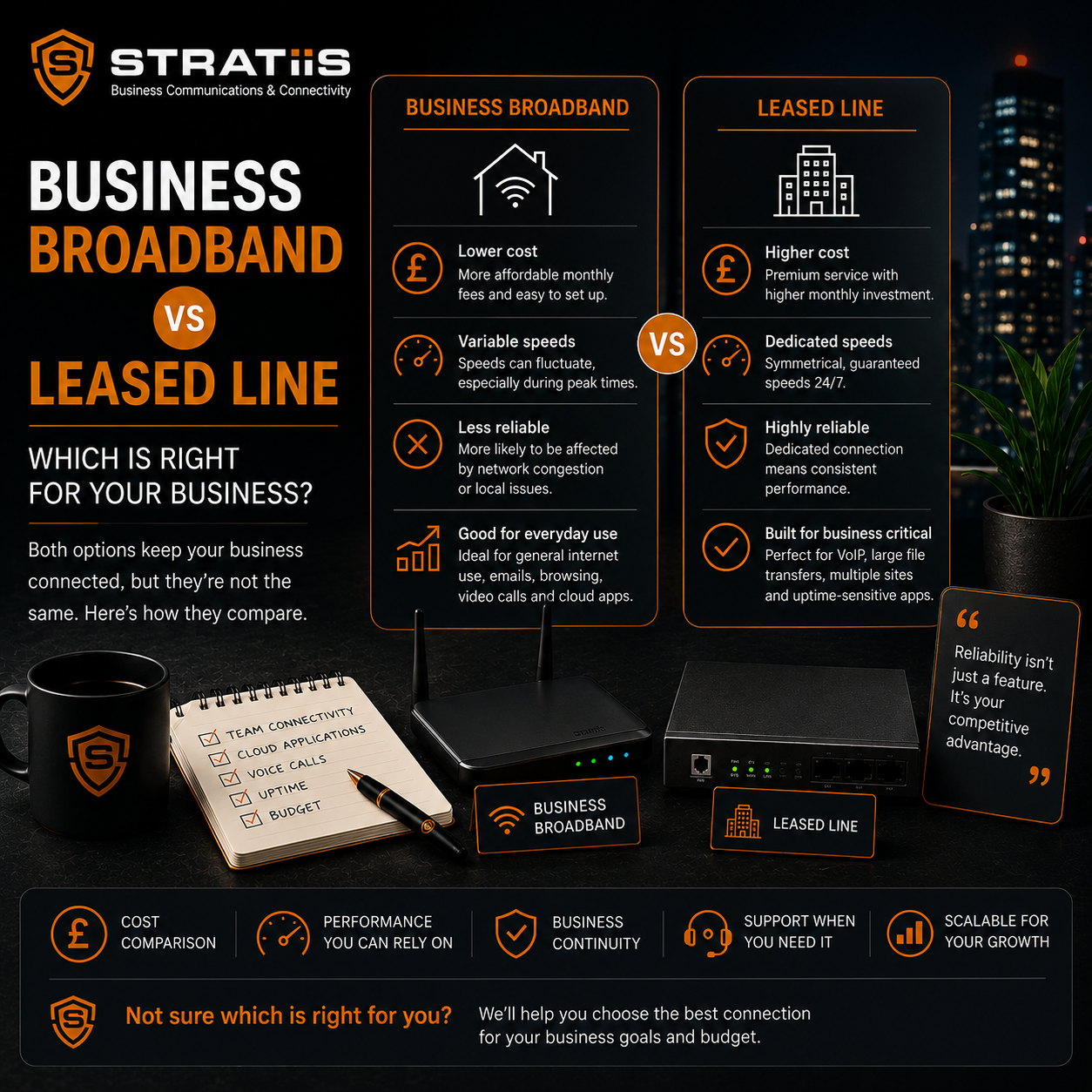
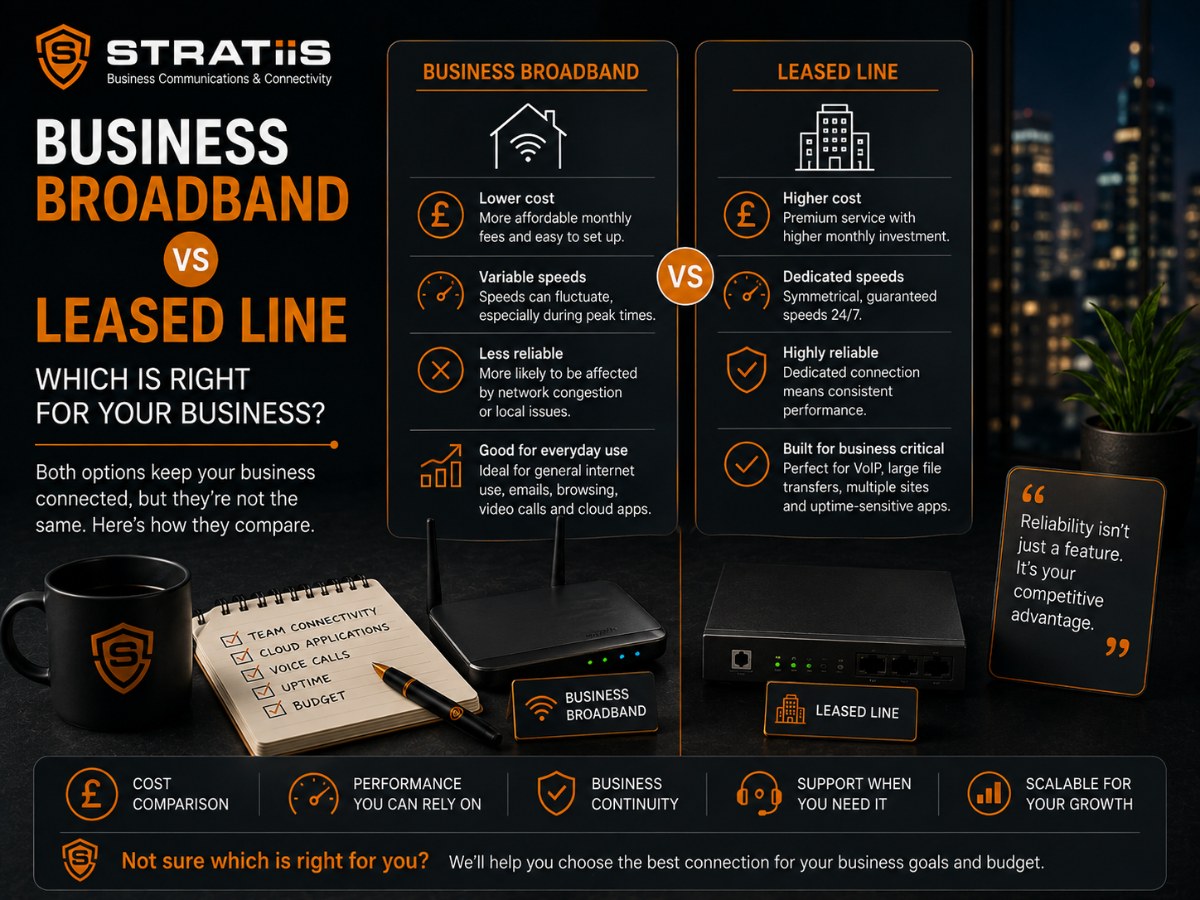
Business broadband is usually cheaper and quicker to install, but its capacity is shared and its repair commitments may be limited. A leased line provides dedicated, symmetrical bandwidth with stronger service levels, but it costs more and takes longer to install.
Business broadband may be the better choice when your organisation:
- Has a smaller number of employees
- Can tolerate occasional disruption
- Has reliable Full Fibre available
- Uses cloud applications moderately
- Has a limited connectivity budget
- Can use 4G or 5G as backup
- May move premises within the next few years
A leased line may be the better choice when your organisation:
- Depends heavily on cloud systems
- Has many simultaneous users
- Needs strong upload performance
- Runs a contact centre
- Relies on Hosted Voice or Teams Phone
- Transfers large files
- Needs stronger fault-repair commitments
- Would lose significant money during an outage
Neither option is automatically better.
A ten-person business may waste money on a leased line it does not need.
A 100-person organisation may lose far more through broadband downtime than it saves through a cheaper monthly rental.
The right answer depends on the business impact of poor performance or failure.
What is business broadband?
Business broadband is an internet service designed and sold for commercial use.
It may be delivered through:
- Full Fibre
- Fibre to the Cabinet
- Cable
- Fixed wireless
- 4G
- 5G
Business broadband may include features such as:
- Business support
- Static IP addresses
- Managed router
- Higher usage allowances
- Security options
- Better fault handling than consumer broadband
- Optional mobile failover
Modern Full Fibre broadband can provide very high download speeds.
Depending on location and provider, businesses may be able to order hundreds of megabits or even gigabit-speed services.
However, business broadband is normally a shared service.
Your connection and the provider’s local network may carry traffic for several customers.
This is known as contention.
What is a leased line?
A leased line is a dedicated business internet connection.
It may also be described as:
- Dedicated Internet Access
- DIA
- Ethernet Internet Access
- Fibre Ethernet
- Dedicated fibre
- Business Ethernet
A leased line normally provides:
- Dedicated access capacity
- Equal upload and download speeds
- Committed bandwidth
- Stronger service levels
- Faster fault escalation
- Static IP addresses
- Business monitoring
- Greater upgrade options
For example, a 500 Mbps leased line would normally provide:
- 500 Mbps download
- 500 Mbps upload
That bandwidth is dedicated to your organisation on the access circuit.
It is not shared in the same way as ordinary broadband.
Business broadband vs leased line at a glance
| Area | Business broadband | Leased line |
|---|---|---|
| Monthly cost | Lower | Higher |
| Installation time | Usually faster | Usually longer |
| Download speed | Can be very high | High and committed |
| Upload speed | Often lower than download | Normally equal to download |
| Bandwidth | Shared or contended | Dedicated access capacity |
| Performance | May vary | More consistent |
| Repair commitment | Usually weaker | Usually stronger |
| Service level | Limited or product dependent | Business-grade SLA |
| Contract length | Often shorter | Commonly three to five years |
| Construction risk | Usually lower | May involve additional works |
| Static IP addresses | Optional or included | Commonly included |
| Best suited to | Smaller or less dependent businesses | Cloud-dependent or critical sites |
The exact service varies by provider.
Some premium business broadband products offer excellent support.
Some low-cost leased-line packages may exclude managed equipment or resilience.
Always compare the full specification.
What is the biggest difference?
The biggest difference is not headline speed.
It is the level of certainty.
A broadband provider may advertise a very fast service.
The business may still experience:
- Variable performance
- Slower upload
- Local congestion
- Longer repair times
- Limited compensation
- Fewer guarantees
A leased line is designed to provide more predictable performance and stronger service commitments.
A business does not normally buy a leased line because websites will load slightly faster.
It buys one because internet performance and availability are important enough to justify paying for greater certainty.
Which option is faster?
Either option may advertise a high speed.
A Full Fibre broadband service may provide a download speed of 500 Mbps or 1 Gbps.
A leased line may also provide 500 Mbps or 1 Gbps.
The figures can look identical.
The experience may not be.
With broadband:
- Download and upload speeds may be different
- The advertised speed may be an “up to” figure
- Performance may vary
- Capacity may be shared
- Busy-period congestion may occur
With a leased line:
- The committed speed is normally clearer
- Upload and download are usually symmetrical
- Access capacity is dedicated
- Performance should be more consistent
A 1 Gbps broadband service is not automatically equivalent to a 1 Gbps leased line.
What does symmetrical speed mean?
Symmetrical speed means the upload and download capacity are the same.
For example:
- 500 Mbps download
- 500 Mbps upload
Leased lines are normally symmetrical.
Business broadband may provide:
- 500 Mbps download
- 50 Mbps upload
The exact ratio depends on the service.
High upload speed is important for organisations using:
- Cloud backups
- Video meetings
- Hosted Voice
- Microsoft Teams
- Large file uploads
- Cloud-hosted servers
- CCTV
- Off-site replication
- Remote access
A business may focus on download speed because that is the largest advertised number.
In a cloud environment, upload performance can be equally important.
What is contention?
Contention means that network capacity is shared among several customers.
Broadband networks are designed on the assumption that not every customer will use their full connection at the same time.
This allows providers to offer high headline speeds at a relatively low price.
Most of the time, that model works well.
Performance may fall when:
- Many local users are active
- The network is congested
- The provider has insufficient capacity
- Heavy uploads are occurring
- The service experiences a fault
A leased line normally provides dedicated access capacity for the customer.
This reduces variation on the connection into the provider’s network.
It does not mean the whole global internet is dedicated to your business.
Is Full Fibre broadband as good as a leased line?
Not necessarily, although Full Fibre may be good enough.
Full Fibre broadband can provide:
- High download speed
- Better upload than older services
- Improved stability
- Lower latency
- Faster installation
- Lower monthly cost
It may be an excellent option for:
- Small businesses
- Professional-services firms
- Hybrid teams
- Organisations with moderate cloud use
- Sites with strong mobile backup
A leased line normally provides additional benefits such as:
- Dedicated bandwidth
- Symmetrical performance
- Stronger service-level agreement
- Faster repair targets
- More predictable capacity
- Easier bandwidth upgrades
- More suitable support for critical sites
The question is not whether Full Fibre is good.
It is whether its support and resilience are sufficient for your business.
How much does business broadband cost?
Business broadband may cost approximately £30 to £150 per month, excluding VAT.
The price depends on:
- Speed
- Location
- Provider
- Static IP addresses
- Router
- Support
- Security
- Mobile failover
- Contract length
Premium business broadband or specialist fixed-wireless services may cost more.
These are broad planning figures rather than quotations.
The attraction is clear: business broadband may provide hundreds of megabits of speed for a fraction of the monthly cost of a leased line.
The lower price normally comes with less certainty over performance and repair.
How much does a leased line cost?
A UK business leased line may typically cost approximately £150 to £700 per month, excluding VAT.
For initial budgeting:
- 100 Mbps may cost around £150 to £300 per month
- 500 Mbps may cost around £250 to £500 per month
- 1 Gbps may cost around £300 to £700 per month
- 10 Gbps may cost £800 to £2,000 or more per month
The actual cost depends heavily on:
- Exact building
- Available carrier infrastructure
- Construction work
- Bandwidth
- Contract term
- Service level
- Backup requirements
[Read: How Much Does a Business Leased Line Cost?]
Why is a leased line more expensive?
You are not paying only for speed.
The additional cost may support:
- Dedicated capacity
- Symmetrical bandwidth
- Stronger service levels
- Faster repair targets
- Monitoring
- Static IP addresses
- Business support
- Carrier engineering
- Dedicated fibre infrastructure
- Upgrade flexibility
The provider may need to build a new fibre route to your building.
Business broadband usually uses infrastructure already designed to serve a wider area and many customers.
Which option is cheaper over three years?
Business broadband will normally be cheaper.
For example, a £70-per-month broadband service costs:
£70 × 36 months = £2,520, excluding VAT.
A £400-per-month leased line costs:
£400 × 36 months = £14,400, excluding VAT.
The leased line may also require:
- Installation
- Firewall
- Managed router
- Backup connection
- Internal network improvements
The comparison should not stop there.
Ask what an outage would cost.
If fifty employees cannot work for half a day, the lost productivity may exceed the annual saving from broadband.
The correct calculation includes both:
- Service cost
- Business risk
Which option is quicker to install?
Business broadband is normally quicker.
An available Full Fibre broadband service may be installed within days or weeks.
A leased line may take approximately 45 to 90 working days.
Complex installations can take longer.
Leased-line delays may be caused by:
- Site surveys
- New fibre construction
- Blocked ducts
- Road permits
- Landlord permission
- Wayleaves
- Building access
- Carrier planning
- Civil engineering
A business opening a new office may need temporary connectivity while it waits.
What are Excess Construction Charges?
Excess Construction Charges may apply when a leased-line installation requires work beyond the carrier’s standard allowance.
Examples include:
- New trenches
- Road crossings
- New ducts
- Clearing blocked ducts
- New poles
- Long fibre routes
- Specialist site access
The charges may range from a few thousand pounds to much more.
Business broadband is less likely to create major construction charges because it normally uses existing local access infrastructure.
However, broadband may simply be unavailable where suitable infrastructure does not exist.
Which option has the better service-level agreement?
A leased line normally has the stronger SLA.
The service agreement may cover:
- Availability
- Fault response
- Repair target
- Network monitoring
- Escalation
- Service credits
- Performance measures
Business broadband may include:
- Business-hours support
- Enhanced care
- Faster fault handling than consumer broadband
- Optional repair targets
The wording matters.
A provider may promise a four-hour response rather than a four-hour repair.
These are very different commitments.
Ask:
- When does the repair clock begin?
- Is the target available 24 hours a day?
- What happens during weekends?
- What service credit applies?
- Is engineer attendance included?
- Does the router fall under the same SLA?
Does a leased line guarantee it will never fail?
No.
A leased line can still fail because of:
- Fibre damage
- Roadworks
- Carrier equipment failure
- Power loss
- Router failure
- Firewall failure
- Building damage
- Exchange fault
- Human error
A leased line may provide better monitoring and faster repair.
It is still one connection unless the business buys additional resilience.
Is business broadband unreliable?
Not necessarily.
Modern business Full Fibre can be very reliable.
Many small businesses operate successfully using it every day.
The weakness is not that broadband always performs poorly.
The weakness is that the service may provide less certainty when a problem occurs.
A business broadband service may be entirely appropriate where:
- The connection has been stable
- Full Fibre is available
- User numbers are modest
- Upload needs are moderate
- Mobile backup is available
- A longer repair would be inconvenient rather than catastrophic
Which option is better for cloud applications?
It depends on how heavily the organisation depends on them.
Business broadband may support:
- Microsoft 365
- Cloud accounting
- CRM
- File storage
- Teams
- Hosted Voice
- Web applications
A leased line may be preferable when:
- Most employees work entirely in the cloud
- Large uploads occur
- Remote desktops are used
- Cloud servers are business critical
- Downtime stops the company
- Performance must remain consistent
Cloud use alone does not automatically justify a leased line.
Business dependency does.
Which option is better for Microsoft Teams?
Both may support Microsoft Teams.
Teams uses the internet for:
- Chat
- Calls
- Video meetings
- Screen sharing
- File collaboration
A small organisation may use Teams successfully over Full Fibre broadband.
A larger organisation may benefit from a leased line when it has:
- Many simultaneous meetings
- Heavy file collaboration
- Teams Phone
- Large office attendance
- High upload use
- Low tolerance for call disruption
The provider should review peak usage, not only employee numbers.
Which option is better for Hosted Voice?
Hosted Voice does not normally use a huge amount of bandwidth.
It does need:
- Low packet loss
- Low latency
- Low jitter
- Stable upload
- Reliable local networking
A quality Full Fibre broadband connection may be sufficient for a small business.
A leased line may be more appropriate when:
- Many calls occur simultaneously
- A contact centre is involved
- Customer calls are critical
- The internet supports every office phone
- The business needs faster fault repair
- Other applications compete heavily for bandwidth
[Read: What Internet Connection Does Hosted Voice Need?]
Which option is better for video meetings?
Both can support video meetings.
The deciding factors include:
- Number of simultaneous meetings
- Video resolution
- Screen sharing
- Meeting-room systems
- Upload capacity
- Other traffic
- User location
A small business with five simultaneous meetings may be comfortable on Full Fibre.
An office with dozens of meetings, cloud backups and file uploads may benefit from a leased line.
Which option is better for cloud backups?
A leased line is often stronger because of symmetrical upload speed.
Cloud backups can consume significant upload capacity.
On an asymmetrical broadband service, this may affect:
- Voice calls
- Video meetings
- Remote access
- File uploads
- General responsiveness
The problem may be controlled by:
- Scheduling backups
- Applying bandwidth limits
- Using Quality of Service
- Upgrading broadband
- Moving to a leased line
A leased line should not be purchased before checking whether a configuration change would solve the problem.
Which option is better for large file transfers?
A leased line may provide a more consistent experience.
This may matter for:
- Architects
- Engineers
- Designers
- Media companies
- Video production
- Construction businesses
- Data analysis
- Software development
A high-speed broadband service may download large files quickly but upload them much more slowly.
A symmetrical leased line may reduce transfer times significantly.
Which option is better for remote access?
Both may support:
- VPN
- Remote desktop
- Cloud applications
- Remote employees
- Site-to-site connectivity
A leased line may provide better upload performance for users accessing systems located at the office.
However, if applications have moved fully into the cloud, remote users may no longer need to pass through the office internet connection.
The wider network design should be reviewed before increasing capacity.
Which option is better for CCTV?
Cloud-connected CCTV can use continuous upload bandwidth.
The demand depends on:
- Number of cameras
- Resolution
- Frame rate
- Cloud recording
- Remote viewing
- Retention design
A leased line may be more appropriate for a site uploading large volumes of video.
A small camera system may work perfectly well over broadband.
CCTV traffic should be measured rather than guessed.
Which option is better for a contact centre?
A leased line is normally the stronger primary option.
A contact centre may depend on the internet for:
- Voice calls
- Customer records
- Call recording
- CRM
- Supervisor dashboards
- Reporting
- Remote agents
- Web chat
An outage may stop the whole operation.
A contact centre may therefore need:
- Leased line
- Second fixed connection
- Carrier diversity
- Automatic failover
- Power backup
- Remote-working continuity
A basic broadband service with an untested mobile router is unlikely to provide sufficient resilience for a critical contact centre.
Which option is better for a five-person business?
Business broadband will normally be sufficient.
A five-person business may need:
- Reliable Full Fibre
- Business support
- Managed router
- Static IP where required
- 4G or 5G backup
A leased line may still be justified when the company:
- Transfers very large files
- Runs critical hosted systems
- Cannot tolerate internet downtime
- Operates in a sector with unusual connectivity needs
User count is only one factor.
Which option is better for a 20-person business?
Business Full Fibre may be the best starting point.
It may support:
- Microsoft 365
- Teams
- Hosted Voice
- Cloud accounting
- CRM
- Hybrid working
A leased line becomes more attractive when:
- All employees depend on cloud applications
- Upload capacity is limited
- Video use is heavy
- Internet faults cause major disruption
- Repair commitments matter
- The business expects significant growth
Which option is better for a 50-person business?
Either may be appropriate.
Business broadband may be sufficient when:
- Full Fibre is reliable
- Upload is adequate
- Cloud use is moderate
- A strong backup connection is installed
- The business can tolerate some disruption
A leased line may be more suitable when:
- Fifty employees depend on cloud systems
- Teams Phone or Hosted Voice is critical
- Video meetings are frequent
- Upload use is heavy
- Customer service depends on connectivity
- Downtime has a high cost
Which option is better for a 100-person business?
A leased line should normally be considered seriously.
A 100-person organisation may have:
- Large numbers of simultaneous users
- Heavy cloud dependency
- Numerous video meetings
- Hosted telephony
- Large file transfer
- Several sites
- Higher business impact from failure
That does not mean broadband is automatically unsuitable.
A dual-business-broadband design using different carriers may sometimes provide adequate performance and resilience at lower cost.
The comparison should consider:
- Capacity
- Repair
- Carrier diversity
- Contract
- Support
- Three-year cost
Can two broadband connections replace a leased line?
Sometimes.
A business may use:
- Full Fibre broadband from one provider
- Second broadband service from another provider
- Automatic firewall failover
This can provide:
- Lower cost than some leased lines
- More total bandwidth
- Backup during a provider fault
- Faster installation
- Contract flexibility
It may still provide:
- Shared bandwidth
- Lower upload performance
- Weaker repair targets
- Less predictable quality
- No guaranteed route diversity
Two broadband services are not automatically independent.
They may use the same:
- Duct
- Openreach infrastructure
- Exchange
- Street route
- Power source
The physical design should be checked.
Can business broadband back up a leased line?
Yes.
This is a common approach.
The leased line provides:
- Primary dedicated connectivity
- Stronger service levels
- Consistent capacity
Business broadband provides:
- Lower-cost backup
- Additional route
- Temporary service during a fault
The firewall may automatically move critical traffic to the backup.
The backup capacity may be lower.
The organisation may restrict:
- Video meetings
- Guest Wi-Fi
- Cloud backups
- Large downloads
- Non-essential systems
A reduced-capacity backup can still keep important services operating.
Can 4G or 5G back up either service?
Yes.
Mobile failover can protect both business broadband and leased lines.
It may provide temporary access for:
- Hosted Voice
- Microsoft Teams
- Cloud applications
- Payments
- Essential users
Its performance depends on:
- Signal strength
- Mobile operator
- Local congestion
- Router
- External antenna
- Data allowance
- Building materials
Mobile backup should be tested regularly.
A strong signal on a mobile phone does not guarantee sufficient capacity for the whole office.
Which option provides better resilience?
A leased line provides stronger primary-service characteristics.
It does not automatically provide full resilience.
True resilience may require:
- Primary leased line
- Secondary connection
- Different carrier
- Different physical route
- Different building entry point
- Automatic failover
- Power protection
- Monitoring
Business broadband combined with a second independent connection may be more resilient than one leased line.
The design matters more than the label.
What happens if the router fails?
Both services can become unavailable.
The internet circuit may remain active while the business cannot access it because the router or firewall has failed.
The organisation may need:
- Managed router
- Replacement SLA
- High-availability firewalls
- Spare equipment
- Provider monitoring
- Documented configuration
Paying for a leased line with a four-hour carrier repair target provides limited value when the unsupported firewall takes two days to replace.
Does either option include Wi-Fi?
Usually not.
Business broadband or a leased line brings internet connectivity into the premises.
The internal network may still require:
- Firewall
- Network switches
- Wi-Fi access points
- Structured cabling
- Network security
- Monitoring
Poor Wi-Fi can make a 1 Gbps leased line feel unreliable.
The provider should separate internet performance from local-network performance.
[Explore Managed Business Wi-Fi]
Does either option include cybersecurity?
Not automatically.
The internet service may include basic protections.
The business may still need:
- Managed firewall
- DNS filtering
- Web filtering
- Intrusion prevention
- Secure remote access
- Network segmentation
- Monitoring
- Patch management
- Endpoint security
A leased line is not inherently more secure simply because it is dedicated.
Security depends on the design and controls around the connection.
Which option is easier to move?
Business broadband is normally easier.
A new office may already have suitable broadband available.
A leased line is installed to a specific address and may require:
- New quotation
- New construction
- New contract
- Long lead time
- Overlapping rental
- Early termination charges
A business expecting to move within the next year or two should examine the leased-line contract carefully.
Which option offers more contract flexibility?
Business broadband often provides more flexibility.
Common terms may include:
- 12 months
- 24 months
- 36 months
Leased-line contracts commonly run for:
- 36 months
- 60 months
Longer leased-line terms may reduce monthly or installation costs.
They can become expensive when the organisation:
- Moves
- Downsises
- Closes a site
- Changes operating model
- Merges with another company
The connectivity term should be compared with the building lease.
Which option is easier to upgrade?
It depends on the installed infrastructure.
Full Fibre broadband may offer straightforward speed upgrades within the provider’s product range.
A leased line may be installed with a higher-capacity bearer.
For example:
- 100 Mbps service on a 1 Gbps bearer
- 500 Mbps service on a 1 Gbps bearer
The organisation may then increase the active bandwidth without ordering new fibre.
Ask:
- What speed is active?
- What is the bearer capacity?
- How much will an upgrade cost?
- How quickly can it be completed?
- Will the contract restart?
Which option is more suitable for growth?
A leased line may provide more predictable scalability.
Business broadband may still be the better financial choice while the organisation is small.
A sensible approach may be:
- Start with high-quality Full Fibre broadband
- Add mobile or fixed backup
- Monitor actual usage
- Move to a leased line when performance or risk justifies it
Businesses should avoid buying a leased line only because they hope to grow.
They should also avoid waiting until broadband is failing every day before starting an installation that may take several months.
What are the advantages of business broadband?
Lower cost
Monthly rental is normally far lower.
Faster installation
Existing local infrastructure may allow rapid delivery.
Shorter contracts
The organisation may have more flexibility.
High headline speeds
Full Fibre can provide hundreds of megabits or more.
Suitable for many smaller organisations
A well-designed broadband service can support cloud applications, voice and video.
Lower construction risk
Major new fibre construction is less common.
What are the disadvantages of business broadband?
Shared capacity
Performance may vary.
Slower upload
Some products provide much less upload than download.
Weaker service levels
Repair commitments may be limited.
Longer outage risk
A major fault may take longer to resolve.
Less predictable busy-period performance
Congestion may affect real-time services.
Fewer guarantees
The advertised speed may not be a committed rate.
What are the advantages of a leased line?
Dedicated capacity
Access bandwidth is reserved for the organisation.
Symmetrical speed
Upload and download are normally equal.
More consistent performance
The service should provide greater predictability.
Stronger service levels
Faults normally receive higher priority.
Better for heavy upload
Cloud backup, video and file transfer benefit.
Greater scalability
Higher-capacity bearers may support upgrades.
Better for critical operations
It may be more suitable where internet failure stops the organisation.
What are the disadvantages of a leased line?
Higher cost
Monthly rental is significantly higher.
Long installation
Delivery may take several months.
Construction charges
Additional building or street work may be required.
Longer contract
Three- and five-year commitments are common.
It can still fail
A second connection may still be needed.
Office moves are harder
The circuit is tied to the physical location.
More capacity may be purchased than needed
A smaller business may never use the service fully.
When should you choose business broadband?
Business broadband may be the better option when:
- The organisation is small
- Full Fibre is available
- Upload needs are moderate
- Downtime has a manageable impact
- A mobile backup can keep essential services operating
- Contract flexibility matters
- The office may move
- The leased-line cost cannot be justified
When should you choose a leased line?
A leased line may be the better option when:
- Most employees depend on cloud services
- Customer calls are internet based
- The organisation runs a contact centre
- Upload performance is critical
- Video and file traffic are heavy
- Internet failure stops operations
- Repair commitments matter
- The business needs dedicated capacity
- The cost of downtime exceeds the additional rental
When might neither option be enough?
One primary connection may be insufficient when the business cannot tolerate an outage.
It may require:
- Two leased lines
- Leased line plus business broadband
- Leased line plus 5G
- Two broadband services from different providers
- Fixed wireless backup
- Satellite backup
- Diverse building entry points
- Resilient firewalls
- UPS or generator
Connectivity and resilience should be considered separately.
A premium primary circuit is not the same as a continuity plan.
How should you calculate the cost of downtime?
Consider:
- Number of employees affected
- Average employment cost
- Lost sales
- Missed customer calls
- Service-level penalties
- Delayed work
- Reputation
- Overtime required to recover
- Management time
- Supplier disruption
For example, if fifty employees are unable to work effectively, even one half-day outage can be expensive.
The business does not need an exact figure.
It needs enough understanding to decide whether paying several hundred pounds more each month is reasonable risk reduction.
Common mistakes businesses make
Comparing only download speed
Upload, service levels and contention also matter.
Assuming Full Fibre and leased lines are identical
The headline speed may match while the service commitments differ.
Buying a leased line without measuring usage
The business may overpay for capacity it does not need.
Keeping broadband after it repeatedly disrupts operations
Low monthly cost can create high business cost.
Having no backup
Either service can fail.
Assuming two providers mean two physical routes
They may share the same infrastructure.
Ignoring the firewall
An unsuitable firewall can restrict either connection.
Ignoring Wi-Fi
Poor internal networking may be blamed on the internet service.
Signing a five-year contract without checking the building lease
An office move can create major exit costs.
Waiting until the old service fails
A leased-line installation may take several months.
Questions to ask a connectivity provider
- Which option do you recommend and why?
- What business problem does a leased line solve for us?
- What are our current peak upload and download levels?
- Is Full Fibre available at the site?
- What upload speed does the broadband provide?
- Is the broadband speed guaranteed?
- Is the leased-line bandwidth committed?
- What is the leased-line bearer?
- What service level applies to each option?
- What is the target repair time?
- Is support available 24 hours a day?
- What router is included?
- Do we need a new firewall?
- Do we need better Wi-Fi?
- What backup service is recommended?
- Does the backup use another carrier?
- Does it use another physical route?
- How long will installation take?
- Could construction charges apply?
- Is a wayleave required?
- Can the speed be upgraded?
- What happens if we move?
- Can prices increase during the term?
- What is the complete three-year cost?
Warning signs to watch for
Be cautious when a provider:
- Recommends a leased line without checking usage
- Recommends broadband based only on its headline speed
- Describes broadband as dedicated when it is not
- Says a leased line can never fail
- Does not discuss backup
- Cannot explain the SLA
- Ignores upload performance
- Gives a leased-line price without checking the address
- Says construction charges cannot apply
- Does not review the firewall
- Ignores Wi-Fi and cabling
- Provides no three-year cost
- Hides annual price increases
- Does not compare the contract with the building lease
Business broadband vs leased line: which is better?
Business broadband is better when the organisation needs affordable, high-speed connectivity and can accept a lower level of performance and repair certainty.
A leased line is better when the organisation needs dedicated bandwidth, symmetrical speed and stronger service commitments.
The decision should be based on four questions:
- How much bandwidth do we really need?
- How important is upload performance?
- What happens to the business if the connection fails?
- How quickly must service be restored?
For many small businesses, high-quality Full Fibre broadband with tested 4G or 5G failover provides excellent value.
For a larger, cloud-dependent or customer-facing organisation, a leased line with a second connection may be the more responsible choice.
Choose connectivity based on business impact, not the product name
A leased line is not automatically the professional choice.
Business broadband is not automatically the cheap and unreliable choice.
Modern Full Fibre may provide an excellent service for a smaller organisation.
A leased line may provide essential certainty for a business that cannot operate without the internet.
The correct design may involve:
- Business broadband only
- Business broadband with mobile failover
- Two broadband connections
- Leased line with broadband backup
- Two diverse leased lines
Stratiis can review your current connectivity, cloud services, Microsoft Teams use, Hosted Voice, bandwidth, Wi-Fi, firewalls and business-continuity requirements.
We can then help you compare:
- Business Full Fibre
- Leased lines
- Fixed wireless
- 4G or 5G failover
- Dual-carrier connectivity
- Physically diverse services
Book a Business Broadband vs Leased Line Review
Call: 0141 348 7960
Email: sales@stratiis.com