Internet outages no longer affect only web browsing. They can interrupt cloud applications, customer calls, payments, remote access and the everyday work of an entire organisation. The practical question is not whether a connection can fail, but whether your business can continue when it does.
Should a business have a backup internet connection?
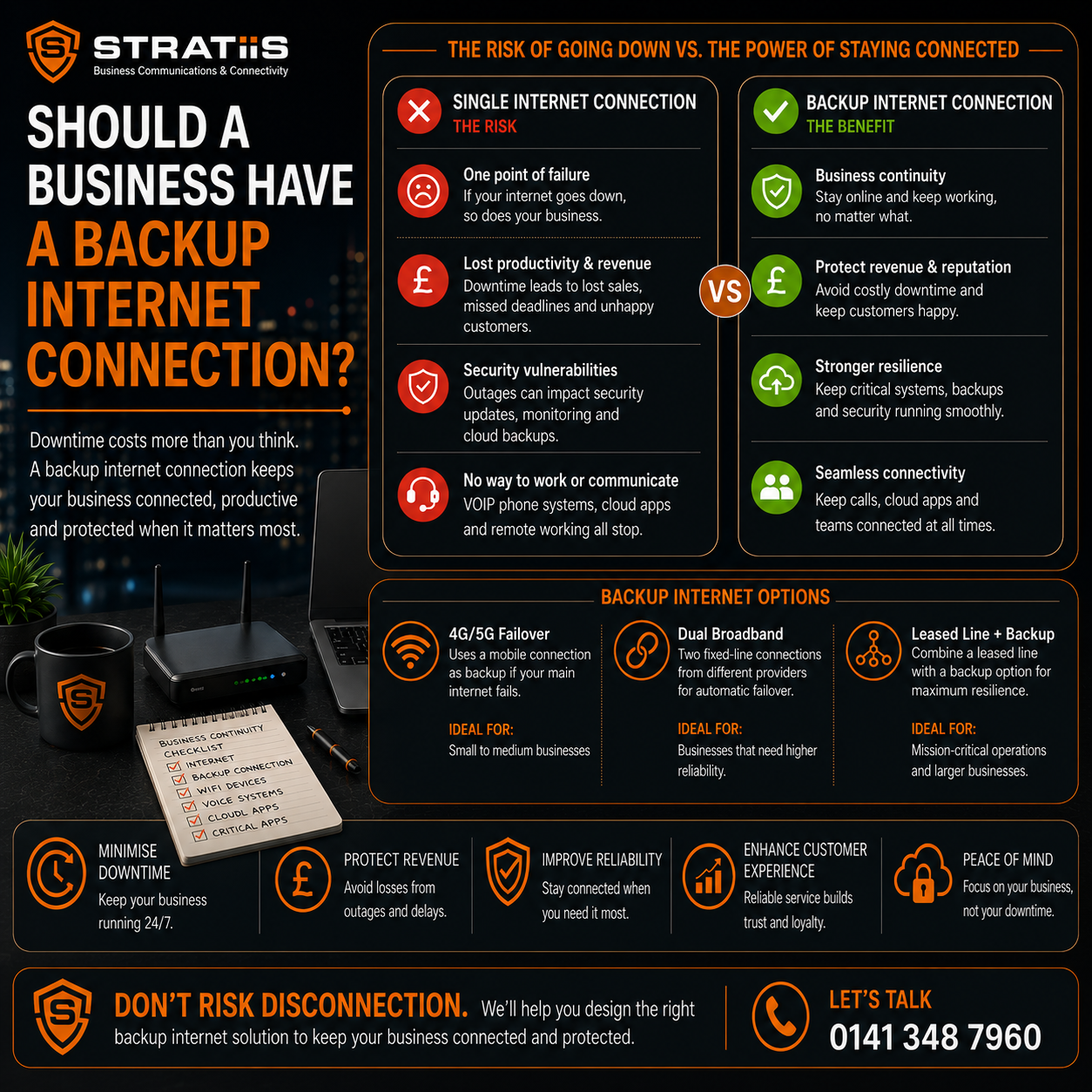
Most cloud-dependent businesses should have a tested backup internet connection. It does not need to match the speed of the primary circuit. It needs enough capacity to keep essential people, calls and applications working until the main service is restored.
A small office may use managed 4G or 5G failover. A larger or more critical operation may need a second fixed connection, a leased line with broadband backup, or two connections using different carriers and physical routes.
Why backup connectivity has become a business-continuity decision
Customer communication
Hosted Voice, Teams Phone, contact-centre queues and online customer services all depend on reliable connectivity.
Cloud-based work
Microsoft 365, email, CRM, accounting, document storage and other SaaS platforms may become unavailable together.
Revenue and reputation
Missed sales, delayed payments, unanswered calls and unproductive employees can make even a short outage expensive.
No connection is immune. Fibre damage, roadworks, carrier faults, power loss, failed routers or firewalls, damaged cabling and human error can all cause disruption. A leased line offers dedicated capacity and stronger service commitments, but it is still a single connection unless an independent route is provided.
What are the main backup internet options?
| Option | Best suited to | Advantages | Points to check |
|---|---|---|---|
| 4G or 5G failover | Small and medium offices needing essential continuity | Lower cost, quick deployment and a different access technology | Indoor signal, congestion, data limits, upload speed and user capacity |
| Second business broadband | Cloud-based offices with good local fibre availability | Useful capacity at a practical cost | Whether both services share the same duct, cabinet, exchange or underlying carrier |
| Leased line plus broadband | Organisations needing strong primary performance and proportionate resilience | A good balance of service level, capacity and cost | Automatic failover, route diversity and whether the backup supports critical traffic |
| Two diverse leased lines | Contact centres and other mission-critical operations | High capacity, symmetrical speeds and stronger service commitments | Different carriers, street routes, building entry points and network nodes |
| Fixed wireless or satellite | Sites where a second cable route is unavailable or undesirable | Can avoid the primary underground infrastructure | Coverage, line of sight, latency, weather, installation and equipment placement |
Mobile hotspots and home working can form part of a continuity plan for very small teams, but a permanently connected, monitored service is normally more dependable.
How much does backup internet cost?
Indicative UK planning ranges are approximately £20–£100 per month for 4G or 5G failover, £40–£150 per month for a business broadband backup and £150–£700 or more per month for a second leased line, excluding VAT. Installation, router or firewall configuration, mobile data, antennas, monitoring and physically diverse routing may add to the total.
The meaningful comparison is the cost of resilience against the cost of downtime. If 50 employees lose several productive hours, customer calls stop and transactions are delayed, the impact can easily exceed a year of basic backup connectivity.
Different providers do not always mean different routes
Commercial diversity
Two broadband brands may still use the same Openreach line, street cabinet, exchange, duct or building entry point. One cable incident could affect both.
Physical diversity
Stronger designs use different carriers, ducts, exchanges, network nodes or building entry points. True diversity normally requires surveys and explicit confirmation.
Resilience must cover the complete path. Two healthy circuits are of little use if both pass through one failed firewall, switch or power supply. Critical designs may also require a UPS, high-availability firewalls, managed configuration backups or a rapid replacement plan.
How automatic failover works
The primary connection is monitored
The firewall or router continually checks that the main service is reachable.
A failure is detected
The equipment confirms the loss and activates the alternative route.
Essential traffic moves
New internet sessions use the backup and monitoring alerts the support team.
The primary service returns
After stability is confirmed, traffic moves back under the agreed configuration.
Employees may notice a brief interruption. Active calls, video meetings or VPN sessions can disconnect because the public internet route changes. New sessions should work once failover completes. Traffic-management rules can prioritise voice, payments, CRM and critical cloud applications while restricting guest Wi-Fi, large downloads, backups and streaming.
How much backup capacity is enough?
A business with a 1 Gbps primary circuit may not need a 1 Gbps backup. The correct capacity is determined by the work that must continue, not by normal unrestricted demand.
For many organisations, a smaller backup can preserve email, voice, CRM, payments and urgent cloud access while non-essential services are temporarily limited.
Who is most likely to need backup internet?
Cloud-dependent offices
Teams centred on Microsoft 365, cloud accounting, CRM, document systems or remote access.
Customer-facing services
Organisations relying on hosted voice, bookings, payments, contact centres, portals or helplines.
Operational and multi-site teams
Housing, healthcare, manufacturing, distribution and organisations whose sites must communicate continuously.
Need is determined by impact rather than headcount. A five-person online retailer may require stronger resilience than a larger business that can continue temporarily through local systems or another location.
Test, monitor and maintain the service
A router stored in a cupboard may have an expired SIM, weak signal, outdated firmware or an unknown password. A live backup should be monitored and tested after major network changes and at an interval matched to business criticality.
Questions to ask before buying backup internet
| Area | Questions that expose the real design |
|---|---|
| Continuity | Which business services and how many users will continue during an outage? |
| Performance | What are the download, upload, latency and data limits? Which traffic will be prioritised? |
| Failover | Is switching automatic, how long should it take and will active calls disconnect? |
| Diversity | Does the backup use a different carrier and a genuinely different physical route? |
| Ownership | Who monitors, tests and supports the circuit, firewall, voice service and internal network? |
| Whole-life cost | What equipment, installation, data, monitoring and support are included over three years? |
Frequently asked questions
Does every small business need backup internet?
Not in the same form. A very small business may use managed mobile failover, secure home working or another location. If an outage stops calls, payments, bookings or cloud applications, a centrally managed backup is usually easier to justify.
Is 4G or 5G a good backup connection?
It often works well for smaller and medium offices, provided signal, latency, upload performance, data allowance and capacity are tested at the exact premises. An external antenna may be needed.
Can mobile failover support Hosted Voice and Microsoft Teams Phone?
Often, yes. The service must provide stable latency, low packet loss, adequate upload speed and the correct firewall configuration. Active calls may drop during the switch, but new calls should work after failover.
Does a leased line remove the need for a backup?
No. A leased line offers dedicated symmetrical capacity and stronger repair commitments, but fibre damage or equipment failure can still interrupt it. Businesses that cannot tolerate the repair window should consider a second route.
Does backup internet protect against a power cut?
Not by itself. The fibre termination, mobile router, firewall, switches, Wi-Fi and phones also need power. A UPS may cover short interruptions; longer outages may require a generator, home-working plan or alternative site.
How often should failover be tested?
Test after significant network changes and periodically—often quarterly or twice yearly, depending on criticality. A contact centre or essential public service may test more frequently.
Explore related Stratiis services
Communications & ConnectivityInternet FailoverBusiness BroadbandLeased LinesMulti-Site ConnectivityHosted VoiceMicrosoft Teams PhoneCloud, Backup & Disaster Recovery
Plan internet resilience around your business risk
Stratiis can review your primary connection, firewall, voice services, mobile coverage, internal network and continuity requirements—then help you choose and test a proportionate backup.