
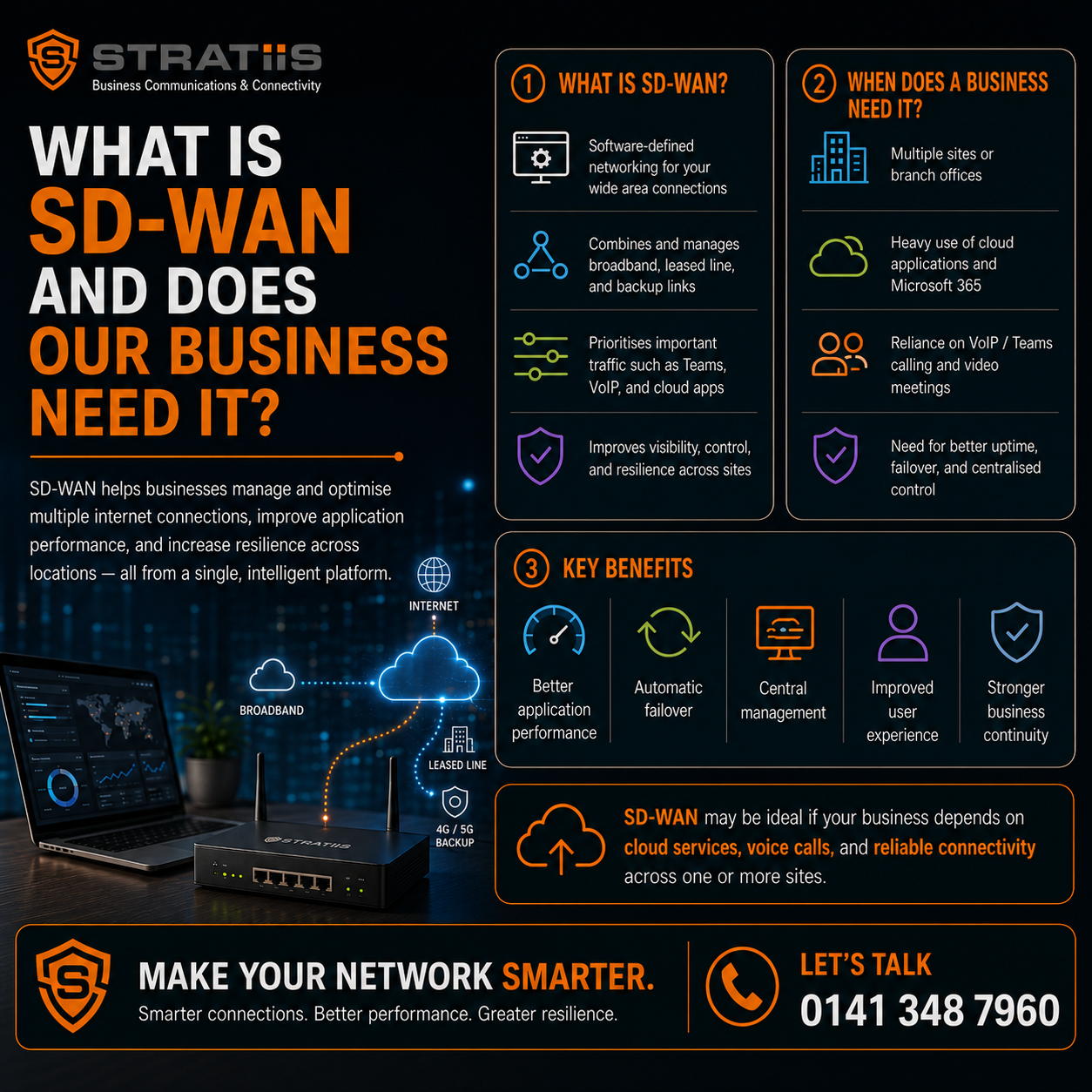
SD-WAN can make a multi-site, cloud-dependent network more resilient and easier to control. It is not automatically the right answer for every organisation—and it cannot compensate for slow circuits, poor Wi-Fi or an unclear support model.
What is SD-WAN, and does your business need it?
SD-WAN—Software-Defined Wide Area Networking—is a centrally managed way to control how business traffic uses multiple internet, private and cloud connections. It can select the best available path for Microsoft Teams, Hosted Voice, Microsoft 365 and other applications, while moving traffic automatically if a circuit fails or deteriorates.
It is most valuable for organisations with several sites, more than one connection, important cloud applications and a need for consistent policies and visibility. A small single-site business may be better served by a capable managed firewall with straightforward dual-WAN failover.
What does SD-WAN actually do?
Chooses the best path
The platform monitors availability, latency, packet loss, jitter and bandwidth, then applies routing policies by application and priority.
Manages sites centrally
Offices, cloud networks and data centres can use consistent routing, security and failover policies from one management portal.
Improves cloud access
Approved services such as Microsoft 365 or Azure can take a more direct route instead of being backhauled through head office.
SD-WAN does not replace fibre, broadband, leased lines, 4G or 5G. Those services still provide the connectivity. SD-WAN manages how the available connections are used.
SD-WAN compared with simpler network options
| Approach | What it does | Best suited to | Main limitation |
|---|---|---|---|
| Basic internet failover | Moves all traffic to a backup when the primary service fails | One site with straightforward continuity needs | Usually reacts to total failure rather than application performance |
| Managed dual-WAN firewall | Provides load balancing, monitoring, traffic priority and failover | One or two sites with moderate requirements | May offer less central orchestration and reporting across a larger estate |
| SD-WAN | Uses application-aware policies across several links and sites | Multi-site, cloud-reliant organisations needing control and visibility | Adds licensing, appliances, design complexity and provider dependency |
| SASE | Combines wide-area networking with cloud-delivered security and user access | Cloud-first organisations with sites and substantial remote working | Broader scope, cost and change than many businesses require |
When does a business need SD-WAN?
If several of these conditions apply, an SD-WAN assessment is sensible. If the problem is simply an overloaded broadband connection, the answer may be more bandwidth, a leased line or a tested internet failover service instead.
How application-aware routing helps
Monitor every usable path
The service measures availability, latency, packet loss, jitter and capacity rather than checking only whether a circuit is online.
Identify important traffic
Policies distinguish voice, video, Microsoft 365, finance systems, backups, guest access and other applications.
Apply business priorities
Real-time services can use the healthiest route while updates, backups and guest browsing receive lower priority.
Respond to change
Traffic can move when a path fails or becomes slow, and normal routing can resume after recovery.
This is broader than basic failover. A connection may remain technically online while high latency or packet loss makes Teams calls unusable. SD-WAN can recognise that degraded condition and choose a healthier route.
Can SD-WAN improve Teams, Hosted Voice and cloud performance?
Voice and video
Policies can favour the route with the lowest latency, packet loss and jitter. New calls may move quickly, although an active call can still drop if its original path fails suddenly.
Microsoft 365 and Azure
Local internet breakout and cloud integration can avoid unnecessary backhaul, reduce delay and simplify connections between branches and Azure resources.
Business applications
CRM, cloud desktops, finance and customer-service systems can receive priority over guest Wi-Fi, software downloads and background backups.
SD-WAN cannot fix weak office Wi-Fi, faulty headsets, Microsoft service incidents, insufficient total capacity or an underpowered firewall. The complete user-to-application path still matters.
Does SD-WAN replace MPLS, leased lines or firewalls?
| Technology | Relationship with SD-WAN |
|---|---|
| MPLS | SD-WAN can replace, reduce or incorporate MPLS. Some organisations retain MPLS as one path while adding broadband, leased lines or mobile connectivity. |
| Leased lines | A leased line supplies dedicated connectivity; SD-WAN decides how that link and its alternatives are used. It does not turn one circuit into two. |
| VPNs | A VPN is an encrypted link between points. SD-WAN can create and manage encrypted connections across many locations while also controlling path choice and application priority. |
| Firewalls | Some secure SD-WAN appliances include firewall and threat-protection functions; others rely on separate products or cloud security. The included controls and licences must be specified. |
What does SD-WAN cost?
For broad UK planning, a managed service may cost approximately £50–£150 per small site per month, £150–£500 per medium or more complex site, and £500 or more for a large, high-capacity or security-heavy location. Straightforward installation may be around £500–£2,000 per site, with complex deployments costing more. Figures exclude VAT and the underlying internet circuits.
Pricing depends on sites, throughput, appliance capacity, security features, high availability, cloud gateways, remote users, monitoring and support. A useful comparison separates connectivity, hardware, licences, migration and managed support across the full three-year term.
Check the circuits, appliances and support model
An SD-WAN platform cannot route around a failure if only one external connection exists. Two carrier brands may still share the same duct or building entry point, while one appliance controlling every link can itself become a single point of failure.
How to assess SD-WAN without overbuying
Define the business problem
Document site, application, resilience, performance and support issues before discussing products.
Review what you already own
Modern firewalls may already provide dual-WAN monitoring, load balancing, application control and central management.
Compare complete alternatives
Evaluate managed firewalls, VPNs, internet failover, MPLS, SD-WAN, SASE and Azure networking against the same requirements.
Pilot and prove the design
Test application identification, failover, degraded circuits, security, reporting and support ownership before a wider rollout.
Questions to ask an SD-WAN provider
| Area | Questions that reveal the real service |
|---|---|
| Purpose | What measurable problem will SD-WAN solve, and why is it better than improving our current firewalls? |
| Performance | How are latency, packet loss and jitter measured, and what happens when a circuit degrades but remains online? |
| Security | Which firewall, inspection, segmentation and cloud-security features are included, and which require extra licences? |
| Resilience | Will active calls drop, are routes genuinely diverse, and what happens if the SD-WAN appliance fails? |
| Cloud and users | Does the design support Azure, Microsoft 365, remote workers and the required sites without inefficient routing? |
| Commercials | Who owns faults, what reporting and replacement SLA are included, and what is the three-year cost and exit process? |
Frequently asked questions
Is SD-WAN the same as internet failover?
No. Basic failover usually moves all traffic after a complete outage. SD-WAN can use several connections simultaneously and choose paths according to application, performance, site, user and business priority.
Does SD-WAN combine two internet speeds?
It can distribute sessions and applications across several connections, but one download does not necessarily receive the sum of every circuit. The practical benefit is often better use of total capacity and resilience.
Does a single-office business need SD-WAN?
Usually not. One leased line, one backup connection and a capable managed firewall may be enough. SD-WAN becomes more relevant when the site has several important circuits, complex routing or significant cloud-performance requirements.
Can SD-WAN use 4G or 5G?
Yes. Mobile connectivity can provide emergency backup, rapid deployment or a secondary path. Signal, capacity, data allowances, carrier-grade NAT and external antenna requirements must be tested.
Can SD-WAN reduce costs?
It may reduce MPLS dependence, backhaul and engineer visits, but savings are not guaranteed. Appliances, licences, security subscriptions, migration and managed support must be included in the comparison.
Is SD-WAN a cybersecurity product?
It is primarily a networking technology, although secure SD-WAN platforms may include firewalls, encrypted tunnels, segmentation and threat controls. Security depends on the product, licence, configuration and monitoring.
Explore related Stratiis guidance and services
Communications & ConnectivityMulti-Site ConnectivityInternet FailoverLeased LinesBusiness BroadbandManaged Wi-FiMicrosoft Teams PhoneMicrosoft 365 ServicesCybersecurity ServicesBackup Internet GuideBusiness Internet Speed Guide
Find out whether SD-WAN is the right level of solution
Stratiis can review your sites, circuits, firewalls, VPNs, cloud services, voice traffic and continuity requirements—then compare SD-WAN with simpler and more proportionate alternatives.