Engineering firms depend on data.
From CAD drawings and technical specifications to project documentation and client communications, engineering businesses generate and manage large volumes of valuable information every day.
This data often represents years of expertise, intellectual property, project planning, and commercial investment.
The challenge is that cybercriminals understand its value too.
A ransomware attack, accidental data leak, or compromised user account can disrupt projects, damage client relationships, and create significant financial and reputational risks.
As engineering firms embrace hybrid working, cloud collaboration, and digital project delivery, protecting sensitive project data has become more important than ever.
So what should engineering firms be doing to keep project information secure?
In this guide, we'll explain the key cybersecurity controls, technologies, and best practices that help engineering companies protect sensitive project data while supporting productivity and collaboration.
Why Engineering Firms Are Attractive Targets
Many engineering businesses assume cybercriminals focus primarily on banks, large enterprises, or government organisations.
However, engineering firms are increasingly targeted because they often hold:
- Intellectual property
- Project designs
- Technical drawings
- Infrastructure plans
- Commercial contracts
- Client information
- Supply chain data
In some cases, project data may be worth significantly more than traditional financial information.
A successful cyberattack can affect:
- Ongoing projects
- Customer confidence
- Regulatory compliance
- Business continuity
- Competitive advantage
This makes cybersecurity a business-critical requirement.
What Types of Data Need Protecting?
Engineering firms typically manage several categories of sensitive information.
Technical Project Data
Including:
- CAD drawings
- BIM models
- Design files
- Schematics
- Technical calculations
Commercial Information
Such as:
- Project budgets
- Tender documents
- Contracts
- Supplier agreements
Client Information
Including:
- Contact information
- Project communications
- Commercial discussions
Employee Information
Such as:
- HR records
- Payroll information
- Performance reviews
Not all data requires the same level of protection, but every category should be secured appropriately.
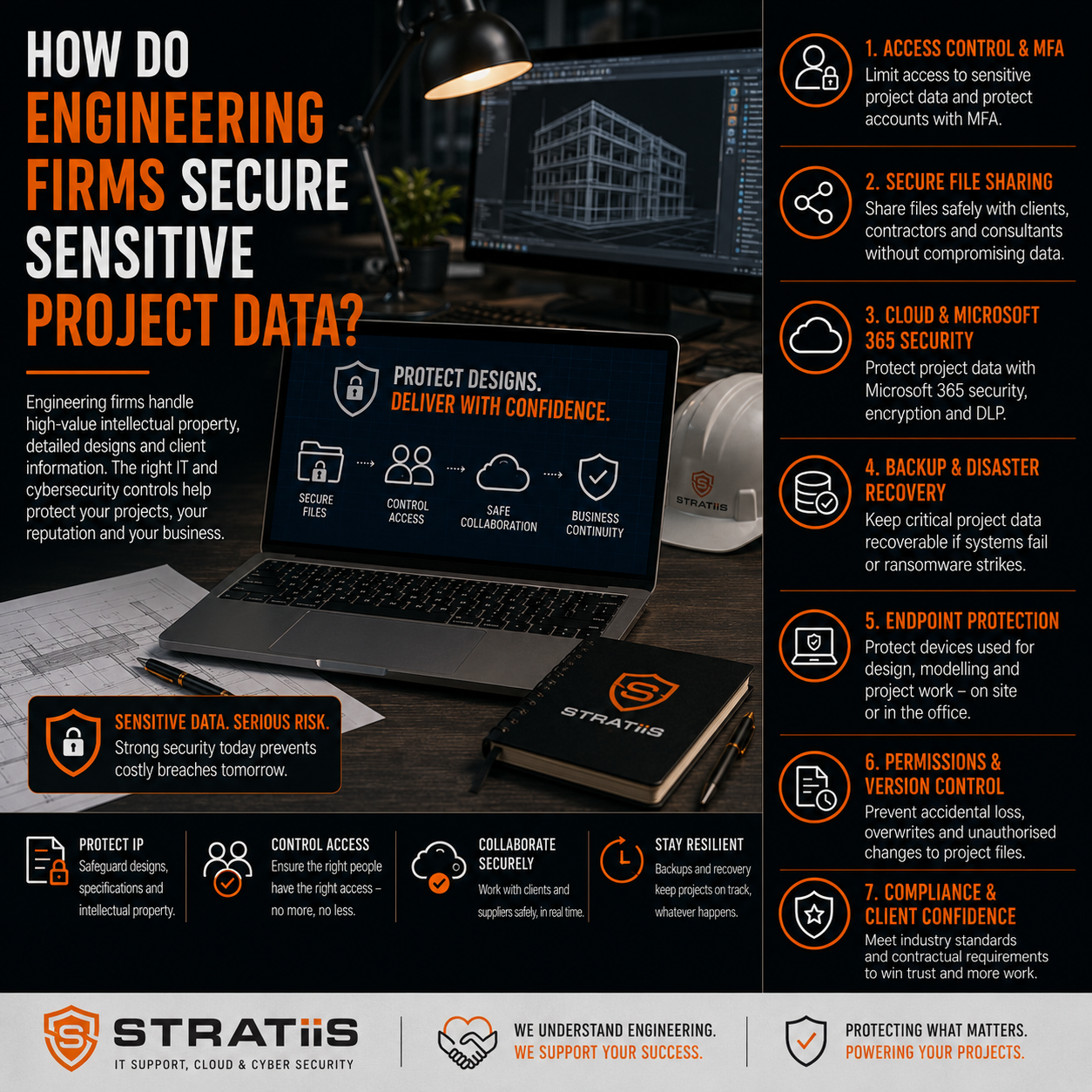
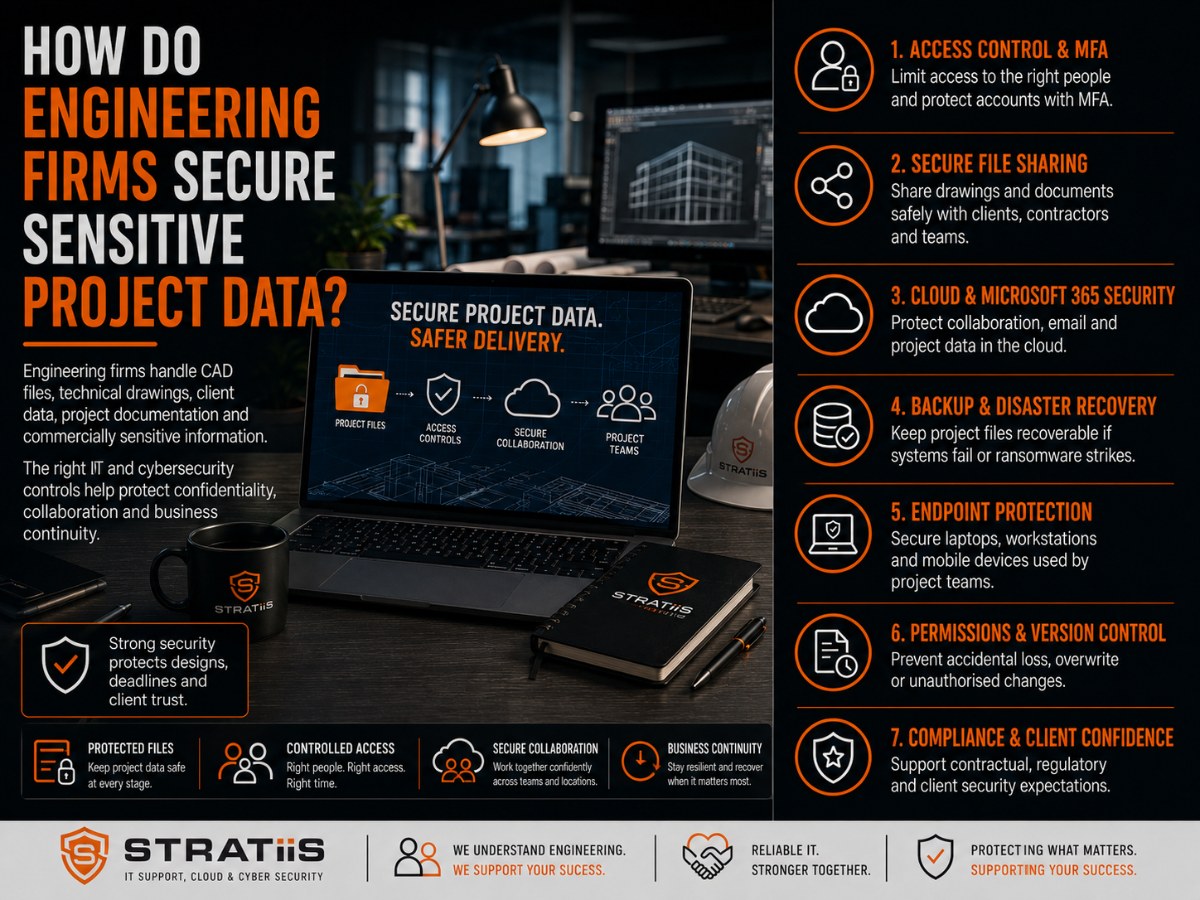
The 7 Essential Security Controls for Engineering Firms
1. Multi-Factor Authentication (MFA)
Passwords alone are no longer enough.
Multi-Factor Authentication requires users to provide an additional verification factor before accessing systems.
Examples include:
- Authentication apps
- Push notifications
- Hardware security keys
Why It Matters
Many cyberattacks begin with compromised credentials.
MFA significantly reduces the likelihood of unauthorised access.
Recommended Coverage
Enable MFA for:
- Microsoft 365
- Email systems
- Remote access
- Cloud applications
- Administrator accounts
This is often the single most effective cybersecurity improvement an engineering firm can make.
2. Secure Document Storage and Sharing
Engineering projects often involve collaboration with:
- Clients
- Contractors
- Consultants
- Suppliers
Sharing documents via email attachments creates unnecessary risk.
Best Practice
Use secure document platforms such as:
- Microsoft SharePoint
- Microsoft Teams
- OneDrive
Benefits include:
- Access controls
- Version control
- Audit trails
- Secure sharing
This helps ensure project information remains protected while supporting collaboration.
3. Role-Based Access Controls
Not every employee needs access to every project.
Role-based access ensures users only access information relevant to their responsibilities.
Examples
Project managers may require access to:
- Budgets
- Contracts
- Technical documentation
While external contractors may only need access to specific project folders.
Benefits
- Reduced risk
- Better governance
- Improved compliance
- Enhanced visibility
Access should be reviewed regularly.
4. Endpoint Protection
Engineering firms often use a combination of:
- Workstations
- Laptops
- Mobile devices
- Remote work environments
Every device accessing project information should be protected.
Modern Endpoint Protection Includes
- Malware detection
- Ransomware protection
- Threat monitoring
- Device isolation capabilities
Traditional antivirus software alone is no longer sufficient.
5. Backup and Disaster Recovery
Project data is often irreplaceable.
A comprehensive backup strategy should include:
Automated Backups
Protecting critical files and systems.
Offsite Backups
Ensuring recovery remains possible after major incidents.
Recovery Testing
Verifying backups can actually be restored.
Business Continuity Planning
Ensuring projects can continue during disruptions.
A backup that has never been tested cannot be assumed to work.
6. Device Management and Security Updates
Many engineering firms support hybrid working and multiple project locations.
Devices should be:
- Managed centrally
- Updated regularly
- Encrypted
- Monitored
Why It Matters
Unpatched systems remain one of the most common causes of cyber incidents.
Effective patch management significantly reduces risk.
7. Security Awareness Training
Cybercriminals frequently target employees through:
- Phishing emails
- Fake invoices
- Social engineering
- Credential theft attempts
Training Should Cover
- Identifying phishing attacks
- Password security
- Safe file sharing
- Data handling practices
- Incident reporting procedures
Employees remain one of the most important cybersecurity controls.
How Microsoft 365 Helps Protect Engineering Data
Many engineering firms already use Microsoft 365.
When configured correctly, it provides powerful security capabilities.
Microsoft 365 Security Features
- Multi-Factor Authentication
- Conditional Access
- Data Loss Prevention
- Microsoft Defender
- Device Management
- Audit Logging
Many businesses already own these capabilities but are not using them effectively.
How Engineering Firms Can Secure CAD and Design Files
CAD files often represent some of the most valuable information within an engineering business.
Recommended Controls
✓ Secure cloud storage
✓ Version control
✓ Access permissions
✓ Backup protection
✓ Encrypted devices
✓ Secure file sharing
Common Mistakes
- Storing files on local devices
- Sharing drawings via unsecured email
- Excessive user permissions
- Lack of backup testing
Protecting technical data should be a strategic priority.
What Does Good Data Security Look Like?
A well-protected engineering firm should typically have:
Identity Security
✓ Multi-Factor Authentication
✓ Strong password policies
✓ Role-based access
Device Security
✓ Managed devices
✓ Endpoint protection
✓ Encryption
✓ Automated updates
Data Protection
✓ Secure cloud storage
✓ Backup systems
✓ Controlled sharing
User Security
✓ Security awareness training
✓ Phishing simulations
Governance
✓ Cyber Essentials readiness
✓ Incident response plans
✓ Risk assessments
This creates a layered and practical cybersecurity framework.
Common Security Mistakes Engineering Firms Make
Mistake #1: Relying on Email for File Sharing
Email attachments often create security and version-control problems.
Mistake #2: Excessive Access Permissions
Too many users having access to sensitive project data increases risk.
Mistake #3: Ignoring Backup Testing
Recovery capability is critical.
Mistake #4: Delaying Security Updates
Known vulnerabilities remain a common attack vector.
Mistake #5: Treating Cybersecurity as an IT Issue
Cybersecurity should be viewed as a business risk and project delivery risk.
Stratiis Client Example - A 60-Person Engineering Company
Their Challenges
- Multiple active projects
- Large CAD files
- Hybrid workforce
- Growing cybersecurity concerns
The Improvements Implemented
The company deployed:
- Multi-Factor Authentication
- Microsoft SharePoint
- Role-based access controls
- Endpoint protection
- Device management
- Security awareness training
Their Outcomes
Benefits included:
- Improved data security
- Better project collaboration
- Reduced ransomware risk
- Increased visibility of data access
- Enhanced client confidence
The focus was not restricting productivity.
It was enabling secure collaboration.
Why Engineering Firms Across Scotland Choose Stratiis
At Stratiis, we help engineering firms throughout Glasgow, Edinburgh, Lanarkshire, Ayrshire, Lothian, Dumfries & Galloway, and Perthshire protect project information while supporting efficient project delivery.
Our cybersecurity-first approach includes:
- Managed IT support
- Microsoft 365 security
- SharePoint and Teams deployment
- Endpoint protection
- Device management
- Backup and disaster recovery
- Cyber Essentials readiness
- Strategic vCIO services
We help engineering businesses reduce risk, improve resilience, and make informed technology decisions.
Engineering Security Checklist
| Security Control | Implemented? |
|---|---|
| MFA Enabled | □ |
| Secure CAD Storage | □ |
| SharePoint Permissions Reviewed | □ |
| Backup Testing Completed | □ |
| Security Awareness Training Delivered | □ |
| Cyber Essentials Achieved | □ |
Final Thoughts
Engineering firms rely on sensitive project information to deliver successful outcomes for clients.
Protecting that information requires more than antivirus software and strong passwords.
A modern security strategy should include:
- Multi-Factor Authentication
- Secure document sharing
- Role-based access controls
- Endpoint protection
- Backup and recovery
- Device management
- Security awareness training
The goal is not simply preventing cyberattacks.
It's protecting intellectual property, maintaining client trust, and ensuring projects continue without disruption.
In today's engineering environment, data security is no longer optional.
It's a fundamental part of delivering successful projects.
Related Articles
How Can Manufacturing Companies Reduce Ransomware Risk Without Increasing IT Spend?
Should We Move Our File Server to Microsoft 365 and SharePoint?
What Cybersecurity Protections Does a 50-Person Business Actually Need?
Microsoft 365 Business Premium vs E5: Which Is Best for Scottish Businesses?