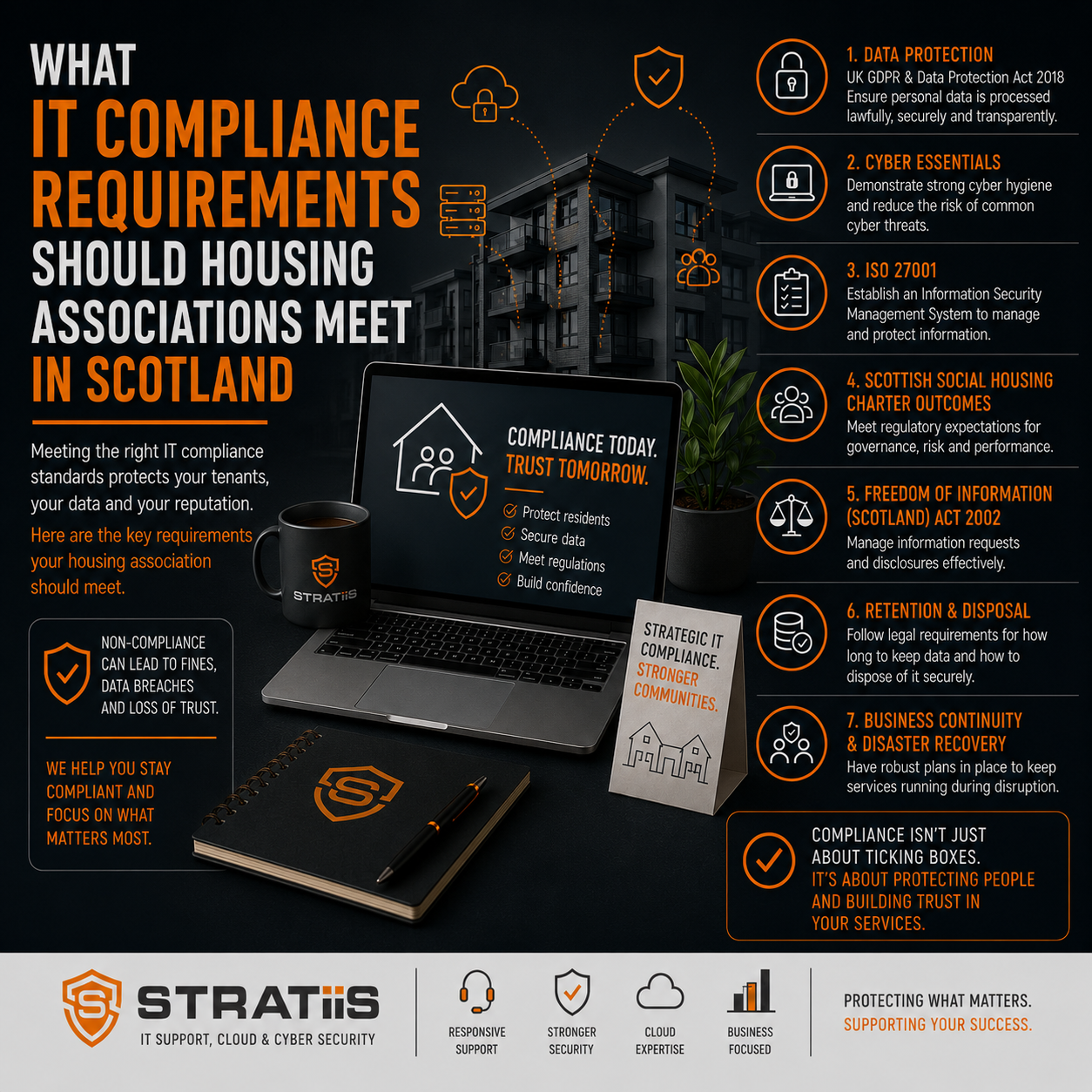
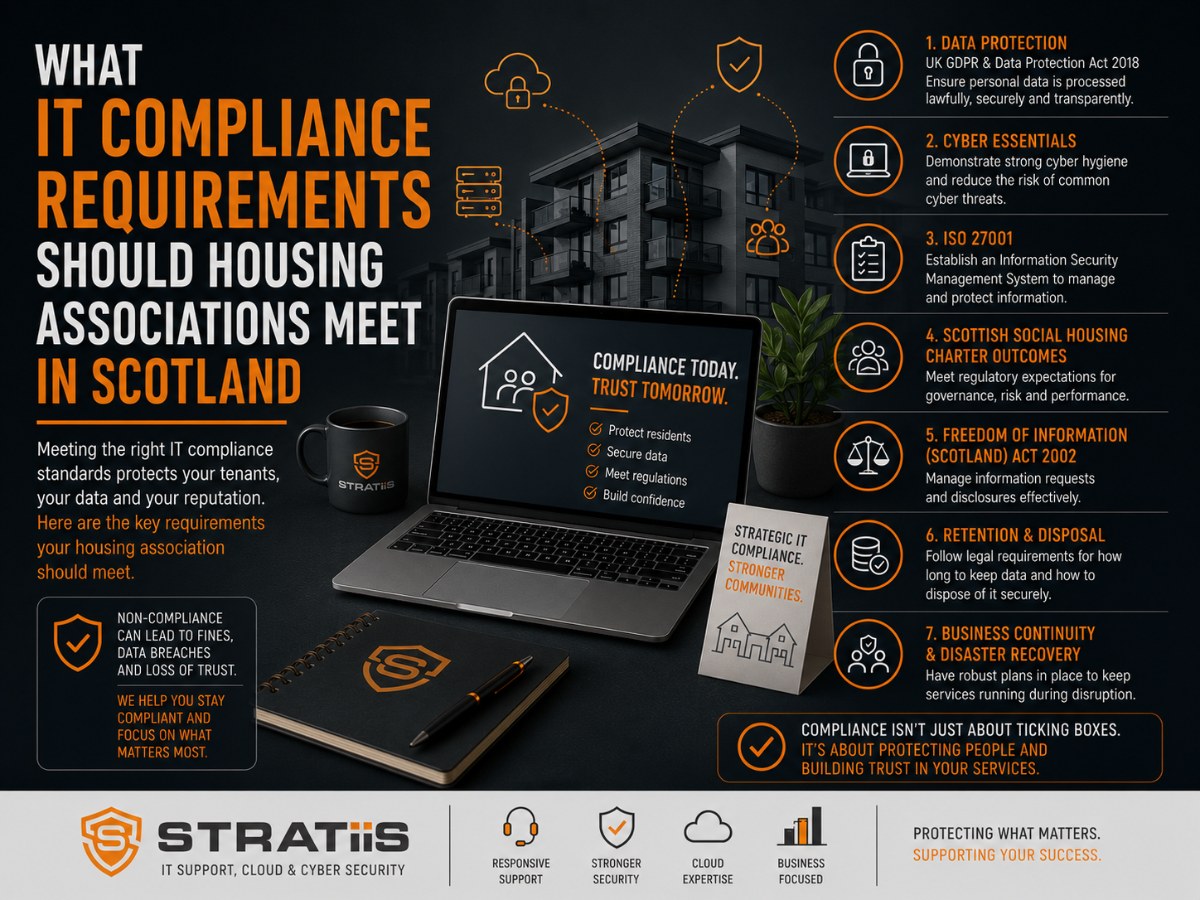
Housing associations across Scotland face increasing pressure to strengthen cybersecurity, protect sensitive information, and demonstrate effective governance.
From tenant records and financial information to contractor data and employee details, housing associations manage large volumes of confidential information every day. As cyber threats continue to grow, regulatory expectations are also increasing.
Many housing associations understand they need to improve cybersecurity and compliance but are unsure where to begin.
The reality is that there is no single compliance framework that applies to every housing association. Instead, organisations must understand and address a combination of legal, regulatory, governance, and cybersecurity requirements.
This guide explains the key IT compliance requirements housing associations should consider in 2026 and how technology can help support regulatory obligations while reducing organisational risk.
Why IT Compliance Matters for Housing Associations
Housing associations rely heavily on technology to deliver services, manage properties, communicate with tenants, and support employees.
Technology failures can have serious consequences including:
- Data breaches
- Service disruption
- Regulatory investigations
- Financial penalties
- Reputational damage
- Loss of tenant trust
Compliance is not simply about meeting regulatory requirements.
It is about protecting people, maintaining services, and supporting good governance.
The Five Key Areas of IT Compliance
For most Scottish housing associations, compliance can be divided into five areas:
1. Data Protection
2. Cybersecurity
3. Governance and Risk Management
4. Business Continuity and Resilience
5. Supplier and Third-Party Management
Understanding these areas provides a practical framework for compliance planning.
1. Data Protection Requirements
Most housing associations process large volumes of personal information.
Examples include:
- Tenant information
- Employee records
- Financial information
- Rent payment data
- Contractor information
- Vulnerability assessments
- Support service records
Key Requirements
Housing associations should ensure:
- Personal information is protected
- Access to data is restricted appropriately
- Data is stored securely
- Information is retained appropriately
- Data breaches can be identified and reported
Technology Controls
Common controls include:
- Multi-Factor Authentication (MFA)
- Encryption
- Secure file sharing
- Access management
- Data backup and recovery
Protecting personal information should remain a core priority.
2. Cybersecurity Requirements
Cybersecurity is now one of the most important governance responsibilities facing housing associations.
Threats include:
- Ransomware
- Phishing attacks
- Business email compromise
- Credential theft
- Supply chain attacks
Recommended Cybersecurity Standards
Most housing associations should consider:
Cyber Essentials
Provides a recognised baseline for cybersecurity controls.
Cyber Essentials Plus
Provides additional independent verification and assurance.
Security Awareness Training
Helps reduce risks associated with human error.
Vulnerability Management
Ensures security weaknesses are identified and addressed promptly.
Device Management
Supports secure control of laptops, mobile devices, and remote workers.
Cybersecurity should be viewed as a continuous process rather than a one-time project.
3. Governance and Risk Management
Technology risks should be managed at a leadership level.
Boards and executive teams increasingly expect visibility into:
- Cybersecurity risks
- Compliance status
- Technology investments
- Business continuity planning
Best Practice Governance Activities
Housing associations should regularly review:
- Cybersecurity risk registers
- Technology roadmaps
- Incident response plans
- Disaster recovery plans
- Supplier risks
Technology governance should align with organisational objectives and risk appetite.
4. Business Continuity and Operational Resilience
Housing associations provide essential services to tenants and communities.
Technology disruptions can affect:
- Housing management systems
- Repairs services
- Financial systems
- Communications
- Employee productivity
Compliance Considerations
Organisations should maintain:
- Backup systems
- Disaster recovery plans
- Business continuity plans
- Incident response procedures
- Recovery testing schedules
The objective is ensuring critical services can continue during disruptive events.
5. Supplier and Third-Party Management
Many housing associations rely on external technology providers.
Examples include:
- Managed IT providers
- Software vendors
- Cloud providers
- Telecom providers
- Security vendors
Questions to Consider
- Do suppliers meet security requirements?
- Are contracts reviewed regularly?
- Do suppliers have Cyber Essentials certification?
- Are responsibilities clearly documented?
- How is supplier risk assessed?
Third-party risk management is becoming increasingly important.
What Does Good Compliance Look Like in Practice?
A well-managed housing association should typically have:
Identity Security
✓ Multi-Factor Authentication
✓ Role-based access controls
✓ Password management policies
Device Security
✓ Managed devices
✓ Endpoint protection
✓ Security updates
✓ Device encryption
Data Protection
✓ Access controls
✓ Secure storage
✓ Data retention processes
✓ Backup procedures
Governance
✓ Risk registers
✓ Incident response plans
✓ Business continuity plans
✓ Regular reviews
Cybersecurity
✓ Cyber Essentials readiness
✓ Security awareness training
✓ Vulnerability assessments
✓ Security monitoring
This creates a strong compliance foundation.
Common Compliance Gaps Found in Housing Associations
Many organisations have similar challenges.
Common examples include:
Weak Password Practices
Passwords remain one of the most common security vulnerabilities.
Lack of Multi-Factor Authentication
MFA remains one of the most effective cybersecurity controls.
Inconsistent Device Management
Remote and hybrid working often increases complexity.
Limited Cybersecurity Training
Employees remain a frequent target for cybercriminals.
Outdated Documentation
Policies, recovery plans, and risk registers often require updating.
Identifying and addressing these gaps can significantly improve compliance and security.
A Recent Stratiis Housing Association Client with 20 Employees
Their Challenges
- Growing cybersecurity concerns
- Office connectivity
- Remote and hybrid working
- Increasing regulatory expectations
Compliance Improvement Programme
The organisation implemented:
- Multi-Factor Authentication
- Device management
- Security awareness training
- Cyber Essentials preparation
- Backup and recovery testing
- Governance reporting
The Outcome
Benefits included:
- Reduced cybersecurity risk
- Improved governance visibility
- Better compliance readiness
- Increased resilience
- Greater stakeholder confidence
- Cyber Essentials Certification
The objective was not simply compliance.
It was building a secure and resilient organisation.
What Questions Should Housing Association Boards Ask?
Board members and executive teams should regularly ask:
Security
- Are we protected against common cyber threats?
Compliance
- How do we demonstrate compliance obligations?
Risk
- What are our highest technology risks?
Resilience
- Could we recover quickly from a cyber incident?
Governance
- Do we receive meaningful technology reporting?
These conversations help strengthen organisational oversight.
Why Housing Associations Across Scotland Choose Stratiis
At Stratiis, we help housing associations throughout Glasgow, Edinburgh, Lanarkshire, Ayrshire, Lothian, Dumfries & Galloway, and Perthshire strengthen cybersecurity, improve governance, and reduce technology risk.
Our services include:
- Cybersecurity-first managed IT support
- Cyber Essentials readiness
- Microsoft 365 security
- Device management
- Backup and disaster recovery
- Strategic vCIO services
- Compliance guidance
- Technology roadmaps
We help housing associations build secure, resilient technology environments that support tenants, employees, and communities.
Final Thoughts
Housing associations face increasing expectations around cybersecurity, data protection, governance, and operational resilience.
Compliance is no longer simply a technical responsibility.
It is a strategic organisational requirement.
By focusing on data protection, cybersecurity, governance, resilience, and supplier management, housing associations can reduce risk, improve compliance readiness, and strengthen service delivery.
The most successful organisations do not treat compliance as a box-ticking exercise.
They use it as a framework for building trust, resilience, and long-term operational success.
Related Articles
What Does a Strategic vCIO Do for a Growing Business and Is It Worth It?
How Much Should Managed IT Support Cost for a 10-100 Employee Business in Scotland?
How Much Cybersecurity Protection Does a 50-Person Business Actually Need?