Many IT managers hear the phrase "Managed Service Provider" and immediately think:
"Are they trying to replace me?"
It's a fair concern.
Traditionally, MSPs were associated with fully outsourced IT services, often aimed at organisations without an internal IT department. However, that's no longer the only model available.
Today, many organisations use co-managed IT services, where an MSP works alongside an internal IT manager or IT team rather than replacing them.
In fact, some of the most successful IT departments use MSPs to provide specialist expertise, additional capacity, cybersecurity support, and project delivery assistance.
The goal isn't to take over IT. It's to help internal teams achieve more.
In this guide, we'll explore how an MSP can support an internal IT manager, the benefits of co-managed IT, and the situations where external support delivers the greatest value.
The Short Answer
A good MSP should make an IT manager's job easier, not harder.
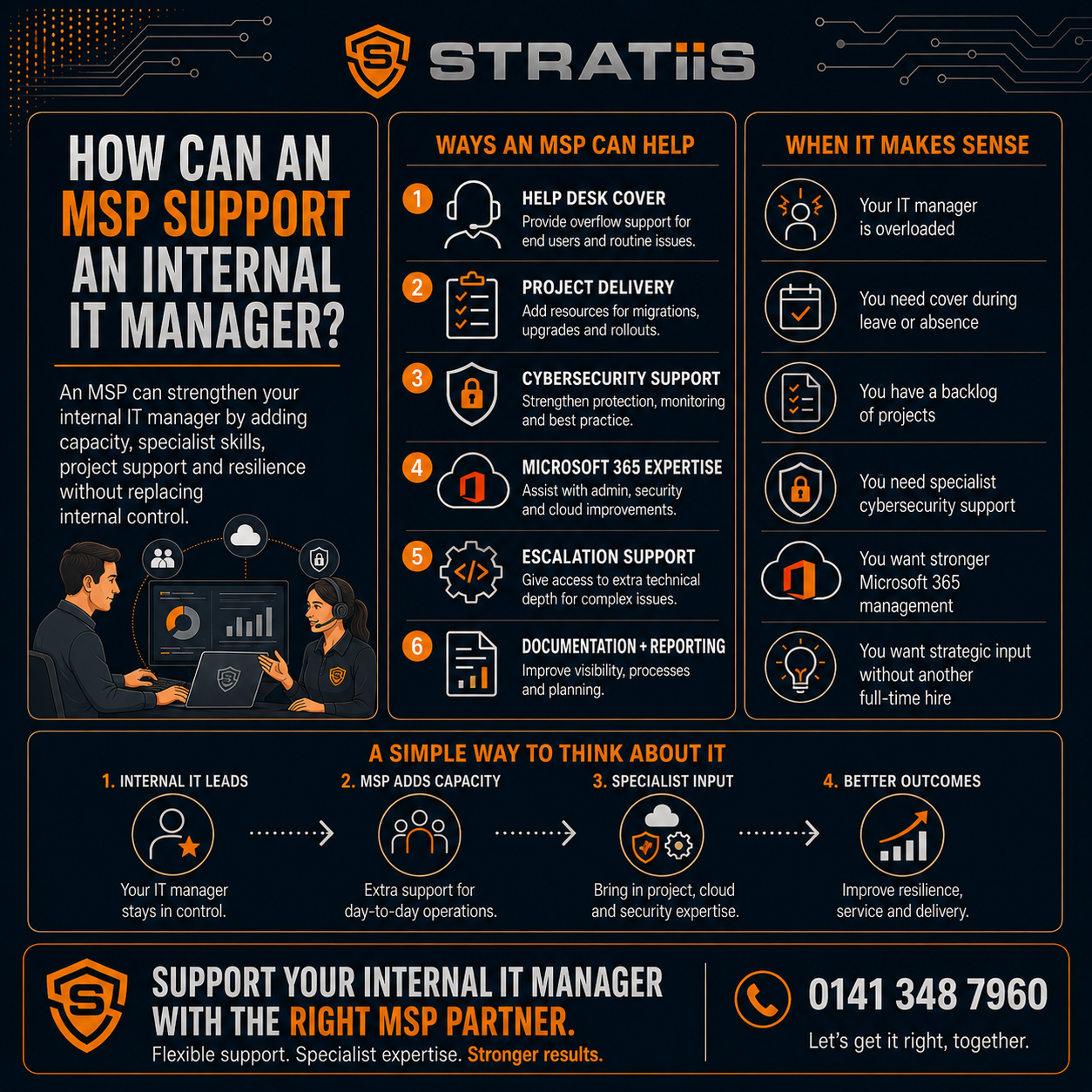
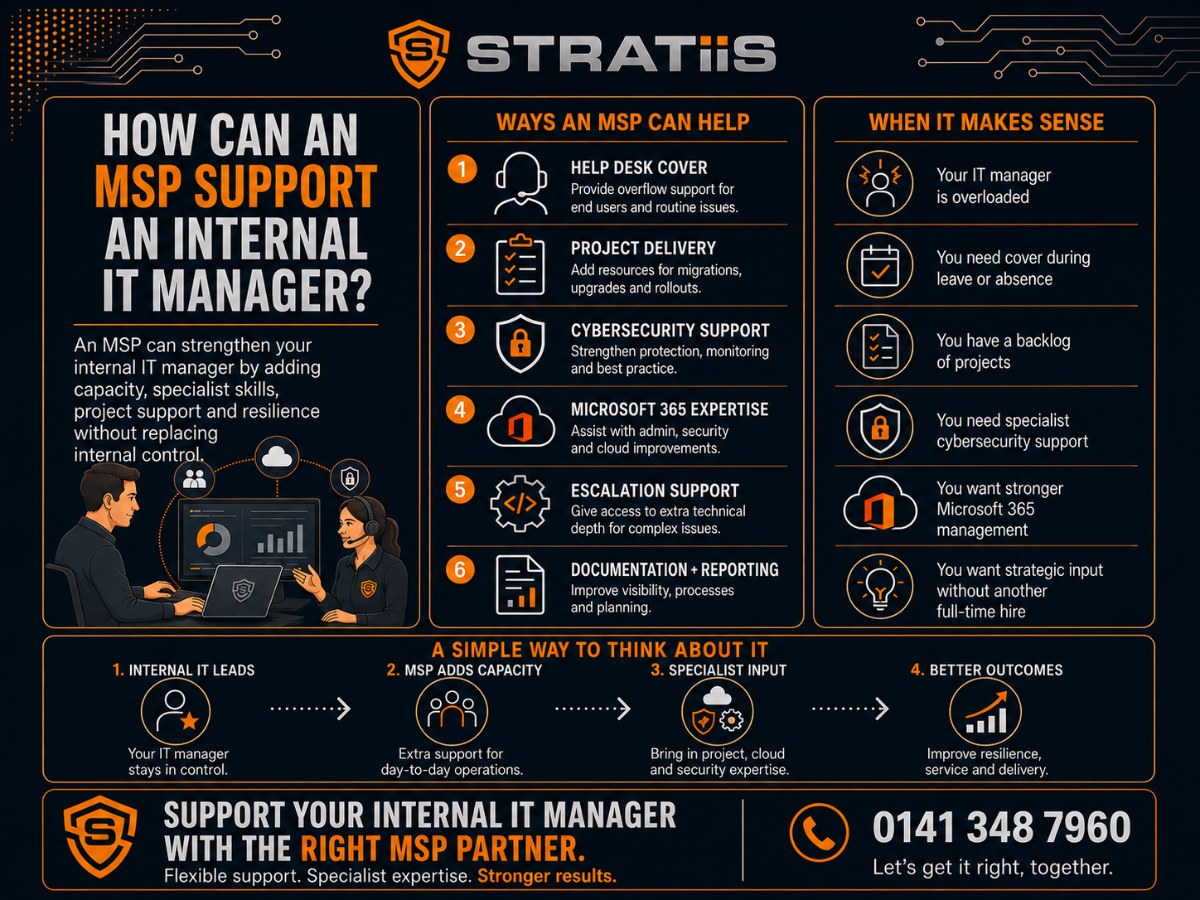
Rather than replacing internal resources, an MSP can:
- Provide specialist expertise
- Reduce operational workload
- Strengthen cybersecurity
- Deliver projects faster
- Cover skills gaps
- Improve resilience
- Provide strategic guidance
Think of an MSP as an extension of your IT team rather than a replacement for it.
Why Internal IT Managers Often Need Additional Support
Modern IT environments are more complex than ever.
An internal IT manager may be responsible for:
- User support
- Microsoft 365
- Cybersecurity
- Cloud services
- Backup and recovery
- Compliance
- Vendor management
- Infrastructure
- Strategic planning
The challenge is that technology continues to evolve while internal resources often remain the same.
As organisations grow, it becomes increasingly difficult for one person or a small team to manage everything effectively.
1. Providing Specialist Expertise
One of the biggest benefits of working with an MSP is access to specialist skills.
Few internal IT managers can be experts in:
- Cybersecurity
- Microsoft 365
- Azure
- SharePoint
- Networking
- Compliance
- Backup and disaster recovery
An MSP gives you access to specialists across multiple disciplines without hiring multiple employees.
Example
An IT manager may understand Microsoft 365 administration but need assistance implementing Conditional Access policies, Microsoft Intune, or advanced security controls.
Rather than spending weeks learning a niche area, they can access specialist expertise immediately.
2. Supporting Cybersecurity Initiatives
Cybersecurity is one of the fastest-growing responsibilities for IT managers.
Threats continue to evolve, while compliance requirements become increasingly demanding.
An MSP can assist with:
- Security monitoring
- Multi-Factor Authentication (MFA)
- Microsoft 365 security
- Vulnerability management
- Cyber Essentials certification
- Security assessments
- Incident response planning
This allows internal teams to improve security without becoming cybersecurity specialists themselves.
3. Reducing Day-to-Day Workload
Many IT managers spend too much time on operational support.
Common examples include:
- Password resets
- Device issues
- User onboarding
- Software support
- Routine maintenance
While these tasks are important, they often prevent IT leaders from focusing on strategic initiatives.
An MSP can provide:
- Helpdesk support
- Overflow support
- Out-of-hours assistance
- User support services
This frees internal resources to focus on higher-value activities.
4. Delivering Projects Faster
One of the biggest frustrations for many IT managers is a lack of time for projects.
Strategic initiatives often get delayed because operational issues take priority.
An MSP can provide additional capacity for projects such as:
- Microsoft 365 migrations
- SharePoint deployments
- Cloud migrations
- Network upgrades
- Cybersecurity improvements
- Infrastructure refreshes
Instead of waiting months for available resources, projects can move forward immediately.
Example
An organisation planning a SharePoint migration may have the internal knowledge to manage the project but lack the available time.
An MSP can provide additional resources to accelerate delivery.
5. Covering Skills Gaps
Technology has become too broad for any one person to master every area.
An MSP helps fill gaps in expertise without requiring additional recruitment.
Common areas include:
Cybersecurity
Threat detection, monitoring, and compliance.
Cloud Services
Azure architecture and migration support.
Microsoft 365
Security, governance, and optimisation.
Backup and Disaster Recovery
Designing resilient recovery strategies.
The result is a stronger IT function without increasing headcount.
6. Providing Cover During Absences
Many organisations depend heavily on a single IT manager.
But what happens if that individual:
- Takes annual leave?
- Becomes ill?
- Leaves the organisation?
An MSP provides continuity and reduces reliance on a single person.
This improves organisational resilience while reducing pressure on internal staff.
7. Supporting Strategic IT Planning
Many MSPs now provide strategic guidance in addition to technical support.
This may include:
- Technology roadmaps
- Lifecycle planning
- Cybersecurity reviews
- Budget planning
- Vendor management
- Digital transformation initiatives
For IT managers, this provides access to additional perspectives and expertise.
Rather than replacing strategic leadership, it enhances it.
Real-World Example: Housing Association
A housing association employs:
- One IT Manager
- 120 employees
The IT manager is responsible for:
- User support
- Microsoft 365
- Cyber Essentials
- Compliance
- Infrastructure
- Supplier management
The organisation partners with an MSP to provide:
- Security monitoring
- Microsoft 365 expertise
- Technical escalations
- Backup management
- Project support
Result:
The IT manager remains responsible for strategy and internal relationships while gaining access to specialist expertise and additional resources.
Real-World Example: Manufacturing Company
A manufacturing business has a small internal IT team supporting production systems.
The MSP assists with:
- Cybersecurity
- Cloud projects
- Infrastructure monitoring
- Disaster recovery planning
Result:
The internal team focuses on production technology while the MSP provides specialist support in areas requiring additional expertise.
Common Concerns IT Managers Have
"Will the MSP Replace Me?"
A good co-managed MSP should strengthen your position, not weaken it.
The objective is to provide support, expertise, and additional capacity.
"Will We Lose Control?"
No.
In a co-managed relationship, the internal IT team retains ownership of technology decisions and priorities.
"Will Users Bypass Internal IT?"
Clear communication and defined responsibilities help ensure support processes work effectively.
The best MSPs integrate into existing workflows rather than disrupting them.
Signs Your IT Team Could Benefit from MSP Support
You may benefit from co-managed IT if:
- Projects are repeatedly delayed
- Cybersecurity demands are increasing
- Your team lacks specialist expertise
- Recruitment is difficult
- Support requests are overwhelming resources
- Business growth is outpacing IT capacity
- You rely heavily on one individual
If several of these sound familiar, additional support may be worth exploring.
What Should an IT Manager Look for in an MSP?
Not all MSPs are experienced in co-managed IT.
Look for a provider that:
- Works collaboratively
- Respects existing internal resources
- Has strong cybersecurity expertise
- Understands Microsoft 365
- Offers flexible support models
- Provides strategic guidance
- Communicates clearly
The relationship should feel like an extension of your team rather than an external supplier.
Final Thoughts
The most effective MSP relationships are built on partnership.
Rather than replacing internal IT managers, co-managed IT gives organisations access to additional expertise, specialist resources, cybersecurity support, and project delivery capabilities that would be difficult and expensive to build internally.
For many organisations, the question is not whether an MSP can replace the IT manager.
It's whether the IT manager can achieve more with the support of a trusted MSP partner.
In most cases, the answer is yes.
The right MSP helps internal IT teams reduce pressure, strengthen security, deliver projects faster, and focus on the strategic initiatives that drive the organisation forward.
Related Articles
What Is Co-Managed IT and How Does It Work?
Co-Managed IT vs Fully Managed IT
How Much Does Co-Managed IT Cost?