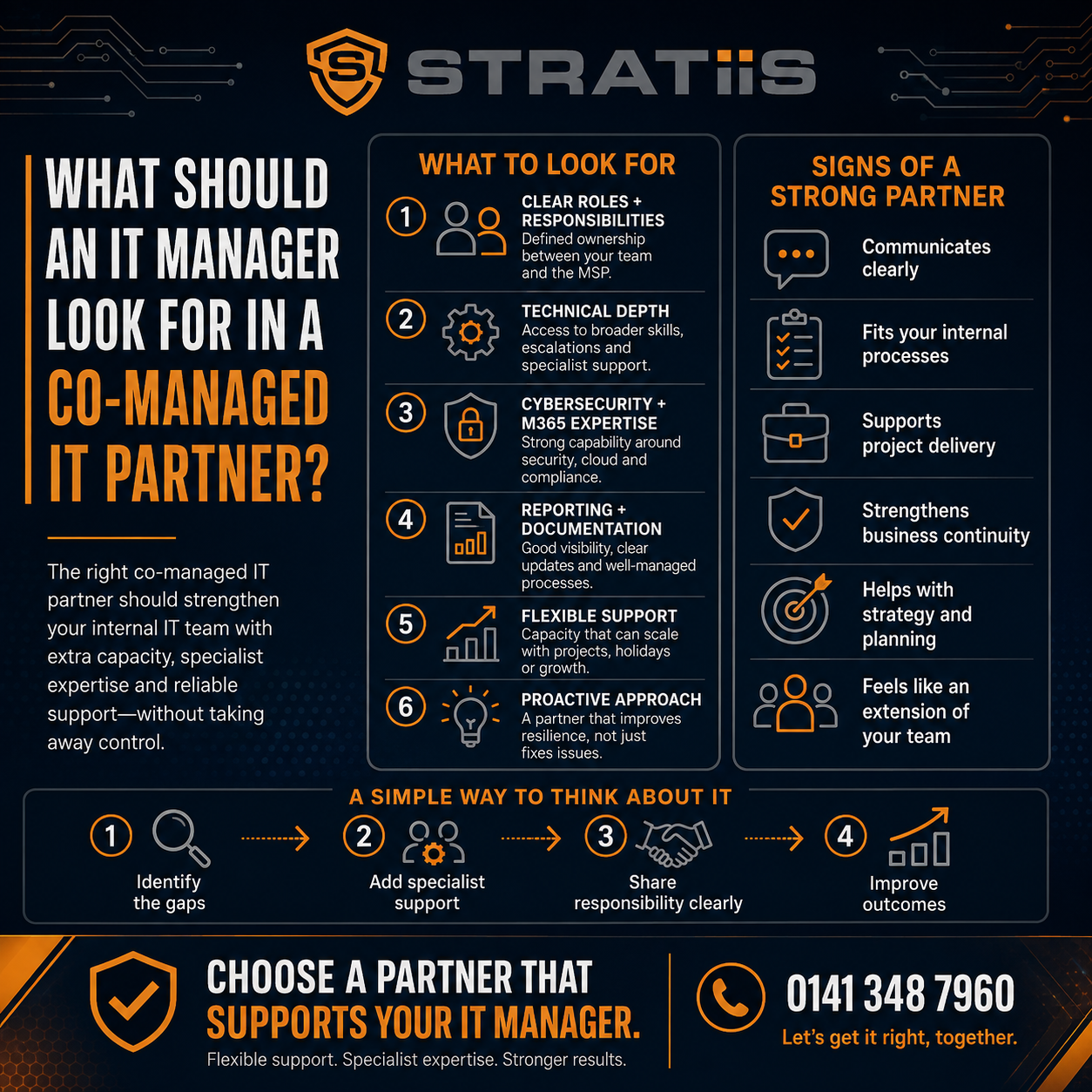
Choosing a co-managed IT partner is very different from selecting a traditional managed service provider.
If you're an IT manager, you're not looking for someone to replace your role. You're looking for a partner that can strengthen your team, fill skill gaps, provide specialist expertise, and help deliver better outcomes for the organisation.
Unfortunately, not every MSP understands how to work effectively alongside an internal IT team.
Some providers try to take over. Others create confusion around responsibilities. The best co-managed IT partners become an extension of your department, providing support where it's needed while allowing you to remain in control.
So, what should you look for when evaluating a co-managed IT provider?
Here are the key criteria every IT manager should consider.
The Short Answer
A good co-managed IT partner should:
- Complement your internal team
- Respect your ownership of IT strategy
- Provide specialist expertise
- Strengthen cybersecurity
- Help deliver projects
- Offer flexible support
- Improve resilience
- Communicate effectively
Most importantly, they should make your life easier—not create additional complexity.
Why Choosing the Right Partner Matters
The success of a co-managed IT relationship depends heavily on trust.
Your MSP will often have access to:
- Critical systems
- Microsoft 365 environments
- Security controls
- Infrastructure
- User data
The wrong provider can create operational challenges.
The right provider can help your team achieve significantly more than would be possible internally.
1. Look for Experience Working with Internal IT Teams
Not all MSPs are experienced in co-managed IT.
Some providers are only accustomed to fully managed environments where they control everything.
Ask questions such as:
- How many co-managed clients do you support?
- Do you regularly work alongside IT managers?
- How do you define responsibilities?
A provider that understands co-managed IT will have clear answers.
Why It Matters
Co-managed IT requires collaboration rather than control.
The MSP should integrate into your existing processes rather than replacing them.
2. Strong Cybersecurity Expertise
Cybersecurity is one of the most common reasons organisations seek co-managed IT support.
Look for expertise in areas such as:
- Multi-Factor Authentication (MFA)
- Microsoft Defender
- Microsoft 365 security
- Conditional Access
- Security monitoring
- Vulnerability management
- Cyber Essentials
- Incident response planning
Questions to Ask
- How do you monitor security threats?
- What cybersecurity frameworks do you follow?
- Can you support Cyber Essentials or ISO 27001 requirements?
Why It Matters
Many internal IT teams need additional cybersecurity resources more than additional helpdesk support.
3. Microsoft 365 Expertise
For many organisations, Microsoft 365 is now their most important business platform.
Your co-managed IT partner should demonstrate expertise in:
- Microsoft 365 administration
- SharePoint
- Teams
- Intune
- Azure
- Microsoft Defender
- Identity and access management
Why It Matters
Microsoft's platform evolves rapidly, and specialist knowledge can significantly improve security and productivity.
4. Flexible Support Models
Every organisation is different.
A good co-managed provider should adapt to your requirements rather than forcing you into a standard service package.
Common support models include:
Specialist Support
Cybersecurity, Microsoft 365, compliance.
Escalation Services
Third-line technical expertise.
Project Support
Cloud migrations, SharePoint projects, infrastructure upgrades.
Full Co-Managed Partnership
Ongoing collaboration across multiple areas.
Why It Matters
Flexibility ensures you only pay for the support you actually need.
5. Clear Roles and Responsibilities
One of the biggest causes of frustration in co-managed IT relationships is uncertainty around ownership.
Before engaging a provider, establish:
- Who handles support requests?
- Who manages security?
- Who owns vendor relationships?
- Who leads projects?
- Who makes final decisions?
Why It Matters
Clear boundaries prevent confusion and improve accountability.
6. Project Delivery Capabilities
Many organisations engage a co-managed partner because important projects are being delayed.
Ask about experience delivering:
- Microsoft 365 migrations
- SharePoint implementations
- Azure projects
- Network upgrades
- Security initiatives
- Infrastructure refreshes
Why It Matters
A provider should do more than maintain systems. They should help move your organisation forward.
7. Strong Communication Skills
Technical expertise is important.
Communication is equally important.
Your MSP should:
- Respond promptly
- Explain technical issues clearly
- Communicate risks effectively
- Provide regular updates
- Work collaboratively
Why It Matters
The best technical solution has little value if communication breaks down.
8. Strategic Thinking
A strong co-managed partner should help you plan for the future.
Look for support with:
- IT roadmaps
- Budget planning
- Hardware lifecycle management
- Cybersecurity strategy
- Business continuity planning
Why It Matters
Technology decisions should support business objectives, not simply solve technical problems.
9. Scalability
Your organisation's requirements will change over time.
The MSP should be able to support:
- Business growth
- Additional users
- New locations
- New technologies
- Evolving compliance requirements
Why It Matters
A provider that can grow with your organisation reduces the need for future supplier changes.
10. Cultural Fit
This is often overlooked.
The MSP will work closely with your team, leadership, and users.
Ask yourself:
- Do they listen?
- Are they collaborative?
- Do they respect internal expertise?
- Do they understand our goals?
Why It Matters
Technical capability matters, but long-term success often depends on working relationships.
Red Flags to Watch For
Be cautious if a provider:
- Talks about replacing internal IT
- Cannot explain their co-managed process
- Focuses only on helpdesk support
- Lacks cybersecurity expertise
- Has little Microsoft 365 experience
- Provides vague answers about responsibilities
- Avoids discussing strategic planning
These can indicate that co-managed IT is not a core part of their service offering.
An Example of Co-Managed IT in Manufacturing
A manufacturing company employs:
- One IT Manager
- One IT Technician
- 120 users
The internal team manages day-to-day support but lacks expertise in cybersecurity and Microsoft 365 security.
When evaluating providers, they shortlist two MSPs.
Provider A
- Focuses primarily on helpdesk support
- Has limited security expertise
- Wants to take over most IT functions
Provider B
- Provides cybersecurity specialists
- Supports Microsoft 365 governance
- Offers technical escalations
- Works within the existing IT structure
The organisation chooses Provider B.
Result:
The internal team remains in control while gaining access to expertise that would have been expensive to recruit internally.
A Practical Evaluation Checklist
Before choosing a co-managed IT provider, ensure they can demonstrate:
Technical Expertise
- Microsoft 365 expertise
- Cybersecurity capabilities
- Infrastructure knowledge
Co-Managed Experience
- Existing co-managed clients
- Defined support models
- Collaborative processes
Strategic Support
- Technology roadmaps
- Budget planning
- Security reviews
Operational Excellence
- Monitoring capabilities
- Escalation procedures
- Project delivery experience
Cultural Fit
- Good communication
- Collaborative approach
- Respect for internal IT teams
Final Thoughts
The best co-managed IT partners don't replace internal IT managers.
They help them succeed.
A strong provider should bring specialist expertise, additional capacity, cybersecurity support, project delivery skills, and strategic guidance while allowing the internal team to remain in control of technology decisions.
When evaluating potential partners, focus on collaboration, technical capability, communication, and flexibility.
The right relationship should reduce pressure, improve outcomes, strengthen security, and help your IT team deliver more value to the organisation.
Ultimately, the best co-managed IT partner is one that feels like an extension of your team rather than an external supplier.
Related Articles
What Is Co-Managed IT and How Does It Work?
Co-Managed IT vs Fully Managed IT
How Much Does Co-Managed IT Cost?
How Can an MSP Support an Internal IT Manager?