One of the biggest misconceptions about co-managed IT is that it means handing over control of your IT department.
In reality, the opposite is often true.
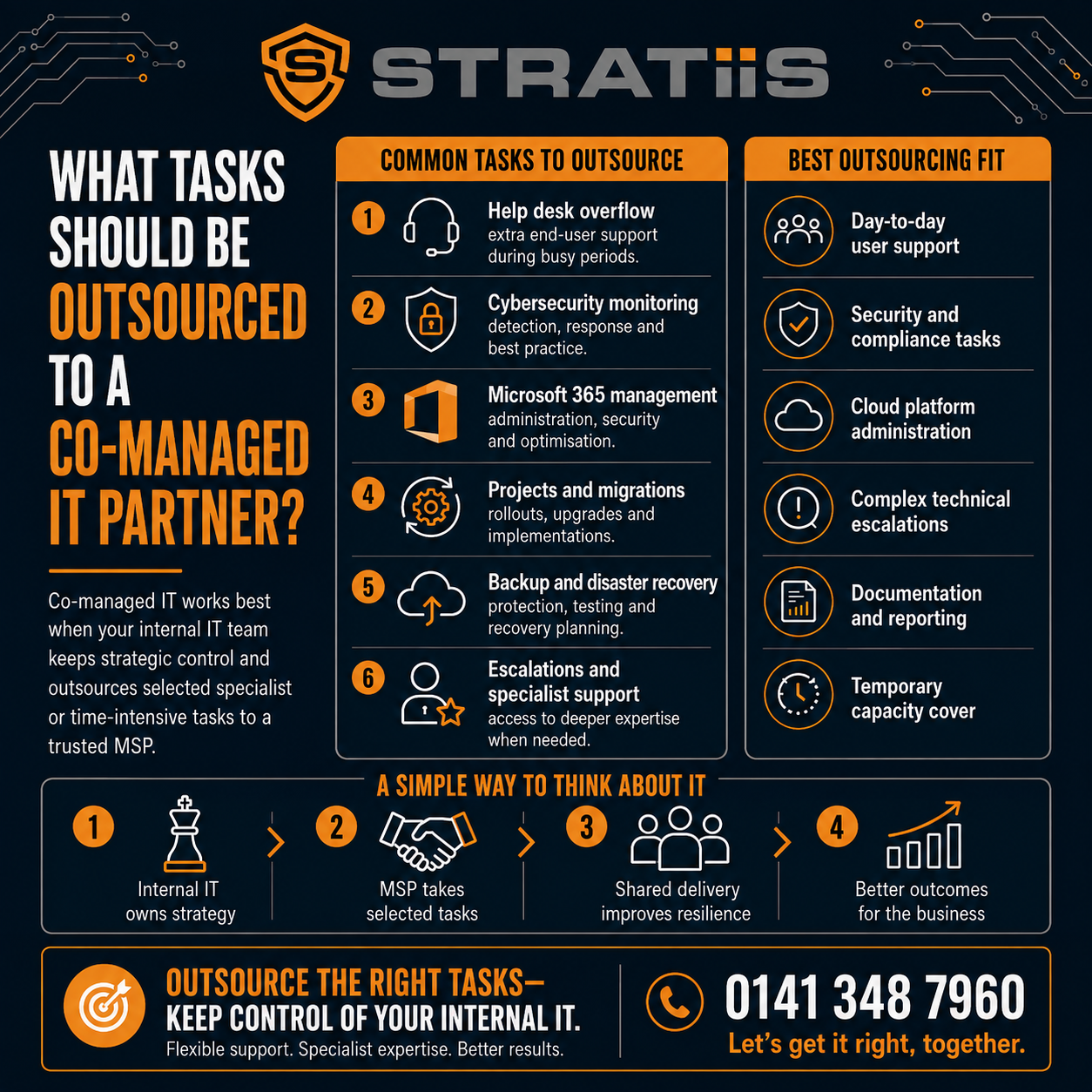
The most successful co-managed IT partnerships allow internal IT teams to focus on strategic priorities while outsourcing specialist, time-consuming, or resource-intensive tasks to an external partner.
The challenge is knowing where to draw the line.
What should remain in-house? What should be outsourced? And how do you ensure your internal IT team remains in control?
In this guide, we'll explore the tasks that organisations most commonly outsource to a co-managed IT provider, the tasks that often remain internal, and how to build a partnership that delivers maximum value.
The Short Answer
Most organisations keep business-critical knowledge, user relationships, and IT strategy in-house while outsourcing specialist expertise, cybersecurity, monitoring, and project delivery.
The goal isn't to replace your IT team.
It's to allow them to focus on the work that has the greatest impact on the organisation.
Why Organisations Choose Co-Managed IT
Many internal IT teams face the same challenges:
- Growing cybersecurity requirements
- Limited resources
- Increasing user expectations
- Microsoft 365 complexity
- Cloud migrations
- Compliance requirements
- Project backlogs
As technology becomes more complex, it becomes difficult for one person or a small team to do everything effectively.
Co-managed IT provides access to additional skills and capacity without hiring multiple specialists.
Task 1: Cybersecurity Management
One of the most common areas organisations outsource is cybersecurity.
Modern cybersecurity requires expertise across multiple disciplines, including:
- Identity security
- Endpoint protection
- Email security
- Vulnerability management
- Compliance
- Threat monitoring
Most internal IT managers simply don't have the time to specialise in every area.
Commonly Outsourced Security Tasks
- Security monitoring
- Microsoft Defender management
- Vulnerability scanning
- Cyber Essentials support
- Security assessments
- Incident response planning
- Risk reviews
Why It Makes Sense
Cybersecurity changes constantly and requires specialist knowledge that can be difficult and expensive to build internally.
Task 2: Microsoft 365 Administration and Security
Microsoft 365 has become the backbone of many organisations.
However, managing Microsoft 365 effectively involves much more than creating user accounts.
Many organisations outsource:
- Conditional Access policies
- Microsoft Intune management
- SharePoint governance
- Microsoft Defender configuration
- Security reviews
- Licensing optimisation
- Compliance controls
Why It Makes Sense
Microsoft releases new features regularly, and many organisations struggle to keep up with best practices.
Task 3: Infrastructure Monitoring and Maintenance
Monitoring infrastructure is essential but rarely strategic.
Many internal IT teams spend valuable time checking systems rather than improving them.
Tasks commonly outsourced include:
- Server monitoring
- Network monitoring
- Device monitoring
- Patch management
- Backup monitoring
- Performance reporting
Why It Makes Sense
These tasks are repetitive, predictable, and well suited to specialist tools and dedicated support teams.
Task 4: Backup and Disaster Recovery
Backups are critical, but they are often neglected until something goes wrong.
Many organisations outsource:
- Backup management
- Recovery testing
- Backup monitoring
- Disaster recovery planning
- Business continuity reviews
Why It Makes Sense
A backup that hasn't been tested may not work when needed.
Specialist oversight helps ensure recovery plans remain effective.
Task 5: Technical Escalations
Internal IT teams often encounter problems that require specialist expertise.
Rather than employing multiple senior engineers, organisations use co-managed IT providers as escalation partners.
Examples include:
- Complex networking issues
- Cloud infrastructure problems
- Microsoft 365 migrations
- Security incidents
- Server troubleshooting
Why It Makes Sense
You gain access to specialist expertise only when you need it.
Task 6: IT Projects
One of the biggest reasons organisations adopt co-managed IT is project delivery.
Internal teams often spend so much time supporting users that strategic projects are continually delayed.
Commonly outsourced projects include:
- Microsoft 365 migrations
- SharePoint implementations
- Cloud migrations
- Server upgrades
- Cybersecurity improvements
- Network refreshes
Why It Makes Sense
Additional resources help projects move forward without disrupting daily operations.
Task 7: Out-of-Hours Support
Many organisations require support outside standard working hours.
Rather than employing additional staff, they outsource:
- After-hours monitoring
- Emergency response
- Weekend maintenance
- Out-of-hours support
Why It Makes Sense
Provides greater coverage without increasing headcount.
What Should Usually Stay In-House?
Not everything should be outsourced.
The most effective co-managed relationships preserve internal ownership of business-critical activities.
IT Strategy
Internal IT leaders should remain responsible for aligning technology with business objectives.
User Relationships
Internal teams often have stronger relationships with employees, departments, and stakeholders.
Business Process Knowledge
No external provider will understand your organisation as deeply as your own team.
Technology Decision-Making
A good MSP should advise, not dictate.
Final decisions should remain with the organisation.
Real-World Example: Housing Association
A housing association employs an IT manager responsible for:
- Stakeholder engagement
- Budget planning
- Technology strategy
- Vendor management
The co-managed IT partner handles:
- Microsoft 365 security
- Cyber Essentials support
- Backup monitoring
- Security reviews
- Technical escalations
Result:
The IT manager spends less time firefighting and more time improving services.
How Co-Managed Works For A Manufacturing Company
A manufacturing business retains responsibility for:
- Production systems
- Operational technology
- Internal support priorities
The MSP manages:
- Cybersecurity
- Infrastructure monitoring
- Cloud projects
- Disaster recovery planning
The Result:
Internal expertise remains focused on manufacturing operations while the MSP provides specialist support.
Common Outsourcing Mistakes
Outsourcing Too Much
Internal ownership is still important.
The best partnerships are collaborative.
Outsourcing Without Defined Responsibilities
Both parties should understand exactly who is responsible for what.
Treating the MSP as a Replacement
Co-managed IT works best when the MSP complements existing resources.
Focusing Only on Cost
The goal should be increasing capability, not simply reducing expenses.
A Simple Decision Framework
Ask these questions:
Is This Task Strategic?
If yes, keep it in-house.
Does This Require Specialist Expertise?
If yes, outsourcing may make sense.
Is This Repetitive and Operational?
If yes, it is often a good candidate for outsourcing.
Do We Have the Internal Capacity?
If not, external support may be more cost-effective than recruitment.
Would Outsourcing Improve Security or Resilience?
If yes, consider involving a specialist provider.
The Ideal Co-Managed IT Model
For most organisations, the ideal split looks something like this:
Internal IT Team
Responsible for:
- Strategy
- Stakeholder management
- Business alignment
- Vendor oversight
- Internal priorities
Co-Managed IT Partner
Responsible for:
- Cybersecurity
- Microsoft 365 expertise
- Monitoring
- Escalations
- Backup management
- Project delivery
- Specialist support
This model combines internal knowledge with external expertise.
Final Thoughts
The purpose of co-managed IT is not to outsource responsibility.
It's to outsource the right tasks.
Most organisations achieve the best results when they retain ownership of strategy, business relationships, and decision-making while outsourcing specialist, operational, and resource-intensive activities to a trusted partner.
By focusing internal teams on high-value work and leveraging external expertise where it adds the greatest benefit, organisations can improve security, accelerate projects, reduce pressure on staff, and build a more resilient IT function.
The question isn't whether you should outsource IT tasks.
It's which tasks will create the greatest value when supported by the right co-managed IT partner.
Related Articles
What Is Co-Managed IT and How Does It Work?
Co-Managed IT vs Fully Managed IT
How Much Does Co-Managed IT Cost?
How Can an MSP Support an Internal IT Manager?