Cybersecurity has become one of the biggest challenges facing internal IT teams.
Threats are increasing, compliance requirements are becoming more demanding, and technology platforms such as Microsoft 365 continue to evolve at a rapid pace. At the same time, many organisations are asking small IT teams to manage user support, infrastructure, cloud services, projects, and cybersecurity with the same resources they've always had.
It's no surprise that many organisations are turning to co-managed IT for help.
But how exactly can a co-managed IT partner improve cybersecurity?
The answer is that a good co-managed IT provider doesn't simply add another layer of support. They bring specialist expertise, additional resources, proven processes, and dedicated security capabilities that many internal IT teams struggle to build on their own.
In this guide, we'll explore how co-managed IT can strengthen your cybersecurity posture and reduce risk across your organisation.
The Short Answer
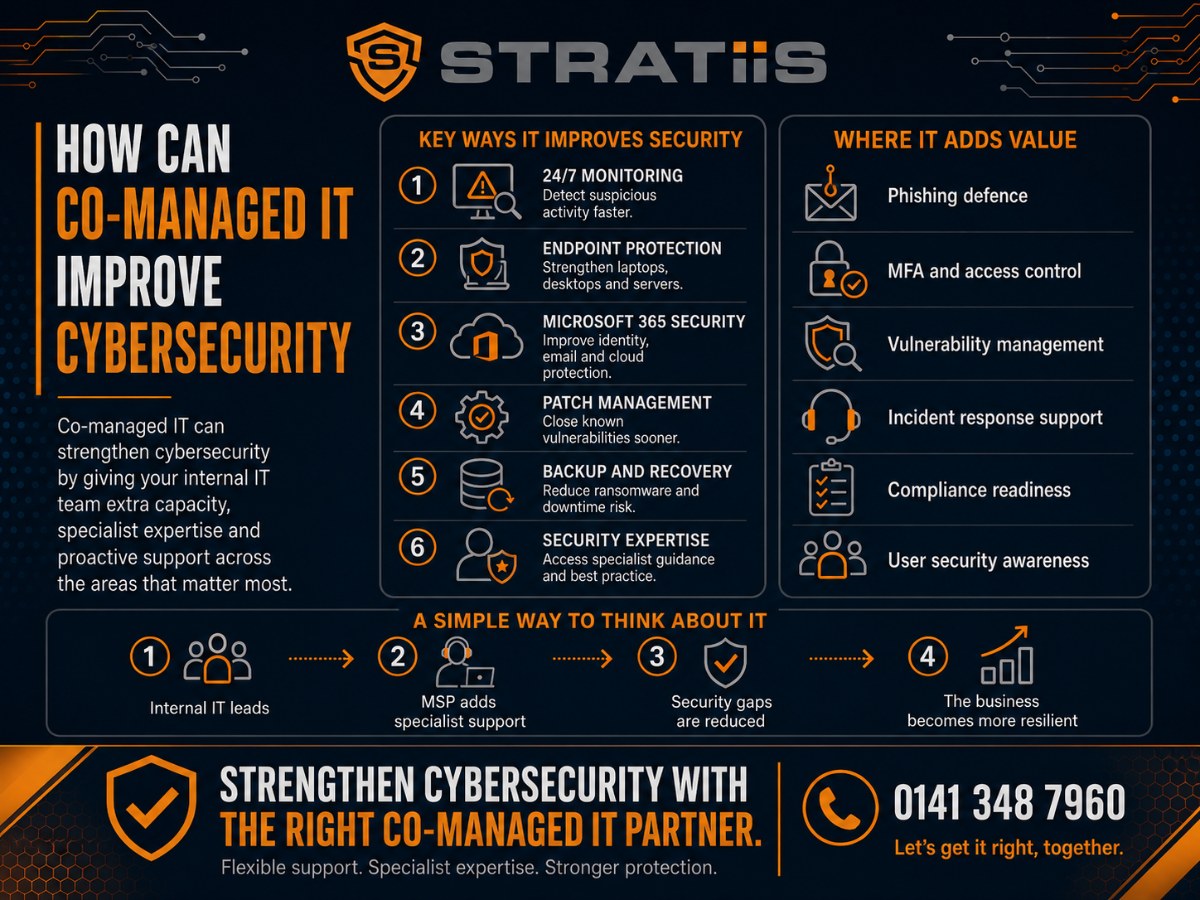
Co-managed IT improves cybersecurity by providing access to specialist expertise, security tools, monitoring capabilities, and additional resources that support your internal IT team.
This often includes:
- Multi-Factor Authentication (MFA)
- Microsoft 365 security
- Security monitoring
- Vulnerability management
- Backup and disaster recovery
- Cyber Essentials support
- Security awareness training
- Incident response planning
The goal is not to replace your IT team.
It's to help them build a stronger and more resilient security posture.
Why Internal IT Teams Often Struggle with Cybersecurity
Most internal IT managers wear multiple hats.
On any given day they may be responsible for:
- User support
- Microsoft 365 administration
- Device management
- Infrastructure maintenance
- Project delivery
- Supplier management
- Budget planning
Cybersecurity becomes just one responsibility among many.
The challenge is that modern cybersecurity is now a specialist discipline in its own right.
Protecting an organisation effectively requires knowledge of:
- Identity security
- Endpoint protection
- Threat detection
- Email security
- Compliance
- Cloud security
- Incident response
Few organisations can afford to hire specialists in every area.
1. Implementing Multi-Factor Authentication (MFA)
One of the most effective cybersecurity controls available today is Multi-Factor Authentication.
Yet many organisations still fail to implement it consistently.
A co-managed IT partner can help:
- Enable MFA across Microsoft 365
- Protect administrative accounts
- Secure remote access
- Implement Conditional Access policies
- Review authentication methods
Why It Matters
Most successful cyberattacks begin with compromised credentials.
MFA significantly reduces the risk of unauthorised access.
2. Strengthening Microsoft 365 Security
Many organisations rely heavily on Microsoft 365 but only use a fraction of its security capabilities.
A co-managed IT provider can help configure and manage:
- Microsoft Defender
- Conditional Access
- Data Loss Prevention (DLP)
- Intune
- Secure external sharing
- Identity protection
- Security policies
Why It Matters
Microsoft 365 is often the most important platform in the organisation.
Securing it properly delivers significant risk reduction.
3. Providing Continuous Security Monitoring
Most cyberattacks do not happen instantly.
Attackers often spend days or weeks attempting to gain access and move through systems.
Continuous monitoring helps identify:
- Suspicious login activity
- Malware infections
- Unusual behaviour
- Failed login attempts
- Potential data breaches
Why It Matters
The earlier threats are identified, the easier they are to contain.
Many internal IT teams simply do not have the resources to monitor systems continuously.
4. Managing Vulnerabilities Before Attackers Exploit Them
Cybercriminals frequently exploit known vulnerabilities in software and systems.
A co-managed IT provider can assist with:
- Vulnerability scanning
- Patch management
- Security assessments
- Risk prioritisation
- Remediation planning
Why It Matters
Reducing vulnerabilities reduces opportunities for attackers.
5. Improving Backup and Disaster Recovery
Even the best cybersecurity strategy cannot eliminate every risk.
That's why recovery planning is critical.
A co-managed IT partner can help manage:
- Automated backups
- Recovery testing
- Backup monitoring
- Disaster recovery planning
- Business continuity reviews
Why It Matters
If ransomware or a security incident occurs, recovery capabilities become just as important as prevention.
6. Supporting Cyber Essentials and Compliance Requirements
Many organisations need to demonstrate compliance with frameworks such as:
- Cyber Essentials
- Cyber Essentials Plus
- GDPR
- ISO 27001
- Industry-specific standards
A co-managed IT provider can help implement the controls required to meet these obligations.
Why It Matters
Compliance often improves overall cybersecurity while reducing business risk.
7. Delivering Security Awareness Training
Technology alone cannot stop cyberattacks.
Employees remain one of the most common targets for cybercriminals.
Training programmes often include:
- Phishing awareness
- Password security
- Social engineering
- Safe data handling
- Incident reporting
Why It Matters
A well-informed workforce is one of the strongest security controls available.
8. Developing an Incident Response Plan
Many organisations focus on preventing attacks but fail to prepare for them.
A co-managed IT provider can help create documented procedures covering:
- Cyberattacks
- Data breaches
- Ransomware incidents
- Service outages
- Recovery processes
Why It Matters
A fast, organised response can significantly reduce the impact of an incident.
How Co-Managed IT Can Help A Housing Association Improve Cybersecurity
A housing association employs a single IT manager responsible for:
- User support
- Microsoft 365
- Infrastructure
- Compliance
Cybersecurity receives attention but often competes with operational priorities.
The organisation adopts a co-managed IT model.
The MSP provides:
- Security monitoring
- Microsoft 365 security reviews
- Cyber Essentials support
- Vulnerability assessments
- Backup oversight
Result:
Improved security posture without increasing headcount.
How Co-Managed IT Can Help A Manufacturing Business Improve Cybersecurity
A manufacturing company operates:
- Office systems
- Production systems
- Remote access services
The internal IT team lacks dedicated cybersecurity expertise.
The co-managed provider assists with:
- Network security
- MFA implementation
- Endpoint protection
- Incident response planning
Result:
Reduced ransomware risk and stronger operational resilience.
Common Cybersecurity Mistakes Internal IT Teams Make
Many security issues arise because teams simply lack time and resources.
Common examples include:
Delaying Security Projects
Operational issues always seem more urgent.
Not Enabling MFA Everywhere
Accounts remain protected by passwords alone.
Underutilising Microsoft 365 Security Features
Organisations pay for security capabilities they never implement.
Failing to Test Backups
Backups exist but recovery procedures are unproven.
No Formal Incident Response Plan
Security incidents become chaotic when roles and responsibilities are unclear.
A co-managed IT partner can help address these gaps.
Signs Your Organisation Could Benefit from Co-Managed Cybersecurity Support
You may benefit from a co-managed approach if:
- Your IT team is overloaded
- Security projects are being delayed
- Compliance requirements are increasing
- You lack cybersecurity expertise
- You are concerned about ransomware
- Microsoft 365 security is not fully configured
- Security monitoring is limited
- You rely heavily on a single IT professional
A Practical Cybersecurity Checklist
Ask yourself:
Identity Security
- MFA enabled for all users
- Administrative accounts protected
- Conditional Access configured
Microsoft 365 Security
- Defender enabled
- Secure sharing configured
- Intune deployed where appropriate
Security Monitoring
- Threat monitoring active
- Alerts reviewed regularly
- Incident processes documented
Recovery Planning
- Backups tested
- Disaster recovery plan documented
- Recovery objectives defined
User Awareness
- Security training delivered
- Phishing awareness programme active
If several items are missing, co-managed IT may help close those gaps.
Final Thoughts
Cybersecurity is no longer a side responsibility for IT teams.
It has become one of the most important business risks organisations face.
For many internal IT managers, the challenge isn't understanding the importance of cybersecurity—it's finding the time, resources, and specialist expertise required to manage it effectively.
Co-managed IT helps bridge that gap.
By providing access to security specialists, Microsoft 365 expertise, monitoring capabilities, compliance support, and recovery planning, a co-managed IT partner can significantly strengthen your organisation's security posture while allowing internal teams to remain focused on strategic priorities.
The result is stronger protection, reduced risk, and greater confidence that your organisation is prepared for the threats it faces today and in the future.
Related Articles
What Is Co-Managed IT and How Does It Work?
Co-Managed IT vs Fully Managed IT
How Much Does Co-Managed IT Cost?
How Can an MSP Support an Internal IT Manager?