The way construction companies operate has changed dramatically over the last decade.
Project managers access plans from site cabins. Quantity surveyors work from multiple locations. Directors review project data while travelling. Engineers collaborate remotely. Office staff support projects from head office and home environments.
Technology has made construction businesses more flexible and productive.
However, it has also created new cybersecurity risks.
Every laptop, smartphone, tablet, and cloud application used outside the office creates another potential entry point for cybercriminals.
The challenge for construction companies is clear:
How do you give employees secure access to the systems and information they need without creating unnecessary cybersecurity risks?
In this guide, we'll explain how construction businesses can support remote and site-based workers securely while maintaining productivity, protecting project information, and reducing cyber risk.
Why Construction Companies Face Unique Security Challenges
Unlike many office-based organisations, construction businesses operate across multiple locations.
Employees may work from:
- Construction sites
- Site cabins
- Temporary project offices
- Home offices
- Customer locations
- Head office environments
This creates a more complex technology environment than many organisations experience.
Common challenges include:
- Mobile workforce management
- Device security
- Unsecured Wi-Fi networks
- File sharing
- Access control
- Project data protection
- Cybersecurity awareness
Without the right controls, these challenges can increase the likelihood of cyber incidents.
What Information Needs Protecting?
Construction companies handle a wide range of sensitive information.
Project Documentation
Including:
- Drawings
- Site plans
- Specifications
- Contracts
- Health and safety documentation
Commercial Information
Such as:
- Tenders
- Pricing data
- Supplier agreements
- Financial records
Employee Information
Including:
- Payroll data
- HR records
- Personal information
Customer Information
Such as:
- Project communications
- Contact information
- Contract documentation
Protecting this information is essential for maintaining client trust and business continuity.
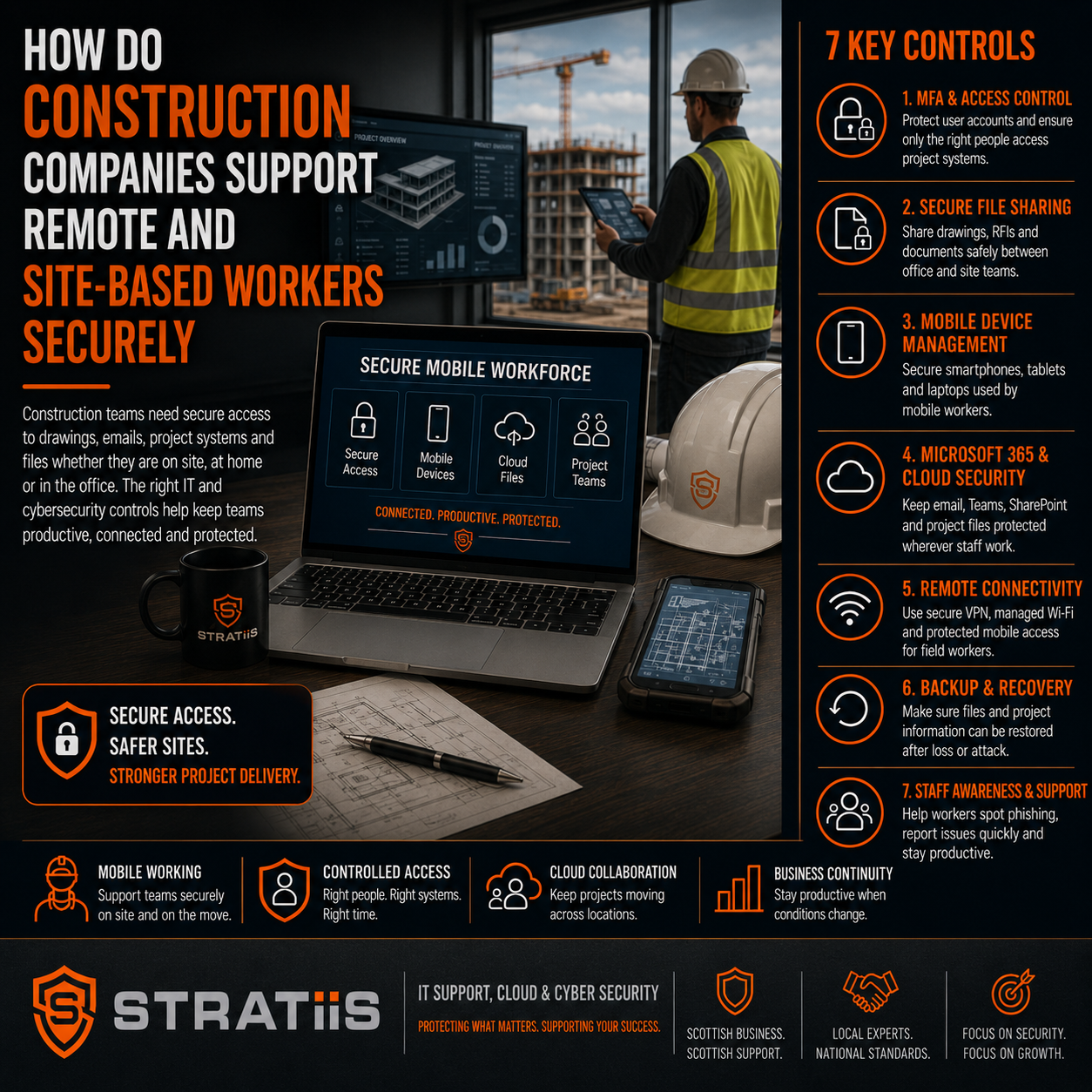
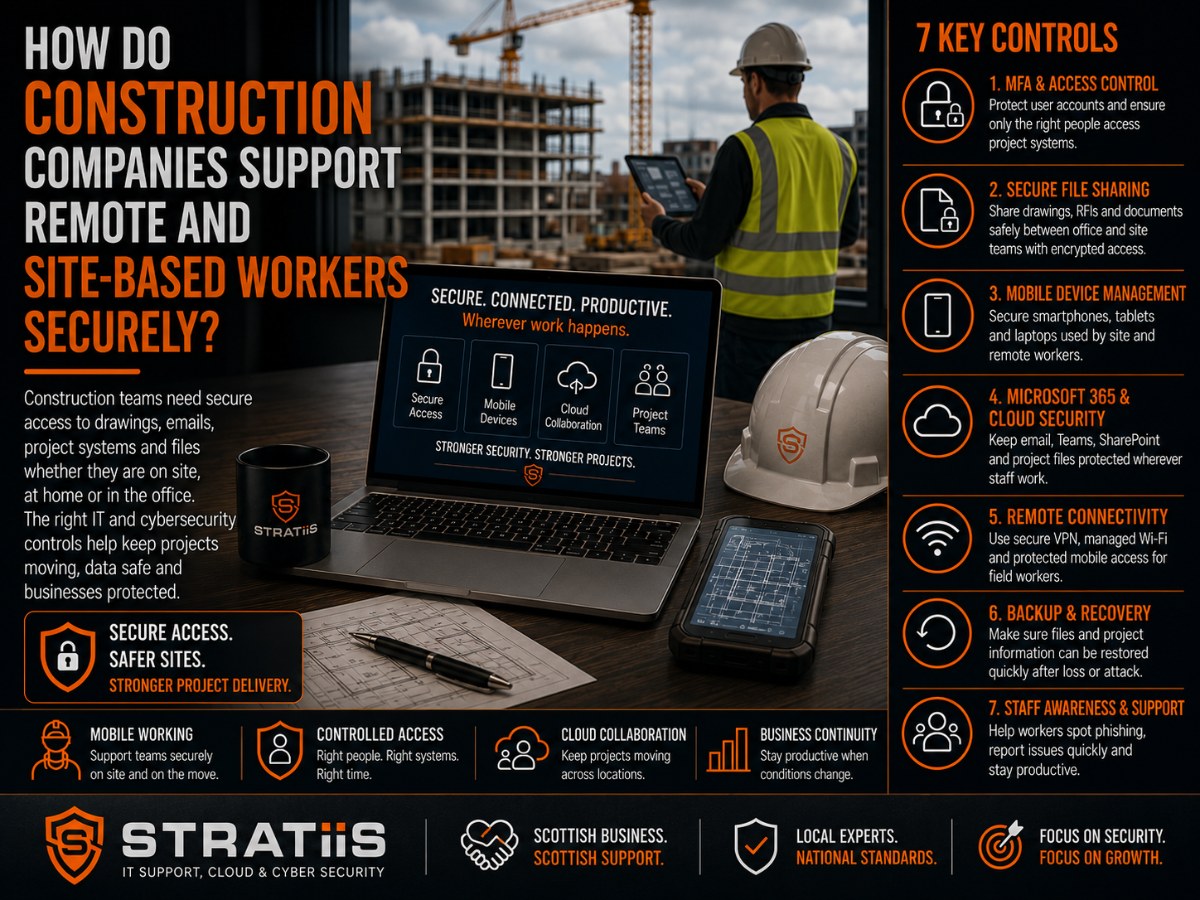
The 7 Essential Security Controls for Remote Construction Teams
1. Multi-Factor Authentication (MFA)
Passwords alone are no longer sufficient.
Multi-Factor Authentication adds an additional layer of security by requiring users to verify their identity using:
- Authentication apps
- Push notifications
- Security keys
- Biometrics
Why It Matters
Many cyberattacks begin with compromised passwords.
MFA significantly reduces the likelihood of unauthorised access.
Recommended Coverage
Enable MFA for:
- Microsoft 365
- Email systems
- Project management platforms
- Cloud applications
- Administrator accounts
For most construction businesses, MFA is one of the most effective cybersecurity improvements available.
2. Secure Cloud-Based Document Management
Construction projects generate large volumes of documentation.
Many organisations still rely on email attachments and local file storage.
This creates unnecessary risks.
Better Alternatives Include
- Microsoft SharePoint
- Microsoft Teams
- OneDrive
These platforms provide:
- Secure document access
- Version control
- Permission management
- Audit trails
- Collaboration tools
Employees can access files from site without compromising security.
3. Managed and Secured Devices
Every device used to access company systems should be managed.
This includes:
- Laptops
- Tablets
- Smartphones
Device Management Should Include
- Encryption
- Security policies
- Remote wipe capability
- Software updates
- Device monitoring
If a device is lost or stolen, the business should be able to protect company information quickly.
4. Endpoint Protection
Construction businesses are increasingly targeted by ransomware and phishing attacks.
Modern endpoint protection helps detect:
- Malware
- Ransomware
- Suspicious behaviour
- Unauthorised access attempts
Protected Devices Should Include
- Laptops
- Desktops
- Mobile devices
- Servers
Traditional antivirus software alone is no longer enough.
5. Role-Based Access Controls
Not every employee requires access to every project.
A site manager should not necessarily have access to HR records.
Likewise, subcontractors should only access relevant project information.
Benefits
- Reduced risk
- Better governance
- Improved accountability
- Stronger data protection
Access should be reviewed regularly.
6. Security Awareness Training
Construction businesses often focus heavily on physical site safety.
Cybersecurity awareness should receive similar attention.
Employees should understand:
- Phishing attacks
- Password security
- Safe file sharing
- Mobile device security
- Incident reporting
Many cyberattacks succeed because employees are unaware of common threats.
Regular training helps reduce this risk.
7. Backup and Recovery Planning
Construction projects rely heavily on digital information.
A ransomware attack or hardware failure can disrupt operations significantly.
Every Construction Business Should Have
✓ Automated backups
✓ Offsite backups
✓ Recovery testing
✓ Business continuity plans
✓ Disaster recovery procedures
The ability to recover quickly is just as important as prevention.
How Microsoft 365 Supports Secure Remote Working
Many construction companies already use Microsoft 365.
When configured correctly, it provides a secure platform for remote and site-based workers.
Key Capabilities
- Microsoft Teams collaboration
- SharePoint document management
- OneDrive file access
- Multi-Factor Authentication
- Conditional Access
- Microsoft Defender
- Device management through Intune
Many organisations already own these features but are not using them fully.
Common Security Mistakes Construction Companies Make
Mistake #1: Sharing Project Files via Email
Email attachments increase the risk of:
- Version control issues
- Data leakage
- Accidental disclosure
Secure collaboration platforms provide a better alternative.
Mistake #2: Using Unmanaged Personal Devices
Personal devices often lack business-grade security controls.
Mistake #3: No Multi-Factor Authentication
Passwords alone no longer provide sufficient protection.
Mistake #4: Poor Access Controls
Too many users often have access to information they don't require.
Mistake #5: No Cybersecurity Training
Employees remain a primary target for cybercriminals.
What Does Good Security Look Like for a Construction Business?
A secure construction company typically has:
Identity Security
✓ Multi-Factor Authentication
✓ Strong password policies
✓ Role-based access
Device Security
✓ Managed devices
✓ Endpoint protection
✓ Encryption
✓ Security updates
Data Protection
✓ SharePoint document management
✓ Secure file sharing
✓ Backup systems
User Security
✓ Security awareness training
✓ Phishing education
Governance
✓ Cyber Essentials readiness
✓ Incident response planning
✓ Risk assessments
This creates a practical and achievable security baseline.
How To Secure A 50-Person Construction Company
The Challenges Faced
- Multiple project sites
- Remote workers
- Growing Microsoft 365 usage
- Increasing cybersecurity concerns
The Improvements Implemented
The business deployed:
- Multi-Factor Authentication
- Microsoft Teams
- SharePoint document management
- Device management
- Endpoint protection
- Security awareness training
The Outcomes
Benefits included:
- Improved collaboration
- Reduced cyber risk
- Better project information control
- Increased productivity
- Enhanced business continuity
The goal was enabling secure remote working rather than restricting it.
Construction Remote Working Security Checklist
Before allowing remote or site-based access, ask:
✓ Is MFA enabled?
✓ Are devices encrypted?
✓ Are project files stored securely?
✓ Are backups tested regularly?
✓ Do employees receive cybersecurity training?
✓ Is device management in place?
✓ Are permissions reviewed regularly?
If the answer to any of these questions is no, there may be opportunities to strengthen security.
Why Construction Companies Across Scotland Choose Stratiis
At Stratiis, we help construction businesses throughout Glasgow, Edinburgh, Lanarkshire, Ayrshire, Lothian, Dumfries & Galloway, and Perthshire support remote and site-based workers securely.
Our cybersecurity-first services include:
- Managed IT support
- Microsoft 365 deployment
- SharePoint implementation
- Device management
- Endpoint protection
- Cyber Essentials readiness
- Backup and disaster recovery
- Strategic vCIO services
We help construction companies improve productivity, strengthen security, and reduce operational risk.
Final Thoughts
Modern construction businesses depend on remote and site-based workers.
The challenge is ensuring employees can access the information they need without exposing the organisation to unnecessary cyber risk.
For most construction companies, this means implementing:
- Multi-Factor Authentication
- Secure document management
- Device management
- Endpoint protection
- Security awareness training
- Backup and recovery planning
The objective is not to restrict flexibility.
It's to enable secure, productive working wherever your employees happen to be.
In today's construction industry, secure remote working is no longer a competitive advantage.
It's a business requirement.
Related Articles
Should We Move Our File Server to Microsoft 365 and SharePoint?
How Can Manufacturing Companies Reduce Ransomware Risk Without Increasing IT Spend?
What Cybersecurity Protections Does a 50-Person Business Actually Need?
What Are the Most Common Cybersecurity Mistakes Made by Scottish SMEs?