
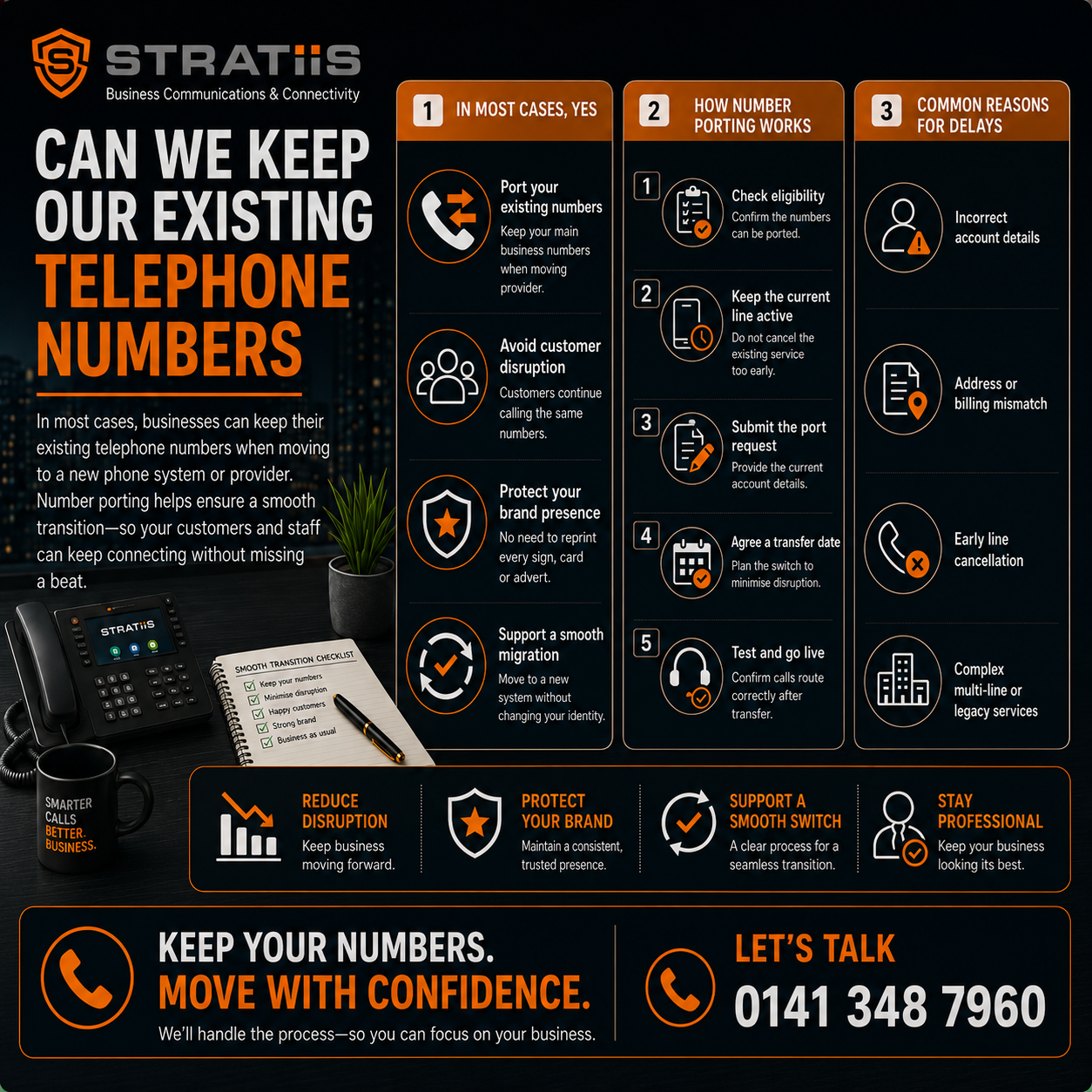
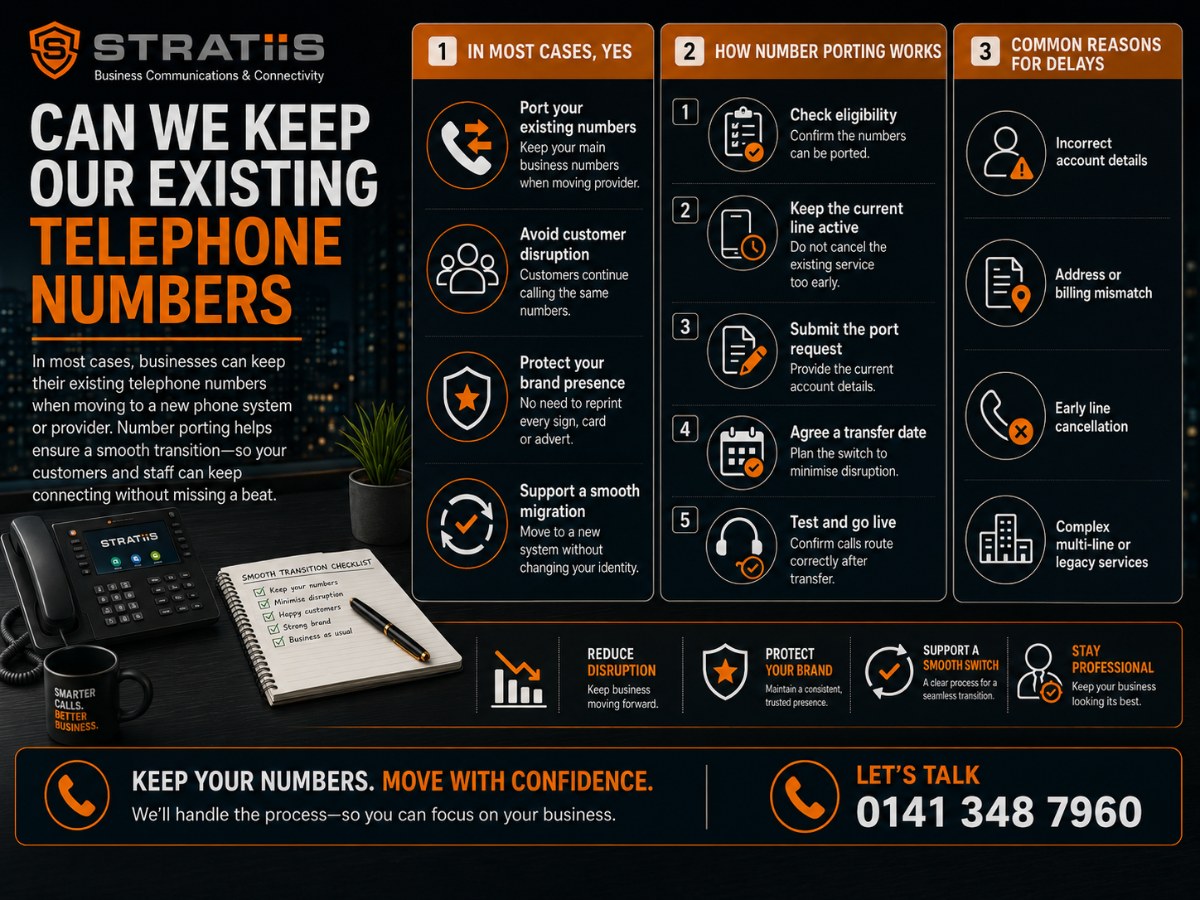
In most cases, yes.
A business can usually keep its existing telephone numbers when moving to:
- Hosted Voice
- Unified Communications
- Microsoft Teams Phone
- A new telecoms provider
- A new office
- A different internet-based phone system
The process is called number porting.
Number porting transfers an existing telephone number from the current provider to the new service.
For many organisations, keeping existing numbers is essential.
Customers may already have them saved. The numbers may appear on your website, business cards, vehicles, invoices, contracts and marketing material.
Changing them could lead to:
- Missed customer calls
- Lost enquiries
- Confusion
- Additional marketing costs
- Calls continuing to reach an old service
- Damage to customer trust
Although most business numbers can be transferred, number porting is not always automatic or risk-free.
The process depends on the number type, current provider, account information and whether any other services are connected to the same telephone line.
In this article, we will explain how number porting works, how long it takes, what can go wrong and how to reduce the risk of losing an important business number.
What is number porting?
Number porting is the process of moving a telephone number from one communications provider to another.
The number itself remains the same.
The service behind it changes.
For example, a business may move a Glasgow telephone number from an old on-site phone system to a cloud-hosted phone service.
Customers continue dialling the same number.
The new provider receives the calls and routes them through the replacement phone system.
Numbers that may be portable include:
- Main business numbers
- Individual direct-dial numbers
- Geographic numbers
- Non-geographic numbers
- Freephone numbers
- Mobile numbers
- Blocks of business numbers
Portability depends on the number, provider and service arrangement.
Why is keeping an existing number so important?
A business telephone number may have been used for years.
It may appear on:
- Website pages
- Google Business Profile
- Business cards
- Email signatures
- Vehicles
- Building signs
- Invoices
- Contracts
- Online directories
- Advertising
- Social media
- Customer databases
- Supplier records
Customers may also have the number stored in their phones.
Changing it can create more disruption than the business expects.
Even when a new number is advertised clearly, some customers may continue using the old one for months or years.
Keeping the number helps maintain continuity.
Can all business telephone numbers be transferred?
Many can, but not every number is guaranteed to be portable in every situation.
The provider should confirm portability before the business signs the replacement contract.
Common number types include:
Geographic numbers
These are numbers linked to a regional area code, such as:
- 0141
- 0131
- 01224
- 01292
Geographic business numbers can normally be transferred between providers.
Non-geographic numbers
These may include:
- 03 numbers
- 08 numbers
- Freephone numbers
These numbers may also be portable, depending on the provider and account details.
Direct-dial numbers
A business may have a range of numbers allocated to employees or departments.
For example:
- Main number: 0141 000 1000
- Direct numbers: 0141 000 1001 to 0141 000 1099
The full range may need to be transferred together.
Moving only one number without understanding the range can create problems.
Mobile numbers
Business mobile numbers can normally be transferred using a mobile porting process.
This is separate from fixed telephone number porting.
What information is needed to port a number?
The new provider may need:
- Current telephone number
- Current provider
- Account name
- Account number
- Installation address
- Billing address
- Main billing number
- Number range details
- Latest invoice
- Letter of authority
- Requested port date
The information must match the records held by the current provider.
A small difference can cause the request to be rejected.
Examples include:
- Old company name
- Previous office address
- Incorrect postcode
- Missing number range
- Wrong account holder
- Number listed under another provider
A number audit should happen before the porting request is submitted.
What is a main billing number?
A main billing number is the primary number linked to a telephone account or group of services.
It may not be the number customers normally call.
It can be important because other numbers or services may depend on it.
If the main billing number is transferred or cancelled without checking those relationships, associated services may be affected.
The provider should identify:
- Main billing number
- Published business number
- Direct-dial numbers
- Linked lines
- Broadband dependencies
- Analogue services
This is one reason number porting needs more than a list copied from the website.
What is a number range?
A business may have a block of numbers rather than separate independent numbers.
For example:
- 0141 000 1000 to 0141 000 1099
This is sometimes called a DDI range or direct-dial range.
The numbers may appear separate to employees and customers.
Behind the scenes, they may form one connected allocation.
A provider may need to port:
- The complete range
- The main number and all associated numbers
- A defined part of the range, where supported
Incomplete records can result in numbers being left behind or rejected.
How can we find every number we own?
This is often harder than expected.
Business numbers may be found in:
- Telecoms invoices
- Phone-system configuration
- Reception records
- Department documents
- Websites
- Email signatures
- Marketing material
- Old contracts
- Customer records
- Provider portals
- Call-forwarding arrangements
The organisation should ask employees whether they use:
- Direct-dial numbers
- Department numbers
- Fax numbers
- Helpline numbers
- Temporary numbers
- Numbers advertised for specific services
A proper number audit should identify:
- Number
- Purpose
- Current user
- Current provider
- Published location
- Whether it still receives calls
- Whether it should be retained
- Whether it belongs to a range
Can we move only some of our numbers?
Sometimes.
This depends on how the numbers are arranged.
Individual numbers may be moved separately where they are independent.
Numbers within a block may need special handling.
Moving part of a number range could affect:
- Remaining numbers
- Billing
- Routing
- Direct-dial services
- Provider records
The new provider should confirm whether a partial port is technically and contractually possible.
Can we keep our number when moving office?
Usually, particularly when moving to a cloud phone system.
Traditionally, a geographic number was more closely linked to a physical exchange area.
Cloud services make it easier to use the same business number from a different building.
The business may keep the number while employees work from:
- A new office
- Home
- Another branch
- Mobile devices
- Temporary premises
The provider should still confirm number portability and emergency-calling arrangements.
Can we keep a Scottish number if employees work elsewhere?
Often, yes.
A Glasgow business number can normally be used through a hosted phone system even when an employee is working from:
- Edinburgh
- Aberdeen
- England
- Home
- Another country
The employee may answer through a desktop or mobile application.
The business should consider:
- Customer expectations
- Emergency location information
- International connectivity
- Call quality
- Data protection
- Provider terms
The number can represent the business location even when individual employees work elsewhere.
Can we keep our number when moving to Hosted Voice?
In most cases, yes.
The number is transferred to the Hosted Voice provider or its telephone carrier.
Once the port completes, calls to the number are routed through the cloud phone system.
The provider then directs calls to:
- Employees
- Call groups
- Reception
- Auto-attendants
- Queues
- Mobile applications
- Voicemail
The old phone service should remain active until the transfer has completed and been tested.
Can we keep our numbers with Microsoft Teams Phone?
Usually, yes.
Existing numbers can be connected to Microsoft Teams Phone through options such as:
- Microsoft Calling Plans
- Operator Connect
- Direct Routing
The porting process depends on which calling method and provider are selected.
Before migration, the business should confirm:
- Which provider will hold the numbers
- Who submits the port request
- How long the process may take
- Which numbers can be moved
- What happens during the migration
- Who supports a failed port
Microsoft Teams licensing alone does not automatically transfer the numbers.
Can we move numbers between Hosted Voice providers?
Usually.
A number that was previously transferred to a Hosted Voice provider can generally be ported again to another provider.
The business may need:
- Account details
- Number records
- Letter of authority
- Contract information
- Porting information from the existing provider
The current provider should not claim ownership of the number simply because it hosts the service.
The contract should explain the exit and porting process clearly.
Who owns our telephone numbers?
This question should be confirmed before entering any agreement.
The business should remain the recognised customer or end user of its important numbers.
The provider may administer or host the number.
That should not prevent the business from transferring it later.
Ask:
- Is our organisation recorded as the customer?
- Can the number be ported away?
- What information will we need?
- Are there exit charges?
- Is there a notice period?
- Can the provider block a port during a dispute?
- Who owns any newly supplied numbers?
A business number should not become a trap that makes changing provider unnecessarily difficult.
Can a provider refuse to release our numbers?
A provider may reject or delay a transfer where:
- Account information is wrong
- The number is not active
- The number is not registered to the business
- A range is incomplete
- The port type is incorrect
- Contract issues exist
- The request lacks authority
- The gaining provider submits incorrect information
A refusal does not necessarily mean the number can never be moved.
The cause should be identified and corrected.
The new provider should take responsibility for coordinating the port rather than leaving the customer to manage several carriers.
How long does number porting take?
The timescale depends on:
- Number type
- Current provider
- New provider
- Number of numbers
- Number ranges
- Account accuracy
- Complexity
- Requested port date
- Rejections
A simple number may be transferred relatively quickly.
A large range or multi-site migration may require several weeks of planning.
The provider should avoid promising an exact completion date before checking the number records.
The most important factor is not speed.
It is completing the transfer without losing customer calls.
Can we choose the porting date?
Usually, a preferred date can be requested.
The provider should coordinate:
- New phone-system configuration
- Number transfer
- Employee readiness
- Hardware
- Call routing
- Training
- Support coverage
The chosen date should avoid:
- Business-critical deadlines
- Payroll periods
- Major customer events
- Office moves
- Holidays
- Reduced staffing
- Important campaigns
A Friday afternoon may sound convenient.
It can create problems if support resources are limited over the weekend.
Will our phone system stop working during the transfer?
There may be a short period of disruption while routing changes from the old provider to the new one.
A well-managed port should minimise this.
The provider may use:
- Temporary numbers
- Call forwarding
- Mobile applications
- Alternative routing
- Staged porting
- Test calls
- Launch support
The organisation should understand:
- Expected interruption
- Which calls may be affected
- Who will test the numbers
- Who will escalate problems
- How employees will communicate
- What customers will experience
No provider should promise zero risk without qualification.
What happens to outgoing calls during a port?
Outgoing calls may be configured before or during the number transfer.
The business should test:
- Caller identity
- Main number presentation
- Direct number presentation
- Emergency calling
- International calls
- Mobile applications
- Reception calls
A system may receive incoming calls correctly while displaying the wrong number on outgoing calls.
Both directions need to be tested.
What happens if the port fails?
A port may fail or be rejected because of incorrect account information or provider records.
Possible outcomes include:
- The old service continues working
- The transfer is delayed
- Some numbers move and others do not
- Incoming routing becomes inconsistent
- Temporary call routing is needed
The migration plan should include:
- Named escalation contacts
- Current-provider details
- Temporary numbers
- Call-forwarding options
- Test scripts
- Employee communication
- Customer communication where necessary
The provider should not cancel or dismantle the old system until the new service is confirmed as working.
What are the most common reasons for a rejected port?
Common causes include:
Incorrect account name
The provider’s records may show an old company or trading name.
Incorrect address
The installation address may differ from the billing or current office address.
Wrong main billing number
The number submitted may not be the account’s primary reference.
Incomplete number range
One number may have been requested when the provider expects the full block.
Wrong provider
The company receiving the invoice may not be the carrier that technically holds the number.
Inactive number
A cancelled or disconnected number may be harder or impossible to recover.
Missing authority
The request may not include valid approval from the account holder.
Linked services
The number may be connected to another telephone or broadband service that has not been identified.
Should we cancel our old phone service first?
No.
Do not cancel the old service before the numbers have transferred successfully.
Cancelling too early may:
- Disconnect the numbers
- Stop incoming calls
- Remove porting eligibility
- Affect broadband
- Cancel linked services
- Make recovery difficult
The correct order is normally:
- Audit the numbers
- Configure the new system
- Submit the porting request
- Complete the transfer
- Test every number
- Confirm the service
- Cancel remaining old services
The provider should tell you when it is safe to cancel.
Could porting a number cancel our broadband?
Possibly.
Some older broadband services are linked to a telephone line or main billing number.
Moving or cancelling that number may affect the associated broadband.
Before porting, the provider should check:
- Whether broadband uses the same line
- Whether the main number is linked
- Whether another service needs to be installed first
- Whether the broadband contract will continue
- Whether a line takeover could occur
This risk is especially important when replacing older phone and connectivity services at the same time.
What other services could be connected to our phone lines?
Telephone lines may support more than voice calls.
They may be used for:
- Broadband
- Fax
- Alarms
- Lift emergency phones
- Door-entry systems
- Payment terminals
- CCTV
- Intercoms
- Franking machines
- Building-management systems
Removing or porting a number without checking these services can cause unexpected failures.
Every line should be audited before it is cancelled.
Can we keep a fax number?
Possibly.
The number itself may be portable.
The fax service behind it may need to change.
Traditional fax can be unreliable over some internet-based voice services.
Options may include:
- Cloud fax
- Email-to-fax
- Fax-to-email
- Retaining a specialist service
- Replacing the process entirely
The business should first ask whether fax is still genuinely required.
If it is, the provider should test or design a suitable replacement.
Can we keep numbers used for alarms or lift phones?
The number may be transferable, but the connected equipment may require a specialist solution.
These services should not be moved as ordinary voice users without checking:
- Equipment compatibility
- Monitoring provider
- Power backup
- Mobile signal
- Emergency requirements
- Maintenance responsibility
Speak to the alarm, lift or equipment provider before changing the line.
Can we keep numbers that are forwarded elsewhere?
Usually, but the current routing must be understood.
A number may currently forward to:
- Mobile phone
- Answering service
- Another office
- Contact centre
- Emergency team
- External supplier
The new phone system can often recreate or improve the routing.
The business should document:
- Where the number currently rings
- When the forwarding applies
- Who answers
- Who pays for diverted calls
- What should happen after migration
Can we keep direct numbers for employees?
Usually.
Direct-dial numbers can be assigned to the same employees on the new system.
The migration is also an opportunity to review whether each number should be:
- Retained
- Reassigned
- Redirected
- Removed
- Used as a department number
Numbers belonging to former employees should not be ported without a reason.
Important customer relationships may justify retaining and redirecting them.
What happens to the number of an employee who leaves?
The business should normally retain control of the number.
It may be:
- Reassigned to a replacement employee
- Redirected to the employee’s manager
- Routed to a department
- Sent to reception
- Placed on a recorded message
- Retired after a defined period
The employee should not take a business-owned number unless the organisation approves a transfer.
The leaver process should also cover:
- Voicemail
- Mobile applications
- Call queues
- Authentication services
- Published contact details
Can an employee keep a personal number used for business?
A personally owned number normally belongs to the employee.
The business may not be able to transfer or retain it without the employee’s agreement.
This creates risk when:
- Customers know only the employee’s personal number
- The number appears on business material
- It is used for authentication
- It receives important customer enquiries
- The employee leaves
Businesses should avoid building customer relationships around personal numbers.
A business-owned number or calling application provides better continuity.
Can personal numbers be moved into a business account?
Often, with the number owner’s authority.
The process may involve:
- Proof of ownership
- Porting authorisation
- Current account information
- Replacement SIM or service
- Agreement about future ownership
Once moved, the employee should understand whether the number becomes a business asset.
This is particularly important when the number has both personal and work use.
Can we change providers without telling customers?
Usually, yes, when the number stays the same.
Customers may not notice that the platform or provider has changed.
You may still need to tell employees about:
- New applications
- New desk phones
- Different voicemail
- Call transfer changes
- Planned migration time
- Temporary disruption
- New support arrangements
Customers may need communication when:
- The migration affects service hours
- A temporary number is used
- Call menus change
- A department number changes
- A major contact process changes
Should we keep every old number?
Not necessarily.
Some numbers may:
- Receive no calls
- Belong to former employees
- Appear nowhere publicly
- Duplicate another service
- Generate unnecessary charges
- Attract only nuisance calls
- Relate to a closed office or department
The provider should help identify which numbers to:
- Port
- Redirect
- Retire
- Replace
- Keep temporarily
Do not pay indefinitely for unused numbers simply because they have always existed.
How do we decide which numbers to retain?
Ask these questions for every number:
- Who uses it?
- Where is it advertised?
- How many calls does it receive?
- Are those calls valuable?
- Does it belong to a number range?
- Is it linked to another service?
- Would customers notice if it disappeared?
- Should calls be redirected?
- Is it used for account recovery?
- Is it used by a former employee?
- Does it have contractual or compliance importance?
Call records can help identify whether a number is active.
A number with little activity may still be important if it is used for emergencies or a specific customer service.
How much does number porting cost?
Some providers include porting within the project.
Others charge according to:
- Number type
- Individual numbers
- Number ranges
- Provider
- Complexity
- Rejected requests
- Resubmissions
- Out-of-hours work
- Temporary routing
The direct porting fee is often a small part of the overall migration.
The main value comes from:
- Accurate auditing
- Project coordination
- Call-flow configuration
- Risk management
- Testing
- Support
A cheap port handled badly can cost far more through lost calls.
Is number porting included in a Hosted Voice quote?
Sometimes.
Ask the provider whether the quotation includes:
- Number audit
- Porting fees
- Letter of authority
- Current-provider checks
- Project management
- Temporary numbers
- Testing
- Rejected port resubmission
- Launch-day support
- Out-of-hours migration
A quotation that says “number porting included” may still exclude complex ranges or non-standard requests.
What should happen before the porting date?
The provider should complete:
Number audit
Confirm every number, range and current provider.
Call-flow design
Decide where each number should route on the new system.
User setup
Create users, extensions, voicemail and applications.
Hardware preparation
Configure desk phones and headsets.
Connectivity testing
Check internet, firewall, switches and Wi-Fi.
Employee training
Show employees how to answer, transfer and manage calls.
Test plan
Define how incoming and outgoing calls will be checked.
Continuity plan
Prepare temporary routing or mobile alternatives if needed.
What should happen on the porting day?
The provider should:
- Confirm the old service is working
- Check the new system
- Monitor the transfer
- Test incoming calls
- Test outgoing caller identity
- Test direct-dial numbers
- Test call queues
- Test reception
- Test voicemail
- Test mobile applications
- Check emergency calling
- Escalate any failures
- Keep management updated
The business should nominate employees who understand:
- Reception
- Customer-service calls
- Department numbers
- Important direct numbers
Testing only the main number is not enough.
What should happen after the port?
The provider should confirm:
- Every number works
- Calls reach the correct people
- Caller identity is correct
- Voicemail works
- Queues operate correctly
- Out-of-hours routing works
- Mobile applications receive calls
- Reporting is accurate
- Temporary diverts are removed
- Old services can be cancelled
The organisation should also update its number register.
What mistakes put business numbers at risk?
Cancelling the old service too early
This is one of the most serious mistakes.
Assuming the website lists every number
Direct and specialist numbers may be missing.
Ignoring number ranges
Porting one number may affect a larger block.
Using incorrect account information
The port may be rejected.
Not checking linked broadband
Connectivity may be disconnected accidentally.
Forgetting alarms and other analogue services
Critical equipment may stop working.
Choosing an unrealistic migration date
The business may not have enough time to correct problems.
Having no temporary routing plan
Customers may be unable to reach the organisation.
Testing only the main number
Direct numbers and queues may still fail.
Letting the old provider own the process
The new provider should coordinate the migration actively.
What should you look for in a provider?
A good provider should:
- Complete a full number audit
- Understand number ranges
- Review existing invoices
- Check linked broadband and analogue services
- Explain portability before contract
- Manage the porting request
- Build the new call routing first
- Provide a migration plan
- Test all numbers
- Provide an escalation route
- Confirm when old services can be cancelled
- Explain who owns the numbers after migration
Be cautious when a provider:
- Says every number can definitely be moved before checking
- Does not request current bills
- Ignores number ranges
- Tells you to cancel the old contract first
- Cannot explain what happens if the port fails
- Leaves you to deal with the old carrier
- Does not provide a test plan
Questions to ask before porting telephone numbers
- Can every number be transferred?
- Which numbers form part of a range?
- Who currently holds the numbers?
- What account information is required?
- Is any broadband linked to the lines?
- Are alarms, lifts or fax services connected?
- Who submits the port request?
- Is porting included in the quote?
- How long should the process take?
- Can we choose the date?
- What interruption should we expect?
- What happens if the request is rejected?
- What temporary routing is available?
- Who tests each number?
- Who supports the migration?
- When can the old service be cancelled?
- Will we own and control the numbers afterwards?
- Can we port them to another provider in future?
Can we guarantee that no calls will be lost?
No responsible provider should promise that there is absolutely no risk.
Number porting involves coordination between different providers and carrier systems.
A good migration can reduce the risk significantly through:
- Accurate records
- Proper planning
- Temporary routing
- Controlled timing
- Thorough testing
- Active escalation
- Employee communication
The goal should be to minimise disruption and recover quickly from any issue.
Be cautious of claims that porting is instant, effortless or completely risk-free.
Is it better to change our telephone numbers instead?
Usually not, unless there is a clear reason.
A new number may make sense when:
- The business has moved into a new market
- The existing number has a poor reputation
- The number receives excessive nuisance calls
- The current number belongs to an employee
- The company is changing identity
- A new central number is part of a wider strategy
- The old number cannot be transferred
Even then, the old number may need to be retained and redirected for a transition period.
Changing numbers should be a planned business decision rather than the result of poor porting preparation.
Can we keep the old number and add new numbers?
Yes.
A Hosted Voice or Unified Communications service may support:
- Existing main number
- New department numbers
- New direct-dial numbers
- Numbers for other locations
- Non-geographic numbers
- Campaign numbers
- Temporary project numbers
The organisation should avoid creating more numbers than it can manage.
Each number needs:
- An owner
- A purpose
- Call routing
- Reporting
- Review
- A plan when it is no longer required
Is keeping our telephone numbers worth the effort?
For most established organisations, yes.
Keeping existing numbers helps protect:
- Customer continuity
- Brand recognition
- Marketing investment
- Supplier communication
- Published contact information
- Customer trust
The process requires careful preparation.
That is still normally easier and less expensive than changing every public reference and hoping customers notice.
Keep your numbers, but do not leave the process to chance
Most businesses can keep their telephone numbers when moving to a new provider or cloud phone system.
The key word is most.
Number porting should begin with a full audit, not an assumption.
The provider needs to understand:
- Which numbers exist
- Who owns them
- Whether they form part of a range
- Which services are linked
- Where calls should route
- How the business will operate during the transfer
The old service should remain active until every important number has been transferred and tested.
Stratiis can help review your telephone numbers, current contracts, call flows, broadband dependencies and analogue services before planning the migration.
We can then coordinate number porting as part of a Hosted Voice, Microsoft Teams Phone or Unified Communications project.
Book a Telephone Number Porting Review
Call: 0141 348 7960
Email: sales@stratiis.com