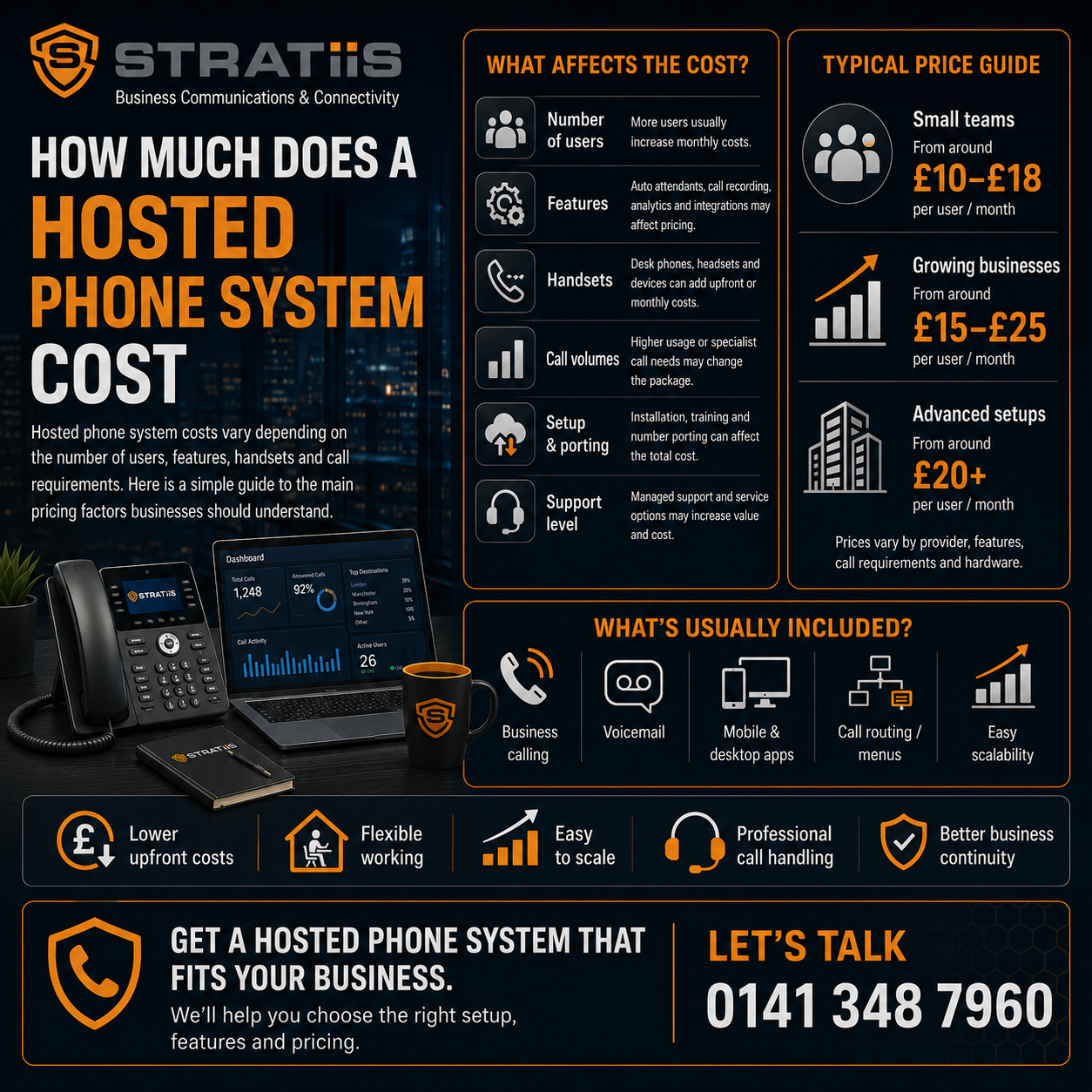
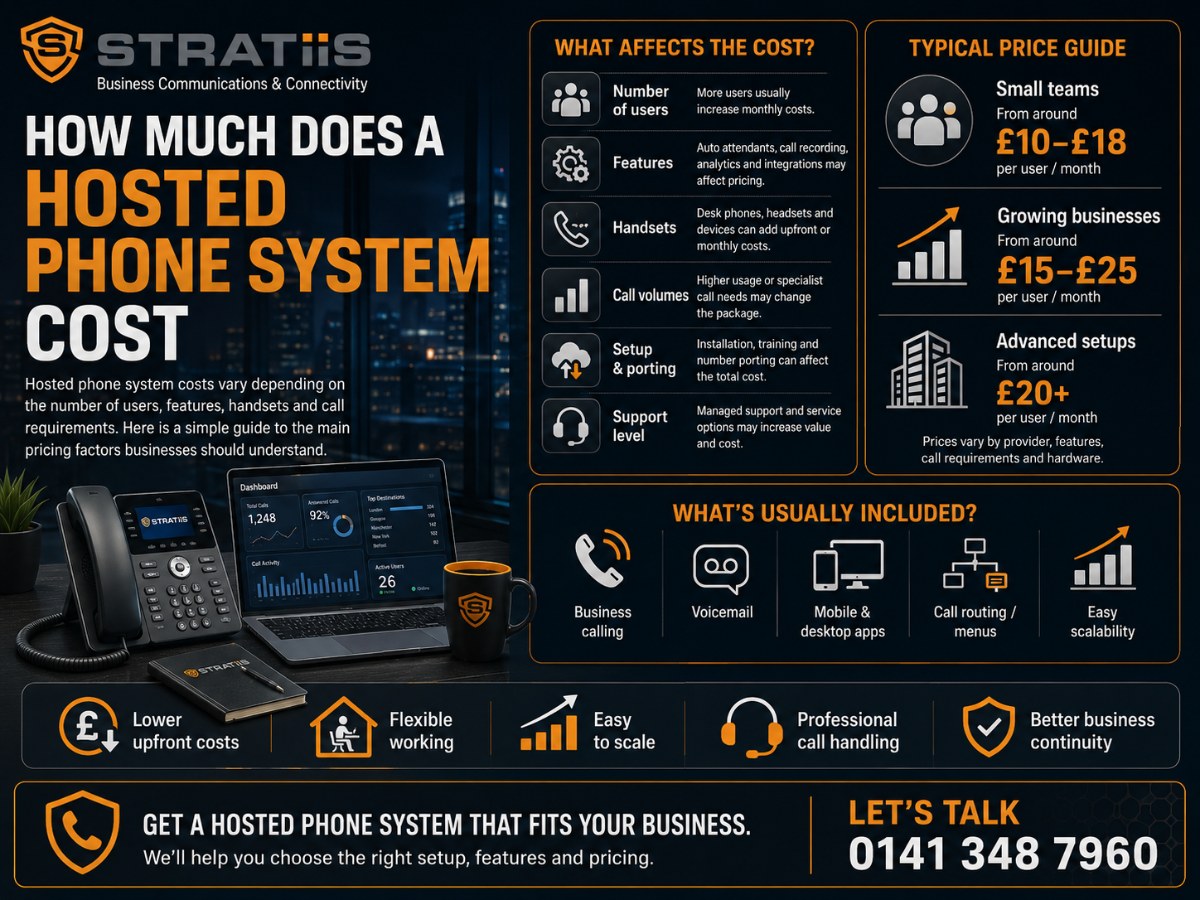
A hosted phone system will typically cost a UK business between £10 and £30 per user per month, excluding VAT.
For early budgeting, you might expect to pay:
- £10–£15 per user per month for a basic hosted phone service
- £15–£25 per user per month for a standard business user
- £25–£50 or more per user per month for advanced calling, recording, analytics or customer-service features
There may also be one-off costs for:
- Installation and configuration
- Number porting
- Desk phones
- Headsets
- Call-flow design
- Training
- Broadband or network improvements
- Internet failover
A ten-user business might therefore spend between £150 and £300 per month for the working phone service, plus approximately £1,000 to £4,000 for setup and equipment.
A 50-user organisation may spend between £750 and £1,500 per month, with a larger one-off project cost where it needs reception tools, call recording, several offices or extensive hardware.
Those ranges are deliberately broad.
A hosted phone system is not one standard package. Two providers may both quote a price “per user” while including very different services.
The only reliable way to compare costs is to look beyond the licence and calculate the total cost of the system you will actually use.
What is a hosted phone system?
A hosted phone system is a business telephone service operated through the cloud rather than through a traditional telephone system installed at your premises.
It is also commonly described as:
- Hosted Voice
- Cloud telephony
- Hosted VoIP
- Cloud PBX
- IP telephony
- Business VoIP
Employees can normally make and receive calls using:
- IP desk phones
- Computers
- Headsets
- Mobile applications
- Tablets
The service may include:
- Business telephone numbers
- Extension calling
- Call transfers
- Voicemail
- Call forwarding
- Hunt groups
- Call queues
- Auto-attendants
- Mobile working
- Call recording
- Call reporting
- Desktop applications
- Integration with other business systems
Instead of buying and maintaining a large physical telephone system, the organisation pays a recurring subscription.
A quick guide to hosted phone-system costs
The following figures are broad UK budgeting ranges and exclude VAT.
| Cost item | Typical indicative range |
|---|---|
| Basic hosted user | £10–£15 per month |
| Standard business user | £15–£25 per month |
| Advanced user | £25–£50+ per month |
| Contact-centre agent | £40–£100+ per month |
| Basic wired headset | £30–£80 |
| Professional headset | £80–£250 |
| Standard IP desk phone | £90–£250 |
| Reception or executive phone | £200–£500+ |
| Initial setup | £500–£10,000+ |
| Call recording | £5–£30+ per recorded user monthly |
| Internet failover | Priced separately |
| Broadband or leased line | Priced separately |
These figures are suitable for planning.
The exact price will depend on the provider, platform, contract term and the features included.
How much does a basic hosted phone user cost?
A basic hosted user may cost approximately £10 to £15 per month.
This type of service might include:
- One business user
- A business telephone number
- Incoming and outgoing calls
- Voicemail
- Call transfer
- Call forwarding
- Basic desktop or mobile application
- Access to an online portal
It may suit:
- Very small businesses
- Light telephone users
- Shared office users
- Employees who mainly use mobile applications
- Organisations with straightforward call handling
A low-cost package may not include:
- UK call allowance
- Desk phone
- Number porting
- Installation
- Provider support
- Call recording
- Advanced queues
- CRM integration
- Reporting
- Internet connectivity
The headline licence is therefore only the starting point.
How much does a standard business user cost?
A standard hosted phone user will commonly cost around £15 to £25 per month.
This may include:
- Business number
- UK call allowance
- Desktop application
- Mobile application
- Voicemail
- Call transfer
- Call forwarding
- Presence
- Call groups
- Auto-attendant access
- Basic reporting
- Provider support
This level may be suitable for:
- General office employees
- Account managers
- Sales teams
- Managers
- Hybrid workers
- Field employees
- Professional-services teams
Ask the provider to confirm whether the price includes both the hosted-phone licence and the external telephone-calling service.
Some quotations separate them.
How much do advanced users cost?
Advanced users may cost £25 to £50 or more per month.
They may need features such as:
- Advanced call queues
- Call recording
- Detailed reporting
- CRM integration
- Call analytics
- Supervisor tools
- Multiple numbers
- International calling
- Enhanced mobile features
- Compliance controls
Advanced licences may suit:
- Receptionists
- Team managers
- Customer-service employees
- Heavy telephone users
- Sales teams
- Regulated employees
Not every employee needs an advanced licence.
Assigning the same package to everyone is one of the easiest ways to overpay.
How much does a contact-centre user cost?
A contact-centre agent may cost from £40 to £100 or more per user per month.
A contact-centre platform may include:
- Skills-based call routing
- Agent states
- Supervisor dashboards
- Call monitoring
- Quality management
- Call recording
- Speech analytics
- CRM integration
- Web chat
- SMS
- Workforce management
- Customer-service reporting
A basic hosted phone-system queue is not the same as a contact centre.
Businesses sometimes buy a low-cost phone system and later discover that it cannot provide the customer-service controls they require.
That can result in paying for an additional platform.
What does the monthly hosted-phone fee include?
There is no standard answer.
A monthly fee may include:
- User licence
- Telephone number
- Calls
- Voicemail
- Desktop application
- Mobile application
- Auto-attendants
- Call groups
- Basic support
- Software updates
It may exclude:
- Call charges
- Desk phone
- Headset
- Number porting
- Setup
- Training
- Recording
- Advanced reporting
- Contact-centre functions
- Integrations
- Broadband
- Internet failover
Ask for an itemised breakdown.
A £12 licence that excludes calling and support may cost more overall than a £20 managed package.
Are telephone calls included?
Sometimes.
Hosted phone systems may use:
- Inclusive UK call bundles
- Shared company minutes
- Individual user allowances
- Pay-as-you-go calling
- Separate landline and mobile allowances
You should ask:
- Are UK landline calls included?
- Are UK mobile calls included?
- Is there a fair-use policy?
- Are calls rounded up to the next minute?
- Are diverted calls charged?
- Are international calls included?
- How are premium numbers charged?
- Are inbound calls included?
- What happens when the allowance is exceeded?
Call charges can make a low-price package considerably more expensive.
Review your current call usage before choosing between bundled and pay-as-you-go plans.
How much do business telephone numbers cost?
Many providers include one number per user or a block of numbers within the service.
Additional charges may apply for:
- Geographic numbers
- Non-geographic numbers
- Direct-dial ranges
- Memorable numbers
- Toll-free numbers
- International numbers
- Additional department numbers
The organisation should understand who owns the numbers and whether they can be transferred to another provider later.
Your business telephone numbers are valuable assets.
They may appear on:
- Websites
- Business cards
- Vehicles
- Customer records
- Marketing material
- Contracts
- Directories
Do not choose a provider that makes number ownership or future porting unclear.
How much does number porting cost?
Number porting moves existing business telephone numbers to the new hosted service.
Some providers include this within the project fee.
Others charge per number or number range.
The direct charge may be relatively modest, but the planning is important.
Porting work may include:
- Number audit
- Current-provider checks
- Account validation
- Letter of authority
- Porting request
- Transfer scheduling
- Testing
- Fault escalation
Porting may become more complicated where the organisation has:
- Direct-dial ranges
- Multiple sites
- Several providers
- Non-geographic numbers
- Old account records
- Broadband linked to telephone lines
- Numbers used by alarms or other equipment
The existing service should not be cancelled before porting has completed successfully.
How much do desk phones cost?
A standard IP desk phone may cost approximately £90 to £250.
A reception, executive or specialist model may cost between £200 and £500 or more.
The cost depends on features such as:
- Colour display
- Touchscreen
- Number of programmable keys
- Expansion modules
- Bluetooth
- Wi-Fi
- Headset compatibility
- Power supply
- Platform certification
- Warranty
Not every employee needs a desk phone.
A sensible deployment may use:
- Headsets for general office employees
- Desk phones for reception
- Shared phones in common areas
- Mobile applications for field workers
- Specialist phones for heavy users
Buying a phone for every employee because the old system had one on every desk can add thousands of pounds unnecessarily.
Can you reuse existing desk phones?
Possibly.
The provider should check:
- Manufacturer
- Model
- Age
- Firmware
- Platform compatibility
- Security support
- Power requirements
- Ownership
- Configuration locks
Some existing IP phones can be reused.
Others may be tied to the previous provider or unsupported by the new platform.
Reusing suitable phones can reduce cost.
Keeping old, unreliable or unsupported phones can create a poor user experience and higher support costs.
How much do headsets cost?
A basic business headset may cost £30 to £80.
A professional wired or wireless headset may cost £80 to £250.
The appropriate model depends on:
- Number of daily calls
- Office noise
- Wired or wireless preference
- Battery life
- Microphone quality
- Noise cancellation
- Comfort
- Computer and phone compatibility
- Hearing-protection requirements
An employee who makes two calls a day may be comfortable with a basic wired headset.
A receptionist or contact-centre employee needs equipment designed for prolonged use.
Customers hear the quality of the microphone, not the technical specification of the phone platform.
How much does installation cost?
A straightforward small-business installation may cost from £500 to £2,000.
A larger or more complex project may cost £3,000 to £10,000 or more.
Installation may include:
- Discovery
- Number audit
- Call-flow design
- User configuration
- Auto-attendants
- Call queues
- Voicemail
- Number porting
- Phone configuration
- Application setup
- Testing
- Training
- Project management
- Launch support
A five-user business with one number and a simple call group should cost less to configure than a 100-user organisation with several offices and complex customer-service queues.
Be cautious when a provider says setup is free.
The work may be recovered through:
- Higher monthly prices
- Longer contracts
- Reduced support
- Hardware charges
- Limited configuration
Free setup is not automatically bad.
You still need to understand what work is included.
How much does call-flow design cost?
Call-flow design may be included within the setup charge.
It covers what happens when someone calls the business.
For example:
- The caller hears a welcome message
- They choose a department
- The call enters a queue
- Several employees are called
- The call overflows to another team
- Unanswered calls reach voicemail
More complex call flows require more planning and testing.
Complexity may come from:
- Multiple offices
- Opening hours
- Different departments
- Holiday schedules
- Emergency messages
- Shared reception
- Out-of-hours support
- Several queues
- Mobile workers
A migration is a good opportunity to simplify old call routing.
Copying every historical rule can increase cost and preserve problems.
How much does an auto-attendant cost?
A basic auto-attendant may be included in the hosted service.
Some providers charge for:
- Additional menus
- Multiple levels
- Extra business numbers
- Professional voice recordings
- Advanced routing
- Out-of-hours schedules
An auto-attendant may say:
Press 1 for sales, 2 for support or 3 for accounts.
It can make call handling more efficient.
It should not create a long and frustrating menu for customers.
A very small business may be better served by a simple call group.
How much do call queues cost?
Basic call queues may be included in standard or advanced hosted-phone packages.
Additional fees may apply for:
- Queue licences
- Advanced announcements
- Supervisor tools
- Detailed reporting
- Wallboards
- Call recording
- Overflow options
- Agent analytics
Clarify how the provider defines a queue.
A simple ring group that calls several people at once is not the same as a managed queue that holds customers, tracks wait times and reports agent performance.
How much does call recording cost?
Call recording may add approximately £5 to £30 or more per recorded user each month.
The price depends on:
- Number of recorded employees
- Storage
- Retention period
- Search
- Playback
- Export
- Access controls
- Encryption
- Transcription
- Analytics
- Quality management
There may also be project costs for:
- Retention policies
- Recording announcements
- User permissions
- Training
- Data-protection processes
Do not enable recording for everyone simply because the feature is available.
Record only where there is a clear business reason.
How much does call reporting cost?
Basic reports may be included.
More advanced reporting may involve additional licences or packages.
Reports may cover:
- Incoming calls
- Outgoing calls
- Missed calls
- Call duration
- Answer times
- Queue performance
- Abandoned calls
- User activity
- Call quality
Advanced systems may also provide:
- Live wallboards
- Scheduled reports
- Supervisor dashboards
- Department comparisons
- Custom analytics
- CRM data
Decide what questions the business needs the reporting to answer.
Paying for a large analytics platform provides little value when nobody reviews the reports.
How much do integrations cost?
Some standard integrations may be included.
Others involve an extra monthly fee, setup charge or custom development.
Common integrations include:
- CRM systems
- Microsoft Outlook
- Microsoft Teams
- Helpdesk platforms
- Customer databases
- Call-recording services
- Workflow tools
Features may include:
- Click-to-call
- Customer-record display
- Automatic call logging
- Recording links
- Follow-up tasks
- Contact synchronisation
Ask:
- Is the integration standard or custom?
- Which features are included?
- Who supports it?
- Is there an extra licence?
- What happens when either platform changes?
A provider displaying a CRM logo does not guarantee that every required workflow is supported.
Does mobile access cost extra?
Many hosted phone systems include a mobile application.
It may allow employees to:
- Make business calls
- Receive calls
- Use the business caller identity
- Transfer calls
- Access voicemail
- Change availability
- View business contacts
Some platforms include the application in the user licence.
Others charge more for mobile capability or advanced features.
The organisation should also consider:
- Mobile-data plans
- Company-owned or personal devices
- Mobile Device Management
- Mobile security
- Lost-device procedures
- Employee privacy
- Leaver access
Does desktop calling cost extra?
Desktop applications are commonly included in standard hosted-phone licences.
Employees can use a headset to make and receive business calls through a computer.
Check whether the package includes:
- Windows application
- Mac application
- Browser calling
- Contact integration
- Click-to-call
- Presence
- Call control
- Automatic updates
A desktop application can reduce desk-phone costs.
It still needs a suitable computer, headset and reliable network connection.
Does voicemail cost extra?
Basic voicemail is normally included.
Additional charges may apply for features such as:
- Voicemail-to-email
- Transcription
- Shared voicemail
- Long-term storage
- Compliance retention
- Advanced forwarding
The organisation should also decide who checks shared mailboxes.
A technically working voicemail service has little value when customer messages are ignored.
Does support cost extra?
Support may be included in the monthly price or charged separately.
A managed service may cover:
- User changes
- New starters
- Leavers
- Number changes
- Call routing
- Voicemail
- Phone faults
- Application support
- Provider escalation
- Reporting
- Licence reviews
Ask whether support includes:
- Unlimited requests
- Office-hours support
- Out-of-hours support
- Remote support
- On-site support
- Hardware replacement
- Configuration changes
- Carrier escalation
- Major incident communication
A low-cost self-managed service may suit a business with internal telecoms expertise.
A small business without that expertise may receive better value from a managed package.
Does training cost extra?
Some providers include basic training.
Others charge for:
- User workshops
- Reception training
- Administrator training
- Contact-centre training
- On-site sessions
- Recorded training
- Quick-reference guides
- Launch-day support
Training is frequently removed to reduce the initial quotation.
That can create higher support costs later.
Employees need to understand how to:
- Answer and transfer calls
- Use voicemail
- Use the mobile application
- Use a headset
- Set availability
- Report faults
- Handle an outage
Receptionists and customer-service teams may need different training from general users.
Will broadband need to be upgraded?
Possibly.
A hosted phone system depends on internet connectivity.
The provider should assess:
- Upload and download capacity
- Packet loss
- Delay
- Jitter
- Number of simultaneous calls
- Other cloud applications
- Wi-Fi
- Router
- Firewall
- Network switches
A fast download speed does not automatically mean the connection is suitable for business voice.
Calls use relatively little bandwidth but are sensitive to instability.
Possible connectivity costs include:
- Business broadband
- Leased line
- Router
- Firewall
- Network switch
- Managed Wi-Fi
- Structured cabling
- Internet failover
How much does internet failover add?
The cost depends on the resilience required.
Options may include:
- 4G backup
- 5G backup
- A second broadband service
- A second leased line
- Dual-WAN router
- Managed firewall
- External mobile antenna
- Uninterruptible Power Supply
- Monitoring and testing
A small office may use managed 4G or 5G failover.
A contact centre may need two fixed connections using different providers or routes.
The correct comparison is between the cost of backup and the cost of being unable to receive customer calls.
Will the firewall need replacing?
Possibly.
The firewall must support:
- Hosted voice traffic
- Required security inspection
- Multiple connections
- Failover
- VPNs
- User numbers
- Available bandwidth
An older firewall may create:
- Poor call quality
- Registration failures
- One-way audio
- Limited performance
- Security risk
A provider should assess the firewall before migration rather than blaming it after problems occur.
Will the network switches need upgrading?
IP desk phones and Wi-Fi access points may receive power from network switches using Power over Ethernet.
Switch upgrades may be needed when:
- There are not enough ports
- Power capacity is insufficient
- Switches are unmanaged
- Hardware is unsupported
- Network segmentation is required
- Performance is limited
The phone-system quote may not include network-switch work.
Ask the provider to identify it before the contract is signed.
Will structured cabling be required?
Desk phones and network equipment may need Ethernet cabling.
Cabling costs depend on:
- Number of outlets
- Building size
- Cable routes
- Wall and ceiling access
- Network cabinets
- Patch panels
- Fibre links
- Testing
- Labelling
Employees using desktop applications and headsets may reduce the number of new phone outlets required.
The organisation should still maintain a reliable wired and wireless network.
How much does a hosted phone system cost for five users?
A five-user business might need:
- Five hosted users
- One main number
- UK calling
- One call group
- Mobile and desktop applications
- Five headsets
- Number porting
- Basic setup and training
An indicative budget could be:
- Monthly service: £75–£150
- Headsets: £200–£750
- Setup and migration: £500–£1,500
The first-year cost might therefore be around £1,600 to £4,050, excluding VAT and connectivity changes.
How much does a hosted phone system cost for ten users?
A ten-user business might require:
- Ten standard users
- Main business number
- UK calling
- Auto-attendant
- Call group or queue
- Mobile and desktop applications
- Headsets
- A small number of desk phones
- Setup and training
An indicative budget might be:
- Monthly service: £150–£300
- Equipment: £750–£2,500
- Setup and migration: £750–£2,500
The first-year cost could be approximately £3,300 to £8,600, excluding VAT and network improvements.
How much does a hosted phone system cost for 25 users?
A 25-user business may need:
- Standard and advanced users
- Reception setup
- Several call groups
- Auto-attendants
- Call reporting
- Selected call recording
- Desk phones and headsets
- Number porting
- User training
An indicative budget might be:
- Monthly service: £375–£750
- Equipment: £2,500–£7,500
- Setup and migration: £1,500–£5,000
The first-year cost could be approximately £8,500 to £21,500, excluding VAT and connectivity work.
How much does a hosted phone system cost for 50 users?
A 50-user organisation may require:
- Different user types
- Shared reception
- Several offices
- Call queues
- Reporting
- Call recording
- Desk phones for selected roles
- Professional headsets
- Internet failover
- More detailed training
An indicative budget might be:
- Monthly service: £750–£1,500
- Equipment: £5,000–£15,000
- Setup and migration: £3,000–£10,000
The first-year cost could be approximately £17,000 to £43,000, excluding VAT, connectivity and major network work.
Why do hosted phone quotations vary so much?
The price changes according to:
- Number of users
- User licence type
- Included calls
- Desk phones
- Headsets
- Recording
- Contact-centre requirements
- Integrations
- Number porting
- Setup
- Training
- Support
- Contract length
- Internet and network work
- Business continuity
One provider may quote only the phone licences.
Another may include the complete implementation and ongoing management.
The second quote will appear more expensive but may be more accurate.
What makes a hosted phone system more expensive?
More users
Most platforms charge per named user.
More advanced users
Reception, supervisor and contact-centre licences cost more.
Desk phones
Hardware can add a significant upfront expense.
Call recording
Recording licences, storage and analytics increase monthly costs.
Complex call routing
Several departments, queues and schedules require more setup.
Contact-centre functionality
Advanced customer-service tools cost more than standard calling.
CRM integration
Integrations may require licences and configuration.
Several offices
Multi-site projects involve more equipment, testing and coordination.
International calling
International bundles and usage add recurring cost.
Resilience
Backup connections and power protection require investment.
Higher support levels
Out-of-hours and managed support add cost.
How can you reduce the cost?
Use different licence types
Light users do not need the same package as receptionists or managers.
Avoid unnecessary desk phones
Use desktop and mobile applications where they suit the role.
Reuse compatible hardware
Keep supported phones and headsets where practical.
Record only necessary employees
Avoid blanket call recording.
Simplify call flows
Do not carry years of unnecessary routing into the new service.
Remove unused numbers
Port only numbers that still serve a purpose.
Review call usage
Choose call bundles based on real activity.
Cancel old services
Remove old lines, maintenance and duplicate applications after migration.
Phase optional features
Add advanced reporting or integrations later when there is a clear need.
What hidden costs should you watch for?
A low quotation may exclude:
- Telephone calls
- Number rental
- Number porting
- Setup
- Training
- Desk phones
- Headsets
- Call recording
- Storage
- Support
- Configuration changes
- International calls
- Premium numbers
- Internet upgrade
- Firewall replacement
- Switch replacement
- Cabling
- Internet failover
- Contract termination
- Annual price increases
Ask the provider for:
- Monthly recurring cost
- One-off cost
- Hardware cost
- Connectivity cost
- Support cost
- First-year total
- Three-year total
- Optional items
- Exclusions
Can a hosted phone system save money?
It can.
Potential savings may come from removing:
- Old telephone-system maintenance
- Traditional telephone lines
- ISDN services
- Separate conference-call services
- Personal mobile expenses
- Office-to-office call charges
- On-site phone-system hardware
- Several supplier contracts
It may also provide operational benefits such as:
- Easier home working
- Faster new-user setup
- Simpler office moves
- Better call routing
- Fewer missed calls
- More flexible mobile use
Savings will not appear automatically.
The business must cancel old services and avoid paying for unnecessary new features.
When is a hosted phone system poor value?
It may provide poor value when:
- The business needs only one simple telephone line
- Every employee receives an advanced licence
- Expensive phones are bought unnecessarily
- The internet connection is unreliable
- Old services remain active
- Employees continue using personal mobile numbers
- Training is ignored
- The system duplicates existing communication tools
- Contact-centre features are purchased without a need
- Contract terms prevent the business reducing users
The cheapest service can also provide poor value when it creates unreliable calls and weak support.
Hosted phone system or Unified Communications?
A hosted phone system mainly focuses on business telephone calling.
Unified Communications may also include:
- Video meetings
- Messaging
- Presence
- Collaboration
- File sharing
Hosted Voice may be better when your main goal is to modernise the telephone system.
Unified Communications may be better when you want to bring calling, meetings and messaging together.
The cost comparison should include any separate platforms the business may be able to remove.
Hosted phone system or Microsoft Teams Phone?
Microsoft Teams Phone can provide external business calling through Microsoft Teams.
A separate Hosted Voice platform may provide:
- More traditional telephone controls
- Different desk-phone options
- Simpler administration
- Strong reception features
- Independent calling applications
Teams Phone may provide:
- Calling inside Teams
- Microsoft 365 integration
- Unified presence
- One application for meetings, messages and calls
The right option depends on:
- Existing Microsoft use
- Call handling
- Reception
- Reporting
- Recording
- Contact centre
- Licensing
- Support
The lowest licence price should not determine the decision.
What contract terms affect the cost?
Hosted phone contracts may include:
- Minimum term
- Minimum user commitment
- Annual billing
- Hardware finance
- Early termination charges
- Notice periods
- Automatic renewal
- Annual price increases
A long contract may reduce the starting monthly cost.
It may also make it difficult to reduce services when:
- Employee numbers fall
- An office closes
- The business merges
- Roles change
- Technology requirements change
Ask whether licences can be added and removed during the term.
Watch for planned annual price increases
Some providers state in advance that prices will rise during the contract.
For example, BT currently lists annual pounds-and-pence increases for its Cloud Voice licence rather than presenting the initial figure as fixed for the whole term.
Before signing, ask:
- Is the monthly price fixed?
- When can it increase?
- Is the increase a fixed amount or percentage?
- Can third-party licence increases be passed through?
- What will the monthly cost be in each contract year?
- What happens at renewal?
The first-year price may not represent the full contract cost.
How should you compare quotations?
Give each provider the same list of requirements.
Ask them to show:
- User licences
- Calling
- Telephone numbers
- Hardware
- Setup
- Porting
- Call flows
- Recording
- Reporting
- Integrations
- Training
- Support
- Internet requirements
- Failover
- Contract terms
- Annual increases
- Exit costs
Compare total cost over the proposed contract.
A quotation should also explain what the business will still need to buy elsewhere.
Questions to ask a hosted-phone provider
- What is the cost per user?
- What is included in that price?
- Are UK landline calls included?
- Are UK mobile calls included?
- Are telephone numbers included?
- Is number porting included?
- Is setup included?
- Is training included?
- What support is provided?
- Do we need desk phones?
- Can existing phones be reused?
- Does the mobile application cost extra?
- Does call recording cost extra?
- What reports are included?
- Are call queues included?
- Do we need a contact-centre platform?
- Will our broadband need upgrading?
- Do we need internet failover?
- What happens during a power cut?
- What is the minimum contract term?
- Can user numbers be reduced?
- What annual increase applies?
- What is the total first-year cost?
- What is the total three-year cost?
- Who owns our numbers if we leave?
Is a hosted phone system worth the cost?
A hosted phone system can be worth the investment when it solves a genuine communication problem.
It may help your business:
- Replace an ageing phone system
- Support hybrid working
- Keep business and personal numbers separate
- Connect several offices
- Improve customer call routing
- Add new employees more easily
- Reduce on-site hardware
- Simplify support
The value depends on buying the right service.
A good hosted phone system should be sized around:
- How employees work
- How customers call
- Which users need advanced features
- Which devices are genuinely required
- How important business continuity is
- What the organisation can support
The best value is rarely the cheapest advertised licence.
It is the complete service that delivers reliable business calling without unnecessary features, surprise charges or unclear support.
Get the complete price before comparing phone systems
A hosted phone system may be advertised at £10 or £12 per user per month.
That does not necessarily mean a ten-user business will pay only £100 or £120 each month.
The working service may also require:
- Calls
- Telephone numbers
- Hardware
- Porting
- Configuration
- Training
- Support
- Better connectivity
- Internet failover
Stratiis can review your existing telephone system, numbers, call patterns, contracts, hardware, internet connection and employee requirements.
We can then provide a clear cost comparison showing:
- Monthly service costs
- One-off project costs
- Hardware
- Connectivity changes
- Existing services that can be cancelled
- Optional features
- First-year cost
- Longer-term cost
Let’s build a hosted phone-system budget around what your organisation genuinely needs.
Book a Hosted Phone System Cost Review
Call: 0141 348 7960
Email: sales@stratiis.com
All indicative prices in this article exclude VAT and are intended for early budgeting. Actual prices depend on the provider, platform, contract, call usage, equipment and implementation requirements.