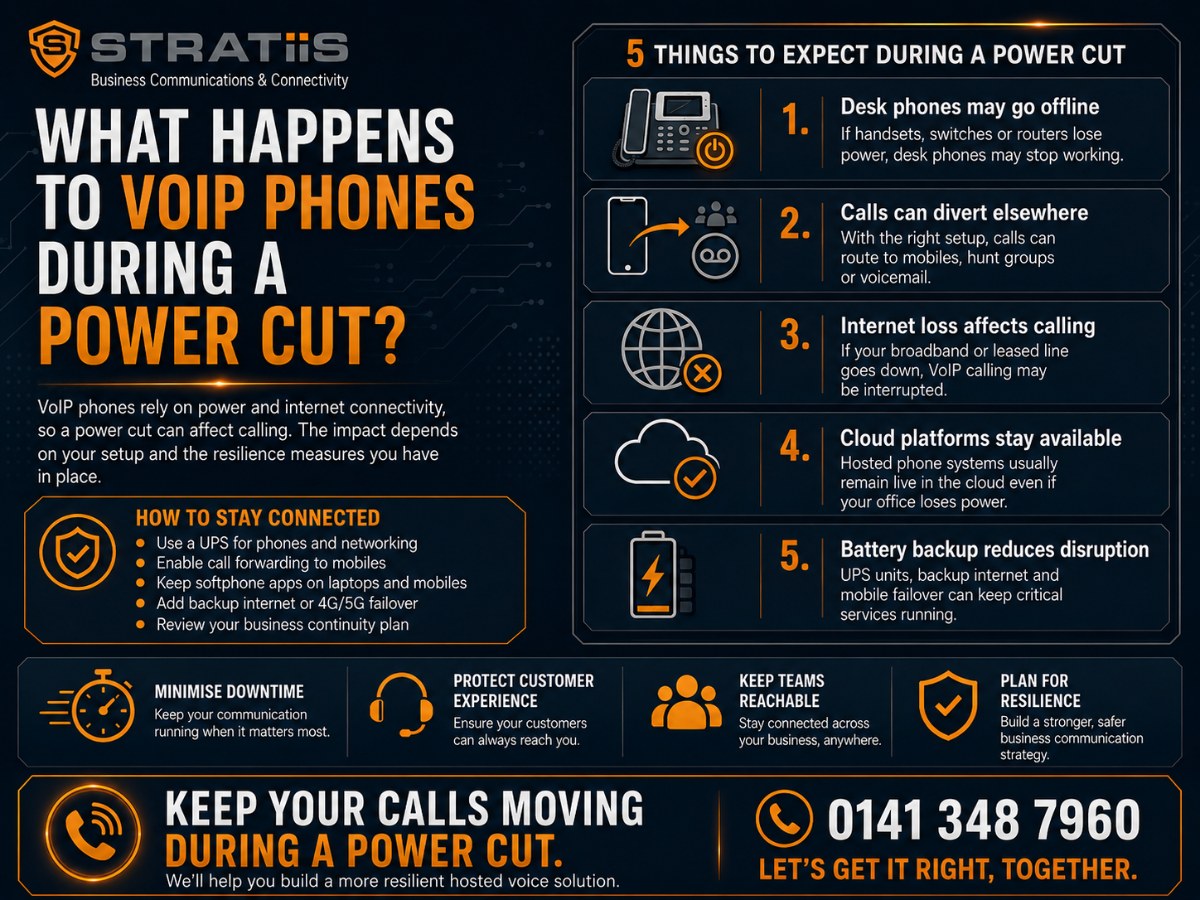
In most offices, VoIP desk phones stop working during a power cut because the phones, router, firewall and network switches all need electricity. The cloud phone platform may remain available, so calls can still reach mobile apps, another site, voicemail or a pre-arranged diversion if business continuity has been configured in advance.
The short answer
A power cut normally disconnects office VoIP phones from the cloud rather than shutting down the hosted platform itself. A UPS can keep selected network equipment and phones operating during a short outage. For a longer interruption, the business may need mobile apps, alternative call routing, another office, home workers, backup connectivity or a generator.
In this guide
THE CORE ISSUEWhy Do VoIP Phones Stop During a Power Cut?
A VoIP phone uses an internet or data network to make and receive calls. A desk phone may receive electricity from a mains adapter or through Power over Ethernet, usually called PoE. PoE allows a network switch to carry data and power over the same cable.
When that switch loses electricity, every phone powered by it turns off. A phone with its own adapter can still fail because it cannot reach the cloud platform when the router, firewall, internet termination equipment or upstream switch is unavailable.
The quality and resilience of the connection also matter during normal operation. See What Internet Connection Does Hosted Voice Need? for the wider network requirements.
CLOUD AND SITEWhat May Continue Working?
The provider’s cloud platform will often remain operational even though one office is without power. This distinction means the business number can continue receiving calls, but the configured call flow decides whether anybody answers them.
Cloud call routing
Auto-attendants, opening hours, queues, voicemail and provider-level diversions may continue in the cloud.
Mobile applications
Approved users may make and receive business calls over 4G, 5G, home Wi-Fi or another available connection.
Other locations
Another office or home-based team can remain available when users and queues have been configured correctly.
Voicemail
Cloud voicemail can collect messages, although somebody must monitor and escalate them during the disruption.
Answering services
An external service can follow an agreed script, take messages and escalate urgent calls.
Protected equipment
Selected desk phones may continue when the whole network path is connected to suitable backup power.
A well-designed Hosted Voice service should make these options clear before an outage occurs.
DEPENDENCIESWhich Equipment Needs Power?
The exact design varies by office, but a typical service depends on several connected components. One unprotected device can interrupt the chain.
| Component | Role | What happens without power |
|---|---|---|
| Internet termination equipment | Connects the premises to fibre, broadband or a leased line. | The office loses its route to the provider network. |
| Router and firewall | Routes and secures traffic between the local network and the internet. | Phones and applications cannot reach the hosted platform. |
| Network and PoE switches | Connect devices and may supply power to desk phones. | Connected phones lose network access and PoE power. |
| Wi-Fi access points | Connect wireless phones, laptops and mobile devices. | Local Wi-Fi calling and softphones disconnect. |
| Desk phones | Provide the user calling endpoint. | Active calls end and the phone becomes unavailable. |
| Local gateways or SBCs | Support analogue devices, specialist routing or some Teams Phone designs. | Dependent calling routes or devices may fail. |
A leased line or full fibre service may remain active in the provider network while equipment at the customer’s premises is unpowered. Local resilience is still required.
CONTINUITY DESIGNHow Can Calls Continue?
The most reliable plan uses several layers. Each layer addresses a different failure and should reflect call volume, customer impact and the length of disruption the organisation must tolerate.
UPS protection
Keeps critical network equipment and selected phones powered for a defined period.
Best for short outages and generator start-up time.
Mobile and desktop apps
Allow trained users to work over mobile data, home internet or another site.
Best when employees have approved, tested devices.
Cloud diversion
Moves calls to mobiles, another office, an answering service or voicemail.
Best when routes and authorised contacts are agreed in advance.
Internet failover
Provides a second route when the primary circuit fails and the equipment remains powered.
Best when fixed or mobile backup is automatic and monitored.
Alternative location
Uses another office or home-based staff to answer shared numbers and queues.
Best for multi-site and hybrid organisations.
Generator power
Supports longer outages when electrical capacity, fuel, maintenance and safe operation are planned.
Best for high-dependency sites and contact centres.
Continuity choices should be included in the project before numbers are ported. What Can Go Wrong During a VoIP Migration? explains the other risks that should be tested before launch.
BACKUP POWERWhat Can a UPS Protect?
An uninterruptible power supply provides temporary battery power when the mains supply fails. It can protect the internet termination device, router, firewall, core and PoE switches, selected Wi-Fi access points, a Session Border Controller and chosen phones.
Central PoE protection
When phones receive power from a PoE switch, protecting the switch and all upstream network equipment can keep several phones working from one managed location.
Individual power adapters
When each phone uses a mains adapter, each device needs local backup power unless calls move to another endpoint.
How long will the UPS last?
Runtime depends on battery capacity, battery condition, total load and the number of protected devices. A small unit may supply only several minutes; a correctly sized system can support selected equipment for longer. The calculation should include actual watts, required runtime, growth, battery ageing and the start-up demands of connected hardware.
Batteries deteriorate with age, heat and discharge cycles. Check alarms and self-tests, record replacement dates and test the expected runtime under a controlled load.
TWO DIFFERENT RISKSDoes Internet Failover Solve a Power Cut?
Internet failover and backup power solve different problems. A second broadband, 4G or 5G connection helps when the main internet service fails. It cannot help if the router, firewall, switch or failover device has no electricity.
Connectivity failure
The office still has power, but the main circuit is unavailable. Automatic internet failover can move essential traffic to a backup route.
Power failure
The local network shuts down. A UPS, generator or alternative working location is required before either the primary or backup connection can be used.
Mobile coverage, network capacity and mast resilience can also change during a widespread outage. A mobile service is useful, but a business-critical operation should avoid relying on one untested backup route.
RETURN TO SERVICEWhat Happens When Power Returns?
Service may not return instantly. The internet termination device, router, firewall, switches, access points and phones restart in sequence. Devices then request network addresses, reconnect to the cloud platform and rejoin queues.
Restore infrastructure
Confirm stable power and bring the internet and core network back in the intended order.
Verify registration
Check desk phones, apps, gateways and users have reconnected to the hosted platform.
Test call flows
Make inbound and outbound calls and check queues, voicemail, caller identity and diversions.
Return from continuity
Remove temporary routes carefully and confirm the primary service is stable.
Calls that were active when power failed will usually need to be made again. Call reporting or CRM records may help teams identify interrupted and abandoned conversations.
PROPORTIONATE RESILIENCEWhat Is the Right Plan for Your Organisation?
| Organisation | Practical starting point | Additional considerations |
|---|---|---|
| Small office | UPS for the network and critical phones, mobile apps, cloud voicemail and documented diversion. | Strong mobile signal, charged devices and simple testing. |
| Medium or multi-site business | Managed UPS, automatic internet failover, mobile users and routing to another location. | Shared queues, monitoring, site-specific recovery targets and supplier ownership. |
| Contact centre | Resilient power, diverse connectivity, backup operating location and remote-agent capability. | Queue behaviour, reporting, recording, customer messages and formal recovery testing. |
| Critical helpline | Multiple power and connection options with tested emergency procedures. | Defined recovery targets, escalation, safety obligations and incident management. |
Organisations with complex queues and high call volumes may need Contact Centre Solutions rather than relying on basic Hosted Voice features.
EVIDENCEHow Should Power-Cut Continuity Be Tested?
Test the plan after installation, after important network or call-flow changes and at an agreed interval. The test should be controlled so it does not create avoidable customer disruption.
Repeat testing after an office move, firewall or router replacement, a new internet service, a phone-system change, additional users or UPS battery work. The installation timetable should allow for this validation; see How Long Does It Take to Install a Hosted Phone System?.
AVOIDABLE GAPSCommon Power-Cut Planning Mistakes
Assuming cloud means power independent
The platform may be hosted elsewhere, but every local device still needs power.
Protecting only the phones
The router, firewall, termination equipment and switches are part of the same service.
Buying a UPS without sizing it
The advertised capacity may provide far less runtime at the real connected load.
Relying on untested mobile apps
Users may be logged out, excluded from queues or unable to work with weak coverage.
Ignoring emergency calling
Employees need a clear alternative when office VoIP endpoints are unavailable.
Testing failover but not recovery
Incorrect restart order or routing can delay service after electricity returns.
Frequently Asked Questions
Can customers still call the main business number?
Usually, yes. The number and cloud platform may remain active. Whether a person answers depends on the configured queue, mobile users, another site, voicemail or diversion.
Will voicemail and the auto-attendant still work?
Cloud voicemail and auto-attendants normally continue while the provider platform is available. Their destinations must include users or services that remain reachable.
Will active calls survive the power cut?
Usually not. A call generally drops when the user’s phone, switch, firewall or connection disappears unexpectedly.
Does every desk phone need its own UPS?
No. Phones powered by a PoE switch can share centrally managed backup power when the switch and upstream devices are protected.
Can Microsoft Teams Phone continue working?
Microsoft’s cloud service may remain available. Users can continue through mobile data, home internet or another office if their accounts, queues and policies are prepared. Review the wider options on the Microsoft Teams Phone page.
Are mobile applications enough?
They may suit a smaller business with low call volumes, good coverage and approved devices. They may be insufficient for a contact centre, shared reception or regulated calling environment.
Are analogue phones always more reliable?
No. Some simple analogue lines historically drew power from the exchange, but many traditional business systems also depend on an on-site PBX, digital handsets, local power and modern network services.
What about alarms, lift phones and door-entry systems?
Treat them as specialist services. Confirm their battery, monitoring, emergency-operation, maintenance and regulatory requirements with the relevant equipment provider.
Can we keep our telephone numbers when improving resilience?
Power resilience does not normally require a number change. If you are also changing platform or provider, read Can We Keep Our Existing Telephone Numbers? before cancelling any service.
How much will the phone platform cost?
Licences are only one part of the design. Devices, connectivity, backup power, failover, support and installation also affect the total. See How Much Does a Hosted Phone System Cost?.
Do Not Wait for a Power Cut to Discover What Stops Working
Stratiis can review your Hosted Voice platform, internet services, network equipment, PoE switches, mobile options and call-routing arrangements, then create a practical continuity plan for your organisation.