
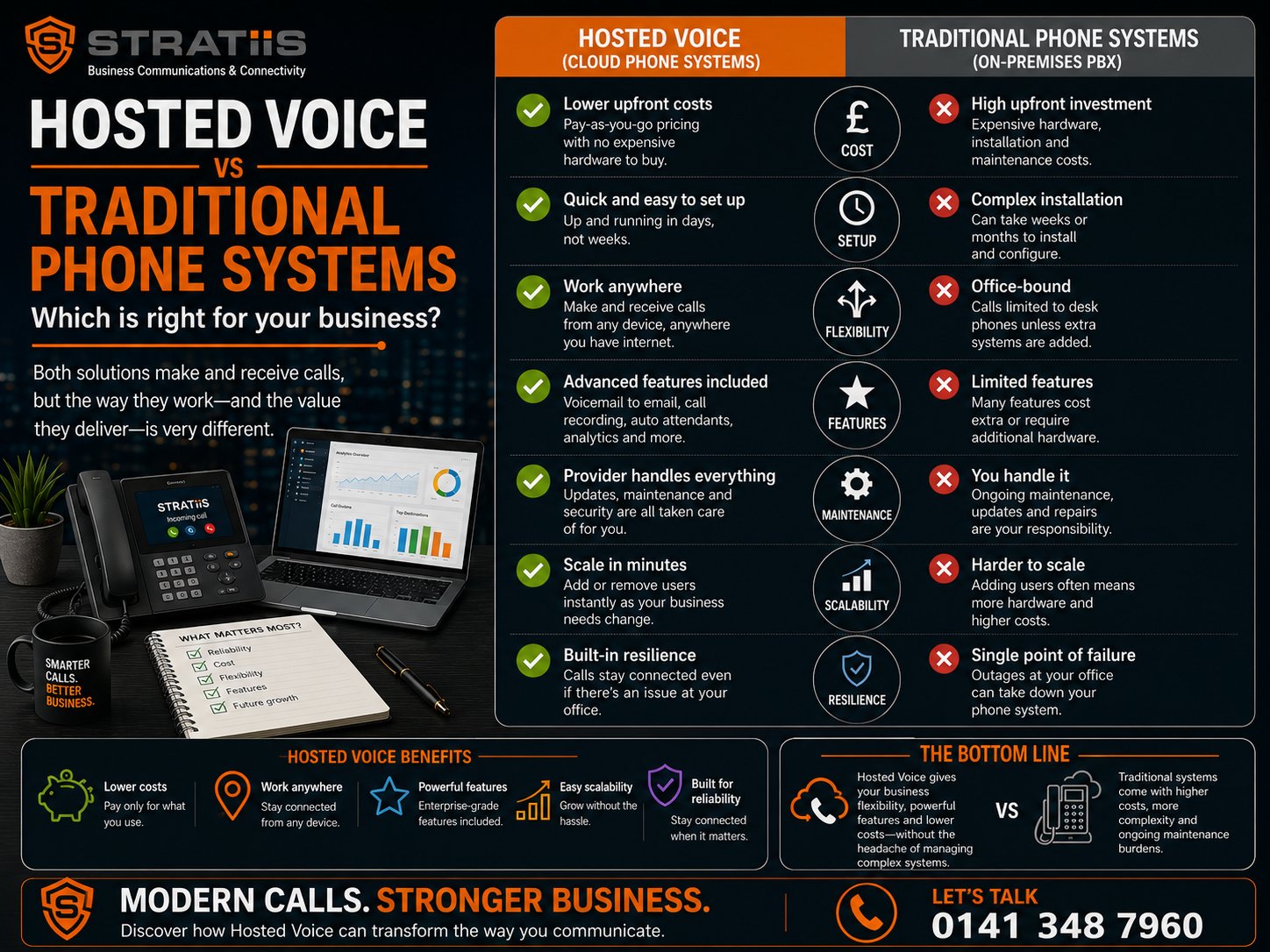
The main difference is where the telephone system is located and how calls are delivered.
A traditional phone system normally relies on telephone equipment installed at your premises.
Hosted Voice runs through a cloud platform and uses your internet connection to make and receive business calls.
In simple terms:
Traditional phone systems are tied more closely to your building and physical equipment. Hosted Voice is designed to let employees use the business phone system from almost anywhere.
Hosted Voice is usually the better fit for organisations that want:
- Hybrid working
- Mobile applications
- Easier expansion
- Multi-site calling
- Lower dependence on on-site phone hardware
- More flexible call routing
A traditional system may still appeal to an organisation that:
- Has very simple calling requirements
- Uses older analogue equipment
- Has poor internet connectivity
- Does not need remote or mobile working
- Wants to retain existing equipment for a limited period
For most organisations replacing an ageing telephone system today, Hosted Voice will be the more practical long-term option.
That does not mean it is automatically right for every business.
In this article, we will compare the costs, features, risks and limitations of Hosted Voice and traditional business phone systems.
What is Hosted Voice?
Hosted Voice is a cloud-based business telephone service.
It may also be described as:
- Cloud telephony
- Hosted VoIP
- Cloud PBX
- IP telephony
- Business VoIP
The phone-system platform is hosted and maintained away from your premises.
Employees connect to it through:
- IP desk phones
- Desktop applications
- Mobile applications
- Headsets
- Tablets
Hosted Voice may provide:
- Business telephone numbers
- Extension calling
- Call transfers
- Voicemail
- Call forwarding
- Hunt groups
- Call queues
- Auto-attendants
- Call recording
- Call reporting
- Mobile working
- Multi-site calling
The service is normally paid for through a monthly subscription.
What is a traditional phone system?
A traditional business phone system is normally based on telephone equipment installed at the organisation's premises.
This equipment may be called:
- PBX
- Private Branch Exchange
- Telephone switch
- Phone-system controller
The system connects desk phones and routes calls inside and outside the organisation.
Traditional systems may use:
- Analogue lines
- ISDN
- SIP trunks
- Digital extensions
- Proprietary desk phones
- On-site voicemail equipment
Some traditional systems are entirely analogue or digital.
Others use IP technology while still relying on a main system installed at the business premises.
For the purpose of this article, "traditional phone system" means an on-site or hardware-led telephone platform rather than a fully cloud-hosted service.
Hosted Voice vs traditional phone systems at a glance
| Feature | Hosted Voice | Traditional phone system |
|---|---|---|
| Main system location | Cloud platform | Business premises |
| Typical pricing model | Monthly per-user subscription | Upfront hardware plus support |
| Internet required | Yes | Not always for internal calling |
| Remote working | Strong | Often limited |
| Mobile application | Usually | Sometimes unavailable |
| Multi-site use | Easier | Often more complex |
| Adding users | Usually straightforward | May require hardware or licences |
| On-site hardware | Limited | Central to the system |
| Maintenance | Mostly provider-managed | Often requires specialist support |
| Software updates | Usually included | May require planned upgrades |
| Business continuity | Requires connectivity planning | Depends on lines and hardware |
| Desk phones | Optional for many users | Usually central |
| Call routing changes | Often portal-based | May require engineer support |
| Long-term flexibility | Generally higher | Usually lower |
The exact answer depends on the platform and provider.
Some modern on-site systems can provide cloud-like features.
Some low-cost Hosted Voice services may offer only limited functionality.
What is the biggest difference?
The biggest difference is flexibility.
A traditional phone system usually assumes employees are working at a fixed location.
Hosted Voice assumes employees may need to communicate from:
- The office
- Home
- Another branch
- A customer site
- A laptop
- A mobile phone
With Hosted Voice, an employee may be able to use the same business number and extension wherever they are working.
With a traditional system, remote working may require:
- Call forwarding
- VPN access
- Specialist remote extensions
- Separate mobile calls
- Additional hardware
- Manual configuration
Hosted Voice makes location less important.
Which option costs more?
It depends on the timeframe and the existing equipment.
Hosted Voice costs
Hosted Voice normally involves:
- Monthly user licences
- Calling service
- Telephone numbers
- Call charges or bundles
- Setup
- Number porting
- Desk phones or headsets
- Support
- Internet connectivity
- Internet failover
A UK business may typically budget around £10 to £30 per user per month, excluding VAT, for a standard hosted service.
Advanced users, recording and contact-centre features may cost more.
Traditional phone-system costs
A traditional system may involve:
- Telephone-system hardware
- Installation
- Proprietary desk phones
- Telephone lines
- Maintenance contract
- Engineer visits
- Software licences
- Expansion cards
- Replacement parts
- Upgrades
- Support
The upfront cost may be substantial.
The monthly licence cost may appear lower after the equipment has been purchased.
The business still needs to budget for maintenance, line rental and eventual replacement.
Is Hosted Voice always cheaper?
No.
Hosted Voice can reduce large upfront hardware costs.
It creates an ongoing monthly subscription.
A business that already owns a working traditional system may find that keeping it temporarily is cheaper than replacing it immediately.
However, the total cost should include:
- Existing line charges
- Maintenance
- Repair visits
- Hardware replacement
- Remote-working limitations
- Separate mobile expenses
- Separate conference services
- Future upgrades
- Difficulty adding users
A traditional system that looks inexpensive may be generating hidden operational costs.
The fairest comparison is normally over three to five years.
What are the upfront costs?
Hosted Voice
Upfront costs may include:
- Discovery
- Setup
- Call-flow design
- Number porting
- Headsets
- Desk phones
- Network changes
- Training
The business usually avoids purchasing a large central phone system.
Traditional system
Upfront costs may include:
- PBX hardware
- Control equipment
- Line cards
- Voicemail equipment
- Desk phones
- Cabling
- Installation
- Configuration
- Licences
- Engineer work
A traditional system may require more capital investment at the beginning.
Which option is easier to expand?
Hosted Voice is normally easier to expand.
Adding a user may involve:
- Creating the account
- Assigning a licence
- Assigning a number
- Configuring call groups
- Providing a headset or phone
- Installing the application
A traditional phone system may require:
- Available extension capacity
- Additional licences
- New line cards
- More cabling
- Additional hardware
- An engineer visit
Some older systems have fixed limits.
Once those limits are reached, expansion can become expensive.
Which option is better for a growing business?
Hosted Voice is normally better suited to growth.
It can support:
- New employees
- New sites
- Remote workers
- Temporary employees
- Office moves
- Business acquisitions
- Flexible licence changes
A growing organisation should still review contract terms.
Some Hosted Voice agreements have:
- Minimum user commitments
- Long contract terms
- Limited licence reductions
- Annual price increases
Cloud flexibility does not automatically mean commercial flexibility.
Which option is better for hybrid working?
Hosted Voice.
Employees may be able to make and receive business calls through:
- Laptop application
- Mobile application
- IP desk phone at home
- Browser
- Tablet
They can use the company number rather than a personal mobile number.
A traditional system may support remote working, but it often requires more configuration and may provide a less consistent experience.
Which option is better for mobile workers?
Hosted Voice normally provides a stronger mobile experience.
A mobile application may allow employees to:
- Make calls using the business number
- Receive transferred calls
- Access voicemail
- View business contacts
- Change availability
- Join call groups
This may be useful for:
- Sales employees
- Housing officers
- Engineers
- Surveyors
- Managers
- Field-service teams
- Remote employees
The organisation should also consider:
- Mobile security
- Mobile Device Management
- Business SIMs
- Data use
- Lost-device procedures
Which option is better for several offices?
Hosted Voice is normally easier to use across several locations.
Employees may share:
- One phone platform
- Extension dialling
- Company directories
- Call queues
- Reception
- Business numbers
- Voicemail
- Reporting
A traditional multi-site system may require:
- Separate phone systems
- Private network links
- Specialist configuration
- Additional maintenance
- More complex call routing
Hosted Voice can simplify multi-site communication.
Each office still needs suitable internet and local networking.
Which option is more reliable?
This is not as simple as saying one is always more reliable.
Traditional phone-system reliability
A traditional on-site system may continue operating internally when the internet fails.
It may depend on:
- On-site PBX
- Telephone lines
- Local power
- Hardware condition
- Maintenance
- Spare parts
If the central hardware fails, the whole organisation may lose telephone service.
Older systems may become difficult to repair.
Hosted Voice reliability
Hosted Voice platforms are normally built across resilient cloud infrastructure.
The service still depends on:
- Internet connection
- Router
- Firewall
- Network switches
- Wi-Fi
- Power
- Provider platform
- Calling carrier
Hosted Voice can be highly reliable when it includes suitable connectivity and failover.
It can perform poorly when the local network is ignored.
What happens if the internet fails?
Hosted Voice may stop working at the affected location unless backup arrangements are in place.
Possible continuity options include:
- 4G failover
- 5G failover
- Second broadband connection
- Second leased line
- Mobile applications using mobile data
- Provider-level call diversion
- Another office answering calls
- External answering service
- Voicemail
A traditional phone system may continue working if it uses separate telephone lines.
That advantage is becoming less relevant as older telephone networks are replaced and more traditional systems use internet-based SIP services.
The organisation should assess the actual design rather than assuming the old system is independent of internet connectivity.
What happens during a power cut?
Both systems require power.
Hosted Voice equipment requiring power may include:
- Router
- Firewall
- Network switches
- Wi-Fi access points
- IP desk phones
Traditional system equipment requiring power may include:
- PBX
- Desk phones
- Voicemail equipment
- Line equipment
- Network hardware
Some older analogue phones may continue working through line power.
Most modern business systems will not operate normally without electricity.
Possible protections include:
- Uninterruptible Power Supplies
- Generator
- Mobile phones
- Mobile applications
- Call diversion
- Alternative offices
Which option provides better disaster recovery?
Hosted Voice normally provides more flexibility.
Calls may be redirected to:
- Mobile applications
- Another site
- Remote workers
- Alternative numbers
- External answering
- Voicemail
Employees may continue working from another location without physically moving the main phone system.
A traditional system may be located entirely at the affected premises.
If the site is inaccessible due to:
- Fire
- Flood
- Power failure
- Building closure
- Hardware fault
telephone service may be difficult to restore quickly.
Hosted Voice still needs a documented continuity plan.
Which option is easier to maintain?
Hosted Voice is normally easier for the customer to maintain.
The provider usually manages:
- Core platform
- Software updates
- Feature updates
- Central infrastructure
- Platform resilience
The organisation may still manage:
- Users
- Numbers
- Call flows
- Devices
- Headsets
- Local network
- Internet
- Security
A traditional system may require:
- Engineer visits
- Hardware repairs
- Software upgrades
- Replacement cards
- Firmware work
- Maintenance contracts
- Spare parts
Maintenance can become more difficult as the system ages.
Which option receives updates more easily?
Hosted Voice normally receives regular cloud updates.
These may provide:
- New features
- Security improvements
- Performance changes
- Updated applications
The provider may apply these without an on-site visit.
A traditional system may require:
- Planned upgrades
- Licence purchases
- Engineer visits
- Hardware replacement
- Downtime
Cloud updates can also create disadvantages.
The interface or features may change with limited customer control.
Which option has the longest useful life?
Hosted Voice avoids dependence on one physical central system reaching the end of its supported life.
Applications and cloud platforms are updated continuously.
Individual devices may still need replacement.
A traditional phone system may operate for many years.
Problems arise when:
- Manufacturer support ends
- Parts become unavailable
- Engineers become harder to find
- Security updates stop
- New services cannot integrate
- Telephone networks change
A working old system is not necessarily a supported or sustainable system.
Which option gives better features?
Hosted Voice normally provides easier access to modern features such as:
- Desktop applications
- Mobile applications
- Presence
- Voicemail-to-email
- Call reporting
- Remote users
- Multi-site calling
- CRM integration
- Automated call routing
- Online administration
Traditional systems may provide strong calling features, including:
- Reception tools
- Hunt groups
- Transfers
- Paging
- Desk-phone controls
Older systems may require additional hardware or licences for advanced functions.
Which option is easier to change?
Hosted Voice normally allows call-routing changes through an online administration portal.
Changes may include:
- Opening hours
- Call groups
- Voicemail
- Auto-attendants
- User assignments
- Diverts
- New numbers
A traditional system may require:
- Specialist software
- Engineer access
- On-site visit
- Additional licence
- Manual programming
This varies by system.
Some modern on-site systems provide good remote administration.
Which option provides better reporting?
Hosted Voice platforms commonly provide reports on:
- Incoming calls
- Outgoing calls
- Missed calls
- Call duration
- Queue performance
- Answer times
- User activity
- Call quality
Traditional systems may provide basic call-logging information.
Advanced reporting may require:
- Separate software
- Local servers
- Additional licences
- Specialist integration
A business should define which reports it will actually use.
More data does not automatically improve customer service.
Which option is better for call recording?
Both may support recording.
Hosted Voice often makes it easier to add cloud recording.
Costs and features may include:
- Per-user licence
- Storage
- Retention
- Search
- Playback permissions
- Export
- Transcription
- Analytics
A traditional system may record through:
- On-site recording server
- External recording equipment
- Specialist software
- Telephone-line recording
The business should consider:
- Purpose
- Access
- Retention
- Storage
- Data protection
- Security
- Employee communication
Which option is better for reception?
It depends on the platform and receptionist's workload.
Traditional systems often provide familiar reception equipment with:
- Physical buttons
- Expansion panels
- Busy-lamp fields
- Call parking
- Quick transfers
Hosted Voice can provide:
- Reception desk phones
- Attendant consoles
- Presence
- Shared directories
- Call queues
- Desktop call control
A general cloud application may not automatically provide the best reception experience.
The reception process should be tested before migration.
Which option is better for contact centres?
A standard traditional phone system or Hosted Voice service may provide basic call queues.
A dedicated contact centre may be required for:
- Skills-based routing
- Agent states
- Supervisor dashboards
- Call monitoring
- Quality reviews
- Workforce planning
- Speech analytics
- CRM integration
- Web chat
- SMS
- Social messaging
Cloud contact centres are generally easier to support across several locations and home workers.
The requirement should be assessed separately from normal office calling.
Which option works better with CRM systems?
Hosted Voice usually provides a wider range of modern integration options.
Possible features include:
- Click-to-call
- Customer-record display
- Automatic call logging
- Call notes
- Recording links
- Follow-up tasks
Traditional systems may also integrate with CRM platforms.
This may require:
- Additional software
- On-site servers
- Custom development
- Specialist support
The actual workflow should be tested.
An advertised integration may provide only basic functionality.
Which option is more secure?
Both can be secure when managed correctly.
Hosted Voice security may include:
- Strong user authentication
- Administrator controls
- Encryption
- Secure applications
- Call-fraud controls
- Monitoring
- Mobile Device Management
- Multi-factor authentication
Traditional system security may include:
- Restricted administration
- Physical protection
- Secure remote access
- Call restrictions
- Supported software
- Fraud monitoring
Security risks may include:
- Weak passwords
- Compromised administrator accounts
- Call fraud
- Unmanaged mobile devices
- Unsupported hardware
- Open remote access
- Poor leaver processes
Cloud hosting does not remove the organisation's security responsibilities.
Which option protects against telephone fraud?
Both require appropriate controls.
Telephone fraud may involve:
- Compromised voicemail
- International call abuse
- Premium-rate calls
- Stolen administrator accounts
- Unauthorised call forwarding
- Weak remote-access passwords
Controls may include:
- Strong passwords
- Multi-factor authentication
- International call restrictions
- Premium-rate blocking
- Usage alerts
- Administrator access reviews
- Call limits
- Provider monitoring
Hosted platforms may provide more central reporting and alerts.
A badly configured cloud service can still be abused.
Which option is better for employee privacy?
The technology itself does not decide this.
Privacy depends on how the organisation manages:
- Mobile applications
- Call recording
- User monitoring
- Reporting
- Personal devices
- Contact information
- Presence
- Working hours
Hosted Voice may make business and personal communication easier to separate by allowing employees to use a business number through an application.
The organisation should still define appropriate mobile and monitoring policies.
Do Hosted Voice systems require new desk phones?
Not always.
Employees may use:
- Existing compatible IP phones
- New desk phones
- Computer applications
- Headsets
- Mobile applications
The provider should assess existing hardware.
Reusing phones may reduce cost.
Some existing devices may be:
- Unsupported
- Locked to the old provider
- Incompatible
- Missing required firmware
- Near the end of their useful life
Can traditional phones be reused with Hosted Voice?
Some can.
The answer depends on:
- Phone model
- Protocol support
- Firmware
- Provider platform
- Configuration access
- Security support
Older analogue or proprietary digital phones may not work directly.
An adapter may be technically possible but not always sensible.
The cost of supporting old equipment should be compared with replacement.
What happens to fax machines and analogue devices?
Traditional systems may support analogue devices more easily.
These may include:
- Fax
- Door entry
- Alarms
- Lift phones
- Intercoms
- Payment terminals
Hosted Voice may require:
- Analogue adapter
- Specialist gateway
- Replacement IP service
- Mobile connection
- Separate managed service
The business should audit every existing line before changing the telephone system.
Fax and alarm services should not be assumed to work normally over every cloud platform.
Which option is better for emergency calling?
Both require planning.
A traditional fixed phone may be clearly associated with one building.
Hosted Voice users may work from:
- Home
- Another office
- Mobile devices
- Temporary locations
The provider should explain:
- How emergency locations are recorded
- How users update locations
- What information is passed
- What happens during internet failure
- Which devices can make emergency calls
Employees should understand the emergency-calling process before the service launches.
Which option is easier for new starters?
Hosted Voice is usually easier.
A new user may be created remotely and receive:
- User account
- Telephone number
- Desktop application
- Mobile application
- Voicemail
- Call-group membership
- Headset
A traditional system may require:
- Available extension port
- Desk phone
- Physical cabling
- Programming
- Engineer support
The difference becomes more valuable when employees start from different locations.
Which option is easier for leavers?
Hosted Voice may make it easier to:
- Disable the user
- Revoke application access
- Reassign the number
- Redirect calls
- Remove queue membership
- Delete voicemail
- Recover the licence
The organisation still needs a documented leaver process.
A user account that is never removed will continue creating cost and security risk.
Which option is easier during an office move?
Hosted Voice normally reduces the difficulty of moving the phone system.
Employees may:
- Take their phones
- Reconnect at the new office
- Continue using mobile applications
- Use desktop applications
- Keep the same numbers
The new location still needs:
- Suitable internet
- Cabling
- Network switches
- Wi-Fi
- Power
- Firewall
A traditional system may require moving or replacing the central PBX and reconnecting telephone lines.
Which option is better during a business merger?
Hosted Voice may simplify bringing users and sites onto one platform.
Possible benefits include:
- Shared directories
- Common call routing
- Central reporting
- Number management
- Easier user changes
- Remote deployment
Mergers can still create complexity around:
- Contracts
- Number ownership
- Different platforms
- Microsoft tenants
- Call flows
- Customer communications
A cloud platform helps, but planning remains essential.
Which option provides better business continuity?
Hosted Voice normally provides more routing flexibility.
Calls may be directed to:
- Another office
- Remote employees
- Mobile devices
- External numbers
- Answering services
Traditional systems may provide strong local continuity when internet access fails.
They may be more vulnerable when:
- The building is unavailable
- Hardware fails
- Telephone lines are damaged
- Replacement parts are unavailable
The correct answer depends on the complete design.
What are the disadvantages of Hosted Voice?
Hosted Voice has several limitations.
Internet dependency
Poor connectivity can affect calls.
Ongoing monthly cost
The business pays a subscription for as long as the service is used.
Local network requirements
Routers, switches, Wi-Fi and firewalls must be suitable.
Provider dependency
The organisation depends on the platform and voice provider.
Cloud changes
Features and interfaces may change.
Contract commitments
Some providers require long terms or minimum users.
Security management
User accounts, mobile applications and administrators need protection.
Migration risk
Number porting and call-flow changes require planning.
What are the disadvantages of traditional phone systems?
Large upfront investment
Hardware, installation and phones can be expensive.
Limited remote working
Employees may be tied more closely to the office.
Difficult expansion
Growth may require hardware, cabling and engineer work.
Maintenance responsibility
The system needs ongoing support and eventual replacement.
Ageing equipment
Parts and expertise may become harder to find.
Fewer integrations
Modern CRM, mobile and collaboration features may be limited.
Office dependency
A building or hardware failure may affect the complete system.
Less flexibility
Office moves and user changes may require more work.
When is Hosted Voice the better choice?
Hosted Voice is usually the better option when the organisation:
- Supports hybrid working
- Has mobile employees
- Operates across several sites
- Wants easier expansion
- Needs modern call routing
- Wants mobile and desktop applications
- Is replacing an unsupported system
- Wants fewer on-site components
- Needs simpler office moves
- Wants cloud reporting and administration
When might a traditional system still make sense?
Retaining a traditional system may make sense when:
- It remains supported and reliable
- Calling requirements are very simple
- Internet connectivity is poor
- The system supports specialist local equipment
- Employees work only from one location
- The business is planning a move or closure soon
- Immediate replacement does not provide enough value
- A phased migration is more practical
This does not necessarily mean purchasing a new traditional system is the best long-term choice.
It may mean keeping the existing system for a controlled period while planning the replacement properly.
When should you not delay replacing a traditional system?
Replacement should be considered urgently when:
- Manufacturer support has ended
- Spare parts are unavailable
- The system fails regularly
- Remote working is difficult
- Maintenance costs are increasing
- The platform cannot support growth
- It relies on services being withdrawn
- Security updates have ended
- Employees use personal mobiles to work around limitations
- A hardware failure could stop all calls
Waiting until the system fails completely can force a rushed migration.
Can you move gradually from traditional telephony to Hosted Voice?
Sometimes.
A phased migration may involve:
- Moving one site first
- Moving remote users first
- Keeping analogue services separate
- Retaining some existing phones temporarily
- Porting numbers in stages
- Running both platforms during transition
A phased approach may reduce risk.
It can also create temporary complexity and duplicate costs.
The provider should explain how the two services will operate together.
How much does migration cost?
Migration costs depend on:
- Number of users
- Number of sites
- Number ranges
- Call-flow complexity
- Desk phones
- Headsets
- Training
- Network work
- Number porting
- Support requirements
A small project may cost several hundred or a few thousand pounds.
A larger multi-site migration may cost significantly more.
The quotation should separate:
- Monthly service
- Setup
- Hardware
- Porting
- Training
- Connectivity
- Support
How should you compare the total cost?
Compare both options over a suitable period.
Include:
Traditional system
- Remaining hardware value
- Telephone lines
- Maintenance
- Engineer visits
- Parts
- Software licences
- Upgrades
- Mobile expenses
- Expansion costs
- Replacement risk
Hosted Voice
- User licences
- Calls
- Numbers
- Setup
- Hardware
- Internet
- Failover
- Support
- Annual price increases
- Contract commitments
Also consider the operational value of:
- Hybrid working
- Faster user setup
- Easier office moves
- Better reporting
- Improved continuity
- Fewer missed calls
Questions to ask before choosing
- Is our current system still supported?
- How often does it fail?
- What does maintenance cost?
- How many users and sites do we have?
- Do employees work remotely?
- Are personal mobiles being used for business?
- Do we need mobile applications?
- Can we keep our numbers?
- Which analogue devices still exist?
- Is our internet suitable?
- Do we need internet failover?
- Are our firewalls and switches ready?
- Which employees need desk phones?
- Can existing hardware be reused?
- Do we need call recording?
- Do we need advanced call queues?
- What happens during an outage?
- What is the three-year cost?
- What contract terms apply?
- Who will provide support?
Hosted Voice or a traditional phone system: which should you choose?
For most businesses investing in a replacement system, Hosted Voice will be the stronger long-term choice.
It normally provides:
- Better support for hybrid working
- Easier mobile use
- More flexible growth
- Simpler multi-site communication
- Less central on-site hardware
- Easier user changes
- Better disaster-recovery options
A traditional system may continue to serve an organisation with simple requirements and reliable existing equipment.
The decision should not be driven by the fact that the current system still makes calls.
Ask whether it supports the way the organisation needs to work during the next three to five years.
A system can be functional while still being expensive, inflexible and close to failure.
Compare the future, not only the systems you have today
The difference between Hosted Voice and a traditional phone system is not simply cloud versus hardware.
It is a choice between two different ways of supporting business communication.
A traditional system is usually centred on a building.
Hosted Voice is centred on the user.
That distinction matters when employees work from home, travel, move between offices or need to respond to customers from different locations.
Hosted Voice still needs good internet, suitable networking and a proper continuity plan.
It should not be treated as a licence-only purchase.
Stratiis can review your current phone system, telephone numbers, contracts, hardware, call flows, internet connection and future working requirements.
We can then help you compare the cost and risk of:
- Retaining the existing system
- Moving to Hosted Voice
- Moving to Microsoft Teams Phone
- Introducing Unified Communications
- Using a phased migration
Book a Business Phone System Review
Call: 0141 348 7960
Email: sales@stratiis.com