
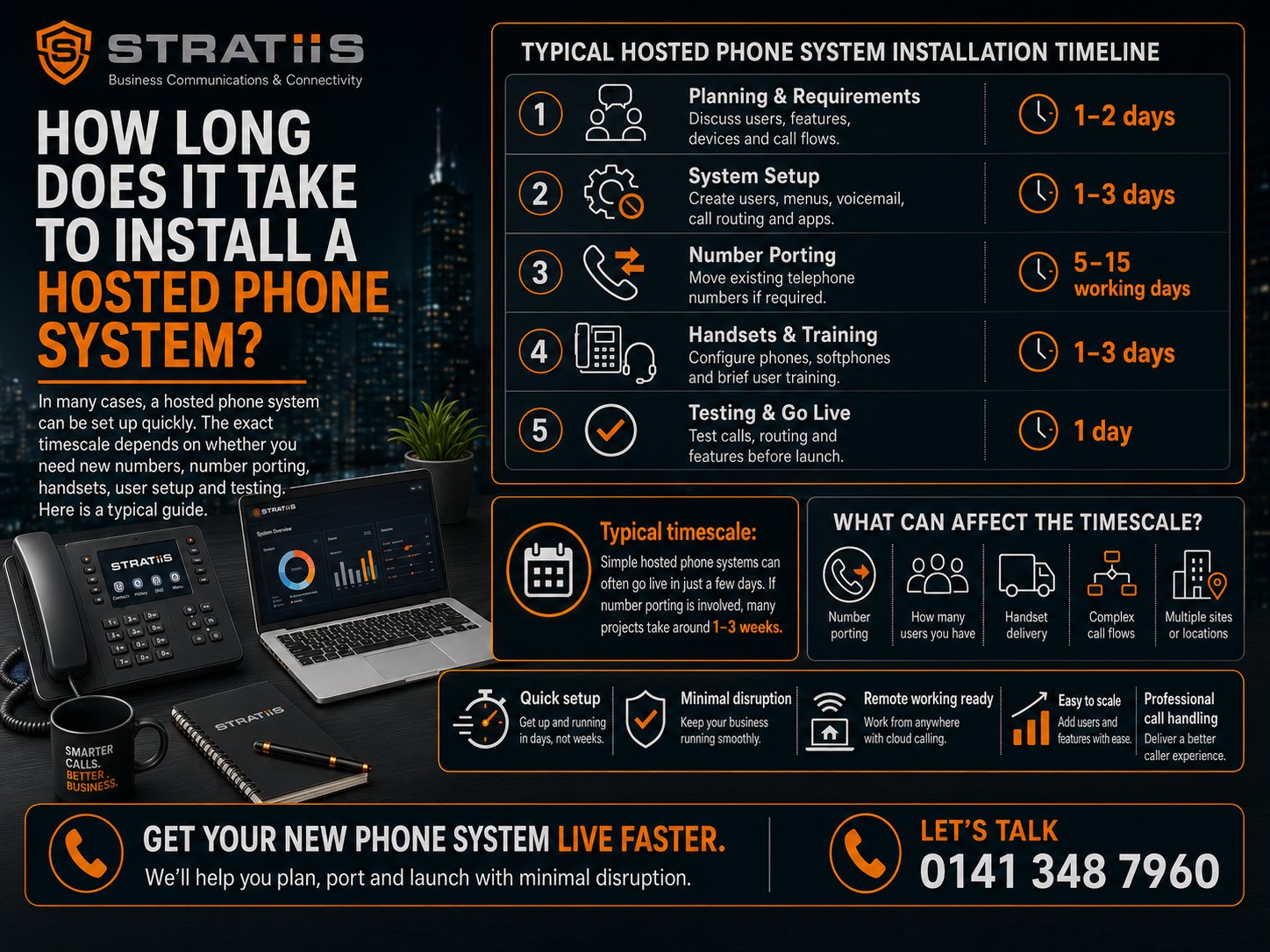
A straightforward Hosted Voice installation for a small business may take around two to four weeks from approval to launch.
A larger or more complex project may take six to twelve weeks, and sometimes longer.
The actual technical setup can often be completed quickly.
The parts that usually determine the overall timescale are:
- Reviewing the existing telephone system
- Auditing telephone numbers
- Designing call flows
- Checking internet and network readiness
- Ordering phones and headsets
- Porting existing numbers
- Configuring users and applications
- Testing
- Training employees
- Planning the migration date
A five-user business with one main number and a simple call group may be ready relatively quickly.
A 100-user organisation with several offices, direct-dial ranges, reception, call recording, contact-centre queues and complex number porting will need much more planning.
The most important goal should not be installing the system as quickly as possible.
It should be moving the business safely without losing customer calls or leaving employees unprepared.
What is a hosted phone system?
A hosted phone system is a cloud-based business telephone service.
It may also be described as:
- Hosted Voice
- Cloud telephony
- Hosted VoIP
- Cloud PBX
- Business VoIP
- IP telephony
Instead of relying on a traditional telephone system installed at your premises, the service operates through a cloud platform.
Employees may make and receive calls using:
- IP desk phones
- Desktop applications
- Mobile applications
- Headsets
- Tablets
The service may include:
- Business telephone numbers
- Extension calling
- Call transfer
- Voicemail
- Call forwarding
- Auto-attendants
- Call queues
- Hunt groups
- Call recording
- Call reporting
- Mobile working
- Multi-site calling
The installation is therefore more than plugging new phones into desks.
It often involves changing telephone providers, call routing, user applications and business processes.
Typical Hosted Voice installation times
The following timescales are useful for early planning.
They are not guarantees.
Very small business: one to three weeks
This may apply when the business has:
- Fewer than ten users
- One site
- One or two telephone numbers
- Simple call routing
- No contact centre
- Suitable internet
- Limited hardware
- No complex integrations
Small to medium business: two to six weeks
This may apply when the organisation has:
- Ten to fifty users
- One or more call queues
- An auto-attendant
- Reception
- Several direct numbers
- Mobile and desktop applications
- Number porting
- User training
- New phones or headsets
Medium to large organisation: six to twelve weeks
This may apply when the organisation has:
- Fifty to several hundred users
- Several sites
- Complex call flows
- Large number ranges
- Call recording
- Contact-centre users
- CRM integrations
- Meeting rooms
- Network improvements
- Phased migration
Complex or high-risk project: three months or longer
This may apply when the project involves:
- Many locations
- Several existing providers
- Large or unclear number ranges
- Contact centres
- Specialist recording
- Legacy analogue services
- New connectivity
- Major network upgrades
- Complex integrations
- Strict change-control processes
Can a hosted phone system be installed in one day?
The new platform may be technically configured in one day.
That does not mean the complete business should migrate in one day.
A very simple installation may be possible when:
- There are only a few users
- New telephone numbers are acceptable
- No number porting is needed
- Employees use applications rather than desk phones
- The internet is already suitable
- Call routing is simple
- Training requirements are minimal
For an established organisation, a rushed one-day migration creates risk.
The provider may not have enough time to:
- Audit every number
- Check linked services
- Test reception
- Train employees
- Confirm call routing
- Review internet failover
- Prepare for rejected number ports
Speed should not replace planning.
What happens during a Hosted Voice installation?
A typical project includes the following stages.
1. Discovery
The provider learns how the organisation communicates.
2. Number audit
Existing telephone numbers, ranges and providers are identified.
3. Connectivity assessment
Internet, firewall, switches, Wi-Fi and failover are reviewed.
4. Call-flow design
The organisation decides how incoming calls should be handled.
5. User and device planning
Licences, numbers, phones, headsets and applications are assigned.
6. Platform configuration
Users, queues, voicemail and routing are built.
7. Pilot and testing
A smaller group tests the service.
8. Training
Employees learn how to use the new system.
9. Number porting
Existing telephone numbers move to the new provider.
10. Launch and support
The new service goes live and is checked.
The stages may overlap.
The project should still have clear responsibilities and milestones.
How long does discovery take?
Discovery may take from a few hours for a very small company to several weeks for a large or complex organisation.
The provider should understand:
- Number of users
- Number of sites
- Existing telephone system
- Current providers
- Customer call volumes
- Reception
- Call queues
- Opening hours
- Remote employees
- Mobile users
- Call recording
- Contact-centre requirements
- Internet services
- Network equipment
- Security
- Business continuity
Discovery often uncovers requirements the original buyer did not know existed.
For example:
- A department may have its own published number
- A former employee’s number may still receive customer calls
- An alarm may use an old telephone line
- Broadband may be linked to the main billing number
Skipping discovery may save days at the start and create weeks of disruption later.
How long does a telephone-number audit take?
A simple number audit may take one or two days.
A more complicated audit may take several weeks.
The organisation may need to collect:
- Telecoms invoices
- Provider account details
- Number lists
- Direct-dial ranges
- Department records
- Current call routing
- Fax numbers
- Alarm lines
- Lift-phone details
- Broadband dependencies
The time increases when:
- Records are incomplete
- Several providers are involved
- Old company names remain on accounts
- Numbers belong to blocks
- Nobody knows which lines are still used
- Current invoices are unavailable
The number audit should be completed before a migration date is promised.
How long does number porting take?
Number porting is often one of the biggest influences on the project schedule.
A straightforward port may be arranged relatively quickly.
A complex port may take several weeks.
The timescale depends on:
- Number type
- Current provider
- New provider
- Number of numbers
- Direct-dial ranges
- Account accuracy
- Provider processes
- Rejected requests
- Requested migration date
Porting may take longer when:
- Account information does not match
- The installation address is wrong
- The main billing number is unclear
- The number range is incomplete
- Several carriers are involved
- Linked broadband has not been addressed
- A previous provider dispute exists
The business should not cancel the old service before the port is complete.
Can we start using the system before our numbers port?
Yes.
Providers may supply temporary telephone numbers so the organisation can:
- Test incoming calls
- Test outgoing calls
- Train employees
- Check applications
- Test desk phones
- Test call queues
- Review reporting
- Test mobile access
Employees may also make outbound calls through the new platform before the main inbound numbers move.
The caller identity must be configured and tested correctly.
Temporary numbers are valuable during a pilot.
They may also provide a continuity option if the porting date changes.
How long does call-flow design take?
A simple call flow may be designed in one meeting.
Complex call routing may require several workshops and approvals.
The provider may need to understand:
- Main number
- Opening hours
- Out-of-hours calls
- Reception
- Departments
- Auto-attendant options
- Call queues
- Ring groups
- Overflow
- Voicemail
- Holiday schedules
- Emergency messages
- Multi-site routing
- Home workers
- Mobile users
The organisation should involve employees who understand how calls are actually handled.
Managers may describe the intended process.
Reception and customer-service employees often know what really happens.
Should we recreate the old call flow exactly?
Not always.
The old system may contain:
- Unused numbers
- Long menus
- Calls routed to former employees
- Unchecked voicemail
- Repeated diversions
- Department names that no longer exist
- Overflow rules nobody understands
Copying everything may feel faster.
It can carry years of unnecessary complexity into the new system.
The migration is an opportunity to decide:
- Which numbers still matter
- Which teams should answer
- How long callers should wait
- What happens when nobody is available
- Whether menus can be shortened
- Whether reception should be shared
A short review may improve the customer experience significantly.
How long does internet-readiness testing take?
A basic review may be completed within a few days.
More detailed testing may continue for one or two weeks to capture real business conditions.
The provider may assess:
- Download speed
- Upload speed
- Packet loss
- Latency
- Jitter
- Busy-period performance
- Router
- Firewall
- Network switches
- Wi-Fi
- Cabling
- Internet failover
- Power resilience
One speed test is not a full readiness assessment.
The connection may perform well in the morning and struggle during:
- Cloud backups
- Video meetings
- Large file transfers
- Busy customer periods
- CCTV uploads
Testing over time gives a more realistic picture.
What happens if the internet is not ready?
The Hosted Voice migration may need to be delayed or phased.
Required work may include:
- Business broadband upgrade
- Full Fibre installation
- Leased-line installation
- Router replacement
- Firewall upgrade
- Network-switch replacement
- Wi-Fi improvement
- Structured cabling
- Internet failover
- UPS installation
Some of these services have longer lead times than the phone platform.
A new leased line may take significantly longer to install than Hosted Voice software.
Connectivity should therefore be reviewed early.
Can the phone system be installed before a new leased line?
Sometimes.
The organisation may temporarily use:
- Existing broadband
- Temporary Full Fibre
- 4G or 5G
- Fixed wireless
- Another connection
This should happen only when the temporary service is suitable for the expected call load.
The migration plan should explain:
- Temporary capacity
- Failover
- Limitations
- Final connection date
- Any reconfiguration required later
Introducing temporary connectivity can speed up the project.
It can also create another change and additional cost.
How long does hardware delivery take?
Common desk phones and headsets may be available quickly.
Specialist equipment may have longer lead times.
Delivery can be affected by:
- Stock availability
- Model choice
- Number of devices
- Platform certification
- Reception equipment
- Expansion modules
- Meeting-room hardware
- Supplier logistics
The provider should confirm hardware availability before setting the launch date.
An alternative model should not be substituted without checking:
- Compatibility
- Features
- User needs
- Warranty
- Audio quality
How long does phone configuration take?
Cloud-managed phones can often be configured quickly.
A phone may receive its settings automatically when it:
- Connects to the network
- Reaches the provider platform
- Identifies itself
- Downloads its configuration
- Restarts
- Registers to the assigned user
The provider still needs to:
- Assign each phone
- Label it
- Test it
- Confirm buttons
- Check caller identity
- Confirm voicemail
- Check headset operation
Large deployments need an accurate asset and user list.
A phone sent to the wrong employee can create support and privacy problems.
How long does application deployment take?
Desktop and mobile applications may be installed quickly for a small team.
A larger organisation may need a managed rollout.
Deployment may involve:
- Windows application
- macOS application
- Mobile application
- User sign-in
- Multi-factor authentication
- Permissions
- Headset selection
- Default calling settings
- Mobile Device Management
- Security policies
Applications may be deployed through:
- Microsoft Intune
- Another device-management platform
- Software-management tools
- Manual installation
The process should be tested on different device types.
How long does a pilot take?
A pilot may run for one to three weeks.
The exact length depends on how much real usage is needed to find problems.
The pilot should include different user roles, such as:
- General office employee
- Receptionist
- Remote worker
- Mobile employee
- Manager
- Heavy caller
- Customer-service employee
The pilot may test:
- Incoming calls
- Outgoing calls
- Caller identity
- Transfers
- Voicemail
- Queues
- Auto-attendant
- Desktop application
- Mobile application
- Headsets
- Desk phones
- Wi-Fi
- Call recording
- Reporting
- Internet failover
A pilot is not simply a product demonstration.
Employees should use the service during normal work.
Can we skip the pilot?
A very small and simple business may decide that a formal pilot is unnecessary.
Larger or more complex organisations should think carefully before skipping it.
A pilot can identify:
- Poor headset choices
- Weak Wi-Fi
- Confusing call-transfer methods
- Reception limitations
- Mobile notification problems
- Incorrect caller identity
- Recording issues
- User-training gaps
- Firewall problems
Finding these problems with five users is easier than finding them after 100 users migrate.
How long does user training take?
Basic training may require one or two short sessions.
More complex environments may need several role-based sessions.
General-user training may cover:
- Making and receiving calls
- Transferring calls
- Voicemail
- Presence
- Desktop application
- Mobile application
- Headset use
- Reporting a fault
Reception training may also cover:
- High-volume call transfer
- Call parking
- Queues
- Shared directories
- Overflow
- Attendant console
Administrator training may include:
- New users
- Number assignment
- Call routing
- Opening hours
- Voicemail
- Reports
- Emergency changes
Training should happen close enough to launch that employees remember it.
How much notice should employees receive?
Employees should normally receive communication before the migration.
The notice may explain:
- Why the system is changing
- What will be different
- Launch date
- New equipment
- Application setup
- Training sessions
- Personal mobile use
- Planned disruption
- Support contact
- What to do on the first day
Too much notice without practical detail may be ignored.
Too little notice creates confusion and resistance.
Communication should become more specific as the migration approaches.
How long does a small-business installation take?
A typical small-business project may follow this schedule.
Week 1
- Discovery
- Number review
- Internet check
- User list
- Proposal confirmation
Week 2
- Platform configuration
- Temporary numbers
- Hardware preparation
- Call-flow setup
- Initial testing
Week 3
- User training
- Pilot
- Final porting checks
- Migration communication
Week 4
- Number port
- Launch
- Testing
- Post-launch support
A simpler business may move faster.
Number-porting requirements may extend the schedule.
How long does a 50-user installation take?
A 50-user project may require around four to eight weeks.
It may include:
- Discovery workshops
- Number audit
- Different user profiles
- Reception design
- Call queues
- Mobile and desktop applications
- Hardware delivery
- Internet assessment
- Pilot group
- Training
- Number porting
- Launch support
The schedule may be longer when:
- Several sites are involved
- Network improvements are required
- Existing records are poor
- Contact-centre features are needed
- Call recording requires governance approval
How long does a multi-site migration take?
A multi-site migration may take six to twelve weeks or longer.
The provider needs to consider:
- Different internet connections
- Local firewalls
- Wi-Fi
- Number ranges
- Existing phone systems
- Site-specific call flows
- Shared reception
- User training
- Local hardware
- Business-critical periods
The organisation may migrate:
- All sites together
- One site at a time
- A pilot site first
- Remote employees first
- Smaller sites before the main office
A phased approach normally takes longer overall.
It may reduce risk and make support easier.
Should every site migrate on the same day?
Not necessarily.
A single launch may provide:
- Faster completion
- Less time running two platforms
- One communication campaign
- Simplified project coordination
It also concentrates risk.
A phased migration may provide:
- Learning from earlier sites
- Lower support pressure
- Easier troubleshooting
- Reduced impact of a problem
It may create:
- Temporary duplicate costs
- Calls moving between platforms
- More complex internal dialling
- Longer overall project duration
The decision depends on the size and complexity of the organisation.
How long does a contact-centre migration take?
A contact-centre migration may take several months.
It may require:
- Detailed call analysis
- Queue design
- Agent profiles
- Supervisor tools
- Recording
- Quality management
- CRM integration
- Reporting
- Workforce planning
- Testing
- Agent training
- Continuity planning
The organisation may also need to test:
- Peak call volumes
- Queue overflow
- Abandoned calls
- Home agents
- Recording storage
- Customer data
- Wallboards
- Supervisor processes
A contact centre should not be migrated as though it were a normal office telephone system.
What can delay a Hosted Voice installation?
Common causes include:
Incomplete number records
The business cannot confirm which numbers it owns.
Rejected porting requests
Account information does not match provider records.
Broadband or network work
New connectivity or hardware is required.
Hardware shortages
Selected phones or headsets are unavailable.
Slow decision-making
Call flows and user lists are not approved.
Unclear responsibilities
The customer and provider assume the other party is completing a task.
Security approval
Applications or mobile access require internal review.
Integration complexity
CRM or contact-centre links take longer than expected.
Employee availability
Key reception or customer-service employees cannot attend testing.
Contract issues
The old provider has notice periods or account disputes.
What can the customer do to speed up the project?
The organisation can help by providing:
- Current telephone bills
- Complete number list
- User list
- Department list
- Current call flows
- Opening hours
- Holiday schedules
- Existing contracts
- Internet details
- Network contacts
- Hardware requirements
- Decision-makers
- Training availability
It should also nominate:
- Project owner
- Technical contact
- Reception representative
- Customer-service representative
- Final approver
Fast decisions help.
Rushed decisions can create rework.
What can the provider do to keep the project on schedule?
The provider should:
- Complete discovery early
- Provide a clear project plan
- Assign responsibilities
- Confirm hardware availability
- Submit porting requests accurately
- Identify connectivity issues quickly
- Build temporary numbers
- Run a pilot
- Schedule training
- Confirm launch support
- Maintain a risk and issue list
- Communicate delays honestly
The provider should not promise a launch date before validating the critical dependencies.
Should the old phone system run alongside the new one?
It often will during testing and migration.
This may allow:
- Pilot users on the new service
- Temporary numbers
- User training
- Gradual equipment deployment
- Backup during testing
The overlap may create extra cost.
It provides valuable risk protection.
The old system should remain active until:
- Numbers have ported
- Inbound calls work
- Outbound caller identity works
- Queues and voicemail work
- Important users are operational
- Any linked services have been checked
When can we cancel the old phone service?
Only after the migration has completed and every important service has been tested.
The organisation should confirm:
- All numbers have moved
- Direct numbers work
- Main number works
- Caller identity is correct
- Call queues work
- Voicemail works
- Fax or analogue replacements work
- Broadband will not be affected
- Contract notice requirements are understood
Cancelling too early may cause number loss or service interruption.
How much disruption should we expect?
A well-planned migration should minimise disruption.
There may still be:
- Short interruption during number porting
- Phone restarts
- Application sign-in
- User questions
- Call-routing adjustments
- Temporary caller-identity issues
- Delayed queue membership
- Hardware replacement
The provider should explain:
- Expected disruption
- Migration window
- Support availability
- Escalation route
- Temporary alternatives
- Customer communication
A promise of absolutely no disruption should be treated carefully.
Should the migration happen outside business hours?
It may be useful for some organisations.
Out-of-hours migration can reduce customer impact.
It can also create challenges:
- Carrier porting may occur only during defined hours
- Key employees may be unavailable
- Problems may remain undiscovered until the next morning
- Out-of-hours support may cost more
- Contact-centre operations may never fully close
The best time depends on:
- Business hours
- Call volumes
- Provider availability
- Employee availability
- Porting process
- Risk
A quiet weekday period may be better than a late Friday migration.
Why can Friday migrations be risky?
A Friday migration may provide the weekend for technical work.
It may also mean:
- Carrier support becomes limited
- Key provider employees are unavailable
- Customers discover problems before staff return
- The business operates with faults all weekend
- Decision-makers are harder to reach
There may be valid reasons to migrate on a Friday.
The organisation should confirm support and escalation availability through the weekend.
What testing should happen before launch?
Pre-launch testing should include:
- User sign-in
- Desk phones
- Headsets
- Desktop applications
- Mobile applications
- Outbound calls
- Internal calls
- Call transfer
- Voicemail
- Auto-attendants
- Call queues
- Call recording
- Reporting
- Wi-Fi
- Home working
- Internet failover
- Emergency calling
Temporary numbers may be used where the existing numbers have not yet ported.
What testing should happen on launch day?
The team should test:
- Main incoming number
- Every important direct number
- Department numbers
- Incoming caller display
- Outgoing caller identity
- Internal calling
- Call transfer
- Call queues
- Auto-attendants
- Voicemail
- Out-of-hours routing
- Mobile applications
- Reception
- Recording
- Contact-centre functions
- Emergency calls
Testing only one incoming call to the main number is not enough.
What happens after launch?
The provider should expect a period of adjustment.
Post-launch work may include:
- Call-flow changes
- Queue adjustments
- User support
- Headset configuration
- Mobile-application support
- Licence corrections
- Phone-button changes
- Reporting review
- Call-quality investigation
- Additional training
A review may be held after:
- First few days
- First two weeks
- First month
The system may be technically live on launch day.
The project is not truly complete until employees can use it confidently and customer calls are handled properly.
How long does it take employees to get used to the system?
Some employees may become comfortable within a day.
Others may need several weeks.
Adoption depends on:
- Similarity to the old system
- Use of desk phones or applications
- Quality of training
- Role
- Call volumes
- Confidence with technology
- Support availability
Receptionists and heavy callers may require more time because they use more features.
Simple quick-reference guides can help with:
- Call transfer
- Voicemail
- Mobile applications
- Presence
- Queue sign-in
- Headset settings
Does Hosted Voice installation require downtime?
A small amount of downtime may occur during number porting.
The provider should minimise it through:
- Preconfigured platform
- Temporary numbers
- Tested devices
- Migration support
- Call diversions
- Alternative routing
- Careful scheduling
The exact interruption depends on:
- Current provider
- Porting process
- Number range
- Network readiness
- Project complexity
Ask the provider to explain the expected outage rather than using vague language such as “seamless migration.”
Can number porting be completed in stages?
Sometimes.
A business may port:
- One site at a time
- Department numbers first
- Main number later
- Direct-dial blocks in phases
- Non-geographic numbers separately
Staged porting may reduce risk.
It can also complicate routing between the old and new systems.
The provider should confirm whether the number ranges support partial porting.
Can we install Hosted Voice during an office move?
Yes, and this may be a good opportunity.
Hosted Voice can allow employees to:
- Use temporary locations
- Keep existing numbers
- Work from home
- Move phones between sites
- Use mobile applications
The project must coordinate:
- New internet service
- Cabling
- Network switches
- Wi-Fi
- Furniture installation
- Power
- Number porting
- Building access
- Employee move date
The internet and network should be ready before employees arrive.
An office move has many dependencies, so the communications project should start early.
Can we install Hosted Voice before the PSTN switch-off affects us?
Yes.
Businesses should plan migration before old services become unreliable, unsupported or unavailable.
A planned migration provides time for:
- Number auditing
- Connectivity improvements
- Device replacement
- Testing
- Training
- Analogue-service review
- Business-continuity planning
Waiting until a withdrawal date or service failure may force the organisation into a rushed decision.
How far in advance should we start planning?
A small business should normally begin at least several weeks before its desired launch date.
A larger organisation may need to begin several months in advance.
Start earlier when the project involves:
- Leased lines
- Several offices
- Complex number ranges
- Contact centre
- Call recording
- CRM integration
- Meeting rooms
- Network upgrades
- Office move
- Existing contract notice period
Planning early does not mean the business needs to pay for the new platform immediately.
It provides time to understand dependencies and avoid a rushed migration.
What if our current phone-system contract is ending?
Do not wait until the final few days.
The organisation should review:
- Notice period
- Automatic renewal
- Number ownership
- Hardware finance
- Broadband links
- Early termination
- Porting timescales
A contract may renew automatically when notice is missed.
Number porting may also take longer than the remaining contract period.
Begin the review well before the renewal date.
Can the provider guarantee an installation date?
A provider can agree a project target and planned migration date.
Some dependencies are outside its direct control.
These may include:
- Current carrier
- Number porting
- Connectivity installation
- Hardware supply
- Building work
- Customer approvals
A responsible provider should explain:
- Which dates are confirmed
- Which dates are provisional
- What dependencies remain
- What happens if one is delayed
- Whether temporary service is available
Be cautious of a guaranteed date offered before any number or connectivity review.
What should be included in the project plan?
A clear project plan should include:
- Discovery
- Requirements
- User list
- Number audit
- Call-flow approval
- Connectivity assessment
- Hardware order
- Platform configuration
- Application deployment
- Pilot
- Training
- Porting request
- Migration date
- Testing
- Launch support
- Old-service cancellation
- Post-launch review
Each task should have:
- Owner
- Target date
- Dependency
- Status
- Escalation route
What should you ask a Hosted Voice provider?
- What is the realistic installation timescale?
- What assumptions is that timescale based on?
- When will you audit our numbers?
- How long is number porting likely to take?
- Will you assess our internet and Wi-Fi?
- What network work may be required?
- Is hardware currently available?
- Will you document our call flows?
- Will there be a pilot?
- What training is included?
- How much downtime should we expect?
- Will temporary numbers be available?
- What happens if porting is delayed?
- Who supports the launch?
- Will support be available out of hours?
- When can we cancel the old service?
- What happens after launch?
- Who owns the project?
Common Hosted Voice installation mistakes
Promising a launch date before auditing numbers
Porting issues may make the date unrealistic.
Treating the project as a phone delivery
Call routing, applications and training matter just as much as hardware.
Ignoring the internet connection
The platform may be ready while the network is not.
Skipping the pilot
Problems are discovered by the whole business at once.
Training employees too early
They may forget everything before launch.
Training employees too late
They may use the system for the first time with a customer waiting.
Cancelling the old service too soon
Numbers and linked services may be lost.
Testing only the main number
Direct numbers, queues and voicemail may still fail.
Moving every site at once without enough support
Small problems can become a major incident.
Launching without post-migration support
Employees are left to solve unfamiliar problems themselves.
Can installation be completed faster?
Possibly.
The project may move faster when:
- Number records are accurate
- Call flows are simple
- Internet is ready
- Hardware is available
- Decision-makers respond quickly
- Employees attend training
- No complex integrations are required
- The business accepts temporary numbers
- A new number is used instead of porting
The provider should still complete appropriate testing.
A faster project is not successful when it creates missed calls or poor adoption.
When should installation take longer?
More time should be allowed when:
- Customer calls are critical
- Reception handles high volumes
- A contact centre is involved
- Several sites are migrating
- Telephone-number records are incomplete
- Network improvements are required
- Call recording is regulated
- Analogue services need replacement
- Employees work in many different ways
- The business cannot tolerate disruption
Taking longer can be a sign of proper risk management rather than poor performance.
How long does it really take to install a Hosted Voice system?
For many small and medium-sized businesses, a realistic answer is:
Around two to six weeks from agreement to launch.
A very simple business may move sooner.
A larger or complex organisation may require several months.
The technical cloud platform is often the easiest part.
The project timescale is normally driven by:
- Accurate number porting
- Network readiness
- Call-flow decisions
- Hardware
- User preparation
- Testing
- Business risk
The best installation is not the one completed in the fewest days.
It is the one where:
- Customer calls continue
- Telephone numbers are protected
- Employees know what to do
- The network is ready
- Important call flows work
- Support is available
- Old services are cancelled safely
Start planning before your existing system becomes urgent
Hosted Voice can often be installed relatively quickly.
That is not a reason to leave the project until the current system fails or the contract reaches its final week.
A planned migration gives the organisation time to:
- Audit every number
- Improve call routing
- Test internet quality
- Replace unsuitable equipment
- Train employees
- Configure mobile working
- Plan continuity
- Resolve porting problems
Stratiis can review your current phone system, numbers, call flows, contracts, internet connection, network and employee requirements.
We can then provide a realistic implementation plan showing:
- Project stages
- Responsibilities
- Number-porting timescale
- Hardware requirements
- Training
- Testing
- Migration date
- Post-launch support
Book a Hosted Voice Installation Review
Call: 0141 348 7960
Email: sales@stratiis.com